

FailForward @FailForward@social.cleverlibre.org
Exploring, failing, backtracking, just to identify the only viable path forward. And then scarred, stumbling forward into the future. Learning.
Boring and steady. Knowing little and questioning a lot. Mostly harmless.
***
This is an experimental scrapbook space. A collection of stuff I want to keep in a form somewhere on the spectrum between a blog and a shoe-box full of scraps, cut-outs, quotes, links and reading notes and sometimes my own silly thoughts about them.
Perhaps it might be of marginal interest to others too, but I don't care that much.
Joined Jan 2021
For some more context: I just came over an article in The Guardian listing the available vaccines together with some economics of each company. I think the AZ story is peanuts here.
I totally agree with @silmathoron. Bill Gates might be a drop out, but this guy knows how to learn. After all, what is a PhD in an area? Monk-like focused mental effort to study an area deeply. You can achieve that either by yourself (Bill Gates does that), or by going to school (the path for the rest of us). Listening to this gentleman over the last years, I think his knowledge is deep and often not recognised. I have a great respect for him.
If you agree with the point on research scientist vs. process engineer I made above, what would open-sourcing it bring? And Bill Gates explains why it might be counterproductive: you need to screw up only once and in a relatively minor way to completely break public trust in this kind of a product. We shall recognise that vaccines are not software. It sounds reasonable to me. And in the end, we'll never know what could have been, just what really happened.
Thanks for your response, this is becoming an interesting conversation.
1. a - well, I am not an expert in this, but I know for certain that developing a molecule in a lab in small quantities and creating a process for producing hectolitres of it are two very different processes requiring two very different mindsets (research scientist vs. process engineer). Personally (as I have quite some experience with academia), I highly doubt 95% of scientists are well positioned to execute that engineering task.
2. b - nonprofit: well, we don't know the details of course. Non-profit might simlply mean that AZ will recover its costs and will get all the benefit of positive press from it (not a negligible value!)
3. c - there's a saying: "he gives twice who gives quickly". And I think it's very relevant in this pandemic.
4. d - see 3/c.
Well, of course we do not know answers to these questions as these issues were and are a part of commercial negotiations and agreements. Why Oxford did what they did and what were their motivations and incentives is up to them to explain and to us to accept, however strange it might seem to us. We are not a party to that deal.
But logic of exclusivity is very understandable to me (I deal with these things regularly). When a buyer or a business partner takes significant risks in the deal and/or is asked to make further big investments to make it work, it's a fairly normal practice to request exclusivity in some form. After all, in civil law, that's what for instance marriage is too. Where I am, this is a normal business condition.
I think what's important here is to realize what Bill Gates said in that interview: we shall see that AstraZeneca stepped up and went into this deal and hundreds of other pharma companies did not dare to do the same. So we might criticize AZ as much as we want, yet they deserve credit for making significant investments on their own and deliver for all of us. The alternative for them was to simply do nothing.
... gives you admin power over babies.
# Der Club der schoenen Muetter
Kriminalhörspiel, 55 min, Deutschlandfunk Kultur (in German)
Absolutely hilarious radio play about 3 typical suburban "smart-ass" mothers and their thoughts about a solo father (a porn-star-type macho techno-fan guy with a violet Pontiac Firebird car) taking care of his little daughter (a small princess "Lillifee"-kind). They are attracted to him, repulsed by him, he does not care about them and then he suddenly dies. Great fun.
# Lessons from a year of Covid
by Yuval Noah Harari
https://www.ft.com/content/f1b30f2c-84aa-4595-84f2-7816796d6841
A very good article by Harrari about what we can learn from dealing with COVID-19 pandemic. It takes a very cold and independent look at what happened and is happening. He identifies mostly _positive_ lessons we can learn from the events of the last year. I think that is an extremely useful view, as newspapers are only full of negative news. These are not just "sunny" observations, he actually goes very deep in identifying what's important and at the same time positive. Similarly, he identifies negative things which are going on, but are highly non-obvious.
As is usual for him, Harrari takes a long-term view on what's happening and impacts of those things. I think this is important reading.
## Lessons
1. scientists of the world were able to come up with bio-tech solutions to this crisis in an unprecedentedly short timeframe. The first time in history, humankind is not helpless against biopathogens.
2. due to vast technological advances since industial revolution, we were able to largely minimise impact of the pandemic: trade is going on well, food supply was effectively not disrupted at all, many sectors of business were able to adapt relatively quickly. 100, or 500 years ago, this pandemic would be devastating, while now it's just "bad".
3. Internet infrastructure is way more resilient than we thought.
4. Internet and cyberspace is becoming the single point of failure for humanity. This will need solving in the future.
5. Science cannot solve everything. The most important decisions finaly need to be taken by politicians. These are failing us. Mostly because, unlike scientists, they do not cooperate on global scale, but rather hold nationalistic turf wars. In a worse case, they fail us by negligence and not taking the right actions, even though scientists tell us.
6. we learned that protection of life is not all. Sometimes, secondary impacts of the pandemic need to be weighed against the loss of life due to illness. These are challenges which we'll need to solve and come to terms with in the future.
7. centralisation and concentration of private information about citizens is becoming a strategic asset of governments. Publics will need to resolve the conundrum of transparency not only top-down, but bottom-up too.
8. globalisation in the face of pathogens is inevitable and global cooperation must be resolved.
9. it's clear we need a global coordination institutions to help with the next pandemic. WHO is there, but needs more money and needs to be improved.
> In the age-old war between humans and pathogens, the frontline passes through the body of each and every human being. If this line is breached anywhere on the planet, it puts all of us in danger. Even the richest people in the most developed countries have a personal interest to protect the poorest people in the least developed countries. If a new virus jumps from a bat to a human in a poor village in some remote jungle, within a few days that virus can take a walk down Wall Street.
FailForward
boosted

re storage: haha! I read you! :-) In the end I gravitated towards owning my own NAS at home. And since QNAP gives you containers and VMs, that turns out into a low powered home (media) server. Which is a whole new set of synchronisaton fun :-).
@academicalnerd @mathias I personally find this thing with tiling window managers somewhat overdone. Not my personal taste, honestly.
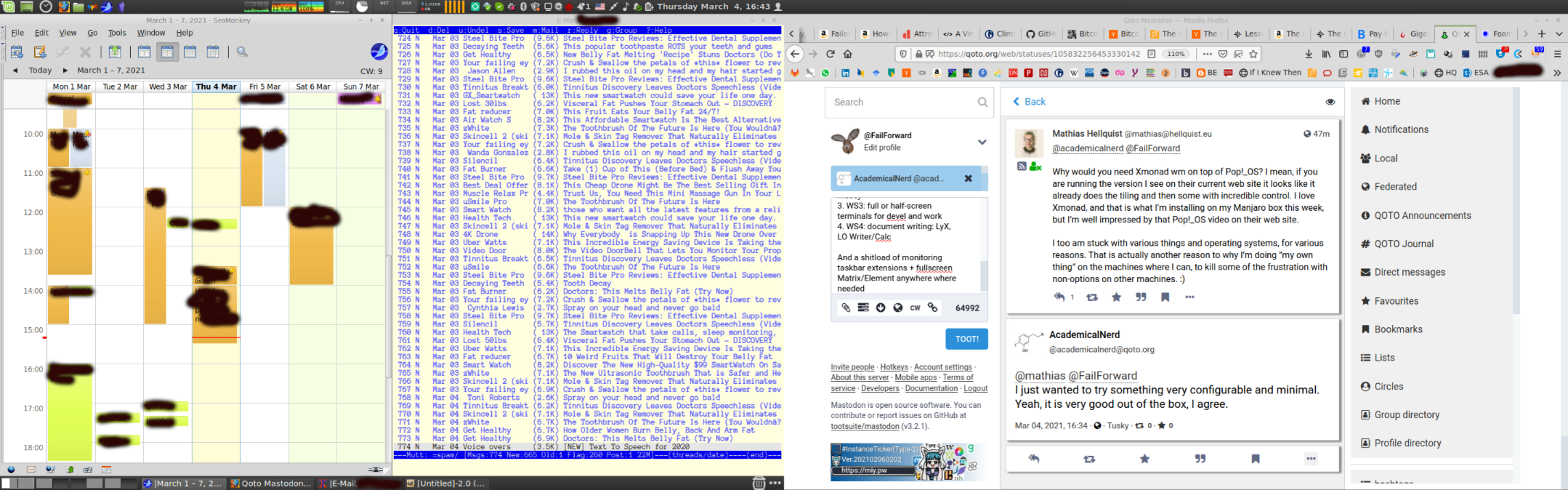
I am a workspaces person and I am running dual-head setup. And the most tiling I do is half-screen. To follow-up on @mathias 's image, this is how it goes for me
1. WS1: calendar, mutt + active FF
2. WS2: extensive browsing - like 7 FF windows, just because I am messy
3. WS3: full or half-screen terminals for devel and work
4. WS4: document writing: LyX, LO Writer/Calc
And a load of monitoring taskbar extensions + fullscreen Matrix/Element anywhere where needed.
## On using Obsidian, Foam and such
I am using Obsidian as well. I admit, I am a bit annoyed with its vim mode, but that's marginal. Generally, I quite like it, but I would like to move away from it, as I decided with moving all my notes towards Jekyll+git+GitLab Pages setup (and I am like 80% done). For this reason, I came back to MS Visual Studio Code and [Foam](https://foambubble.github.io/). Some things are good (as VS Code is good generally), but I am infinitely frustrated by VimCode and neovim extensions to a point where I want to throw all this away.
Apart from editor troubles, where both Obsidian and Foam are failing me are links and keeping connections when I move a page. I want my links to be standard Markdown relative links to other notes and to pictures. But then, I want the thing to help me when I move a note to a different folder to keep relative links fine. And both are failing me with that. Maybe I am doing something wrong there, don't know...
Actually the tool which is really good at this was QOwnNotes, but that is failing me on the general UX/UI level. So it might well be that I will end with my standard low-level solutions: terminal, bash, grep and vim.
@mathias Well, which side is it?
What comes to my mind is the retreat at 4:50 of this battle scene from Vikings: https://www.youtube.com/watch?v=hcEEFnuQO7Q
FailForward
boosted
@tetrapyloctomist @jwildeboer @ffeth
I am getting back to this older thread about how Oxford wanted to open-source their vaccine and Bill Gates stepped in and then the whole thing went allegedly wrong. It needs some further debunking.
So here is a fragment of an interview with Bill Gates by Derek Muller of Veritasium fame where he specifically asks Bill Gates about this KHN story.
https://youtu.be/Grv1RJkdyqI?t=558
Here you have how the sausage is made on the Intertubes. Somebody comes up with something on Twitter, or wherever, smart (but maybe just gullible?) people take it for granted and there you have a story. It saddens me that even many well educated people who should know better fall for this.
This is of course not a level of a proper conspiracy theory, but just giving it a second thought would raise some red flags. Not that I am smarter, in the past there were exactly such stories I fell for, but recognising how wrong I were made my BS detector much more sensitive.
@tetrapyloctomist @jwildeboer @ffeth
I am getting back to this older thread about how Oxford wanted to open-source their vaccine and Bill Gates stepped in and then the whole thing went allegedly wrong. It needs some further debunking.
So here is a fragment of an interview with Bill Gates by Derek Muller of Veritasium fame where he specifically asks Bill Gates about this KHN story.
https://youtu.be/Grv1RJkdyqI?t=558
Here you have how the sausage is made on the Intertubes. Somebody comes up with something on Twitter, or wherever, smart (but maybe just gullible?) people take it for granted and there you have a story. It saddens me that even many well educated people who should know better fall for this.
This is of course not a level of a proper conspiracy theory, but just giving it a second thought would raise some red flags. Not that I am smarter, in the past there were exactly such stories I fell for, but recognising how wrong I were made my BS detector much more sensitive.
FailForward
boosted



RT @SeattleSloth_
My guy hit me up and said "I got some shit that will take you to the next level" and gave me this

Just a quick note: we are both an instance where we get the full HTML/Markdown experience. Go ahead with all your multimedia and rich formatting. Qoto is not a normal Mastodon instance in this aspect, more like Misskey or Friendica.
> Do you people use cli most of the time our of principle or is it a habit?
Neither.
> Ideologies are bad for your health
> -- me, right now
For me it's an emergent phenomenon. Retrospectively, I think I was always optimizing for the speed of my usage of computers. In effect, I want my UX be about as fast (not necessarily faster - for instance I am not a touch typist) as my mind goes. Second force in my relevant fragment of life is that I am a lazy bastard, so I want to automate repetitive boring crap. The consequence of these two forces was that over time I gravitated towards using keyboard as the primary peripheral device with mouse only the second. And once you get to that place, terminal and things like vim or mutt start to make much more sense than other things. I can respond to an e-mail and have it GPG signed with Yubikey faster than many even load Thunderbird, or whatever Gmail tab you have. I care for that. It pays of to shave off 10 seconds off of a activity you do 100x a day.
But as I said above, oftentimes I then discovered that going pure terminal has problems: either crappy UX of those apps, or missing features (for instance now I am typing this into the tiny text box on Qoto Mastodon, rather then `toot gui`, because `toot` turns out to miss too many things - funny enough, among others, comfortable keyboard UX despite it being TUI app). And when I discover that, I then typically look for a desktop version of what I need. Primary concern is that I can either natively handle it with keyboard, or can force it to be like that (shortcuts, macros, etc.). But some things just don't submit to this. I am an avid Firefox user rather whatever `vimperator` stuff).
P.S. Did you know you can handle Mastodon UI (at least on Qoto) largely by keyboard? Check the "Hotkeys" link in the left sidebar.
@ktemkin Well, please don't give up. What you describe is somebody being a jerk. There's nothing else to say. Sorry for that.
I find it always very strange when people make an argument that women are avoiding STEM professions for some biological reasons as if it always used to be the case. That is certainly BS. Let me tell a story.
In some parts of Europe (at least some communist countries I have a 1st hand experience with) around the end of 60s and 70s, actually the majority of students of electrotechnics were women. Why that was the case, I don't know exactly, but that's how it was. Only much later in 80s and 90s the balance went more to male students and finally this is the generation which is "running the show" today. The generation of those women who were back then in majority studying CS and related fields is now retiring, so the are becoming invisible. But until recently, those who stayed in the field, they often held relatively senior positions, as far as I noticed mostly in government institutions. So they were not the captains of businesses, yet many of them were quite visible. You can still walk into mathematics/physics/cs departments of some major universities there and find a non-trivial number of women professors - although by now they are outnumbered by the younger generation of men. Just anecdotally, in mid-90s the head of the University sysadmin team who boldly gave me my first e-mail account (I was not a student there back then, but was bold enough to ask for it) was a lady.
So it's not true that women were historically always out of STEM professions or are not "suited" for it. That's all BS. It just happened to be so in the last few decades, but there's not reason for it not to eventually flip once again.
Good luck there!
Exploring, failing, backtracking, just to identify the only viable path forward. And then scarred, stumbling forward into the future. Learning.
Boring and steady. Knowing little and questioning a lot. Mostly harmless.
***
This is an experimental scrapbook space. A collection of stuff I want to keep in a form somewhere on the spectrum between a blog and a shoe-box full of scraps, cut-outs, quotes, links and reading notes and sometimes my own silly thoughts about them.
Perhaps it might be of marginal interest to others too, but I don't care that much.
Joined Jan 2021
