

XXL le t-shirt... ;-)
@minimalprocedure@mastodon.uno
Non ti voglio convincere, ho solo paura di non essere chiaro!
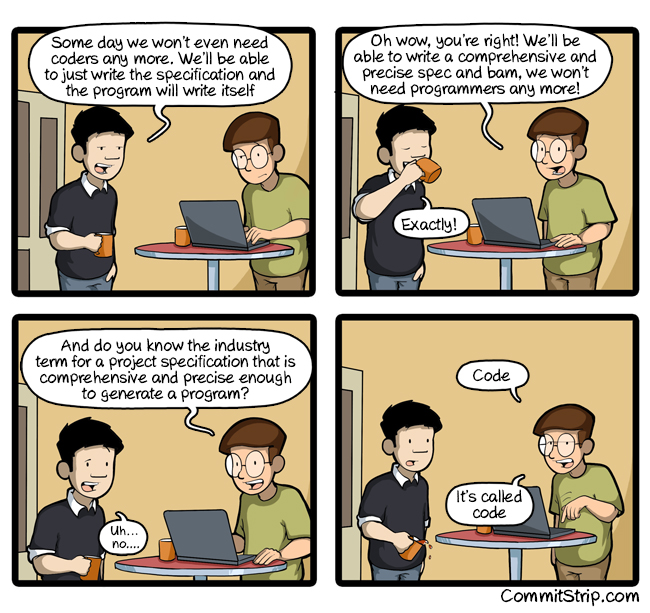
Tu come definisci il codice?
Il codice è sempre un dato.
Il punto è se ogni dato possa essere codice.
Secondo me, se una macchina lo può eseguire, la risposta è sì.
Il ragionamento l'ho espanso anche su Nexa: https://server-nexa.polito.it/pipermail/nexa/2021-June/021823.html
@minimalprocedure@mastodon.uno
s/interpreta/può eseguire/
@minimalprocedure@mastodon.uno
No, se parliamo di reti neurali, non implementi modelli statistici in un linguaggio di programmazione (che so, R o Python), implementi una macchina virtuale (la rete neurale) che poi programmi attraverso i dati che gli dai in input.
I dati sono il programma statistico che la rete neurale "compila" durante la propria calibrazione (impropriamente detta "training).
Il risultato di quella compilazione è la matrice numerica, un binario che solo quella macchina interpreta "correttamente".
@minimalprocedure@mastodon.uno
Esatto sono matrici numeriche opache di pesi calcolate statisticamente.
Queste matrici costituiscono il programma eseguito meccanicamente dalla rete neurale che è sostanzialmente una macchina virtuale.
Potrebbe, in astratto essere costruita anche come hardware (scambiando magari flessibilità per performance) ed eseguirebbe quella stessa matrice numerica.
Perché quella matrice è il suo software, il suo "binario".
E viene prodotto statisticamente.
Per cui è corretto parlare di programmazione statistica.
Non sono "data scientists" sono programmatori.
Non è un'intelligenza artificiale, ma un programma che nessuno capisce completamente.
@minimalprocedure@mastodon.uno
No, non applichi i modelli statistici, sintetizzi i modelli (l'eseguibile di quella macchina virtuale) statisticamente.
Ovvero programmi statisticamente la macchina virtuale costituita dalla rete neurale (che ha una topologia specifica che ne costituisce l'hardware virtuale).
Puoi immaginarla come una CPU, solo che non si programma in assembly ma statisticamente.
@minimalprocedure@mastodon.uno
Una rete neurale è semplicemente una macchina virtuale programmabile (solo) statisticamente.
@minimalprocedure@mastodon.uno
Sappi che ci sto seriamente pensando.
Non so solo come formularla in modo sufficientemente generico e future proof:
- AI e ML sono tutti termini fuffa ma per ora sono ancora l'unico a parlare più correttamente di "programmazione statistica"
- la #HackingLicense non si applica solo al software ma anche ai contenuti ed ai database
Se hai suggerimenti, sei il benvenuto!
@minimalprocedure@mastodon.uno @dataKnightmare
https://server-nexa.polito.it/pipermail/nexa/2021-July/021847.html
Shamar
boosted

Sure: read here about the need to give G. your private key, it is the official docs: https://support.google.com/googleplay/android-developer/answer/9842756?hl=en
It will not directly affect #fdroid, as #fdroid can only build apks, as far as I got it, and not app bundles.
But, as a dev, you end up with two distribution formats, should you also be on the Play Store.
Do you have a source about this private key requirement? Sounds like an obvious threat, too blunt and arrogant even for #Google!
Also I'd like to know if the title was clickbaiting or this is actually an issue with #Android: I do not use #GooglePlay (disabled on my phones) but only @fdroidorg@mastodon.technology: does this change anything for their #APK?
@paulfree14 @yogthos@mastodon.social
Shamar
boosted
Being a developer, I never published my apps at the Play Store but only on #fdroid .
To use app bundles, you need to give them your private key.
This gives them technically the ability to inject any code into your app.
But hey, what could go wrong?
Shamar
boosted

Shamar
boosted

Shamar
boosted

Hi @tindall@cybre.space, just read your thread at https://qoto.org/web/statuses/106500375406792092 and I totally agree.
#GitHub Copilot's models are derivative works (and derived works) of the sources used to calibrate them and thus can violate #copyright (and patents?!) encapsulated in those sources.
I have a question though.
You wrote:
```
If you trained it on MPL code, you are in violation of that license.
```
What clause are you referring to?
In this days I'm finalizing the #HackingLicense (see http://www.tesio.it/documents/HACK.txt ) and I was thinking about this specific problem.
Assuming it could be expressed properly in legalese (without turning the license in a software-only one), I'd be very happy to explicitly impose that any work automatically built out of a covered work would be covered too. If you know a license that impose such terms, I would be eager to learn more about it (MPL is not one... o maybe I'm missing something?)
Shamar
boosted

courtroom, fantasy; (thread missing CW) software licensing, corporations
@tindall .hg
prosecutor: What is the project's licensing model?
Google employee: It's open-source.
prosecutor: Where is the source code located?
Google employee: The code is in a git repository at android.googlesource.com.. There are instructions for building it on the website at source.android.com..
prosecutor: Very well. Please download the source code onto this laptop and build the project.
Google employee:
prosecutor:
Google employee: *sweating bullets*


- O.S.
- http://jehanne.io
Joined May 2019
