


Hei amici, so che non è venerdì, ma ho appena scoperto che @quinta si è unito al #fediverse.
Senatore in Parlamento, membro del High Level Expert Group sull'Intelligenza Artificiale per la Commissione Europea, e molto altro che non ho il tempo di elencare.
Se siete interessati alla #Tecnologia, alla #Politica ed alla loro stretta relazione, vi consiglio di seguirlo.
Shamar
boosted

Hey mates, I know it's not #Friday but I've just learnt that @quinta joined the #Fediverse!
Former Senator in the #Italian Parliament, member of the High Level Expert Group on #ArtificialIntelligence for #European Commission and much much more I have no time to list.
A person worth to follow if you are interested in #Technology, #Politics and their strict relation.
Shamar
boosted

RT @_MagliaNera_@twitter.com
“Sostenere che non si è interessati al diritto alla privacy perché non si ha nulla da nascondere è come affermare che non si è interessati alla libertà di espressione perché non si ha nulla da dire”. (Edward J. Snowden)
🐦🔗: https://twitter.com/_MagliaNera_/status/1170629840422219776
Shamar
boosted

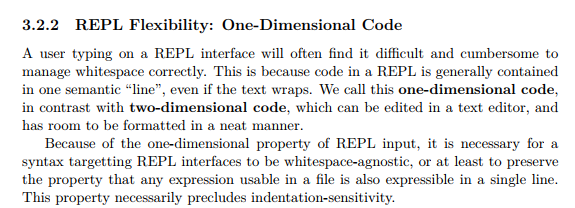
Omg it is SO REFRESHING to see language designers acknowledging that REPLs exist and that yes, indentation-sensitivity FAILS HARD IN A FIRE in a REPL
(from the Magritte language thesis, files.jneen.net/academic/thesis.pdf )
Shamar
boosted

Shamar
boosted
While you might think GtkLabel is just for display, there's a number of input gestures it supports.
There's "mnemonics" which is rendered by Pango and registered to the container GtkWindow to dispatch to an associated widget.
There's clickable hyperlinks that dispatches to the registered app by default.
And you can select text to be copy/pasted or drag/dropped, using a MultiPress gesture, DragGesture, or keyboard with help from Pango.
The latter two are rendered above the rest of the text.
Shamar
boosted
Most of GtkLabel's code is dedicated to abstracting wrapping a PangoLayoutContext with a GtkWidget, abstracting it's capabilities behind several properties.
These layouts are repeatedly created during the sizing pass to try different widths, starting with the minimum and maximum widths (0 & NULL respectively). That's used by the parents to compute the size for the final layout, which is what's used for rendering.
Shamar
boosted
Within Odysseus's addressbar popups I make extensive use of (styled) GtkLabel widgets, and GTK's tooltips and menu options also uses it for much of their rendering.
So this morning I'll discuss how GtkLabel works in GTK3, though it'll mostly hand off to the text layout/rendering stack I described the other day ( https://adrian.geek.nz/gtk_stack_docs/text.html ).
And that'll pretty much finish off describing the components in Odysseus's headerbar/addressbar.
Shamar
boosted

had my first class on #accessibility today
first impressions:
it was a lot of fun
the teacher is super cool
this was probably my first class where women were in majority, which, hm. says something about the techbro attitudes i see in a lot of other students.
anyways, people who are studying #programming , if your uni/school/whatever offers an accessibility class, i highly recommend taking it
Shamar
boosted
RT @WikimediaItalia@twitter.com
Oggi a BASE #Milano è iniziata la Summer School "I progetti #Wikimedia per le istituzioni culturali". La prima edizione del corso è cominciata sotto i migliori auspici, registrando il tutto esaurito.
Buon lavoro ai nostri corsisti! ➡️https://www.wikimedia.it/summer-school/
📸 @wikilaurentius@twitter.com,
🐦🔗: https://twitter.com/WikimediaItalia/status/1171091390698270721
Shamar
boosted

Yes, but that's our fault.
Shamar
boosted

man, computers suck
Shamar
boosted

re: FOSS / tech / privacy musings
@bjarni @mkb Absolutely - although the same holds true to some extent for trustable architectures. Just the fact that you're using Tor, even when some actor cannot see what you're doing, can flag you for closer examination.
In fact, that's exactly the reason why I try to use privacy-minded products: for my threat model, it's not really necessary, but I can provide cover for journalists, whistleblowers, etc.
Shamar
boosted

 🇳🇱
🇳🇱

Shamar
boosted
What OS camp are you in? Hopefully this will be big so please boost so we can get as many votes as possible
I have to say that you could even consider protoWaffle or protoWAFFLE
- O.S.
- http://jehanne.io
Joined May 2019
