

Albert Cardona @albertcardona@social.cleverlibre.org
- Personal website
- https://albert.rierol.net
How does the brain work? Someday, we'll figure it out.
Group Leader, MRC LMB, and Professor, University of Cambridge, UK.
#neuroscience #Drosophila #TrakEM2 #FijiSc #CATMAID #connectomics #vEM
Born at 335 ppm.
Brains, signal processing, software and entomology: there will be bugs.
Joined Oct 2022
Albert Cardona
boosted


🚨 We are hiring a Bioimage Analyst and Research Software Engineer @humantechnopole@twitter.com in Milan. 🚨
I believe we are a really fun team doing great work together. Check us out and apply if you want to join! 👍
We’re looking forward getting to know you!
https://careers.humantechnopole.it/o/bioimage-analyst-and-research-software-engineer-computational-biology-research-center
Albert Cardona
boosted

RT @NicoleCRust
The genetic mutation that causes Huntington's disease was identified in 1993. As I understand it, we still do not understand what that gene does. For those in the know: conceptually, why has this been so difficult to determine?
https://hdsa.org/what-is-hd/overview-of-huntingtons-disease/
Casey Schneider—Mizell studies the #mouse cerebral #cortex with #vEM #connectomics at the Allen Brain Institute, and develops software for mapping and analyzing #neuronal #circuits in very large image volumes with nanometer resolution measuring over a cubic millimeter.
#neuroscience

Time for an #introduction. Nervous systems — yours, mine, those of mice, fish, and insects and worms — are made up of populations of different kind...
Albert Cardona
boosted
Time for an #introduction. Nervous systems — yours, mine, those of mice, fish, and insects and worms — are made up of populations of different kinds of neurons that communicate with one another. Current electron microscopy generates millimeter-scale volumes with the morphology and synaptic connectivity of up to 10^5 neurons. As a scientist at the Allen Institute, I am mapping out the cell types and connectivity rules found in cortex and building computational tools to help others do the same.
Albert Cardona
boosted

Hello! A brief #introduction - I’m an Asst Prof at Boston Children’s Hospital and Harvard Medical School. I study organizational principles of #neuralNetworks. We study #neuralCircuits underlying #motorControl, #sensoryIntegration, and #decisionMaking across species. We also develop methods for synapse-resolution #connectomics. Looking forward to learning more!
Torymus sp. chalcid wasp today at the Cambridge Botanic Garden, UK. Despite the large ovipositor, this tiny metallic green parasitoid wasp does not present any danger to its untimely perch, AKA my finger.
http://www.inaturalist.org/observations/141319131
#iNaturalist #wasplove #entomology
Albert Cardona
boosted

Hello world! This is my #introduction. I’m a #phd student at #UniversityofRochester studying #neuroscience #cognitiveneuroscience. Specifically, I use #psychophysics #ephys and #neuralnetworks to study the computational principles and neural correlates of perception of 3D structure in the world. I’m finishing my #phd soon and would love to explore #postdoc opportunities to continue research on understanding how animals interact with the environment and with each other.
Albert Cardona
boosted


Just a thought, directed to the wrong people, but anyone who professes to want to be supportive and better understand the experience of marginalized folks and make things easier for them would be really well-served and probably learn a lot by listening and incorporating the local culture/etiquette tips being flung around, which are literally telling you what works.
If you want the fun culture tips as well, we will teach you, and create new with you. But the CW and checking profiles for preferences about contact and stuff IS supporting marginalized folks, that's where those customs came from and we finesse the heck out of them regularly.
Albert Cardona
boosted

Hello Mastodon. I am a neuroscientist and PI at Cold Spring Harbor Laboratory in New York, USA. I have long-standing interests in natural behavior, the neural circuitry of auditory and olfactory communication in mice and birds, neuromodulation, and neurodevelopmental disorders. I am skeptical of some aspects of this platform, but I am keeping an open mind. @sheacshl on Twitter.
Albert Cardona
boosted

Hi Mastodon! 👋
Dipping my toes here given the situation on the birdsite. I am Editor in Chief of #PLOSBiology, interested in all things science.
A virologist by training, I am passionate about #OpenScience and making publication process a transparent and constructive one.
I look forward to chatting about science, the evolving publishing landscape, traveling, cooking and a bit of everything!
Albert Cardona
boosted

JOB ALERT (please reblog) -->
Molecular biologist for zebrafish at Janelia Research Campus, HHMI:
Albert Cardona
boosted

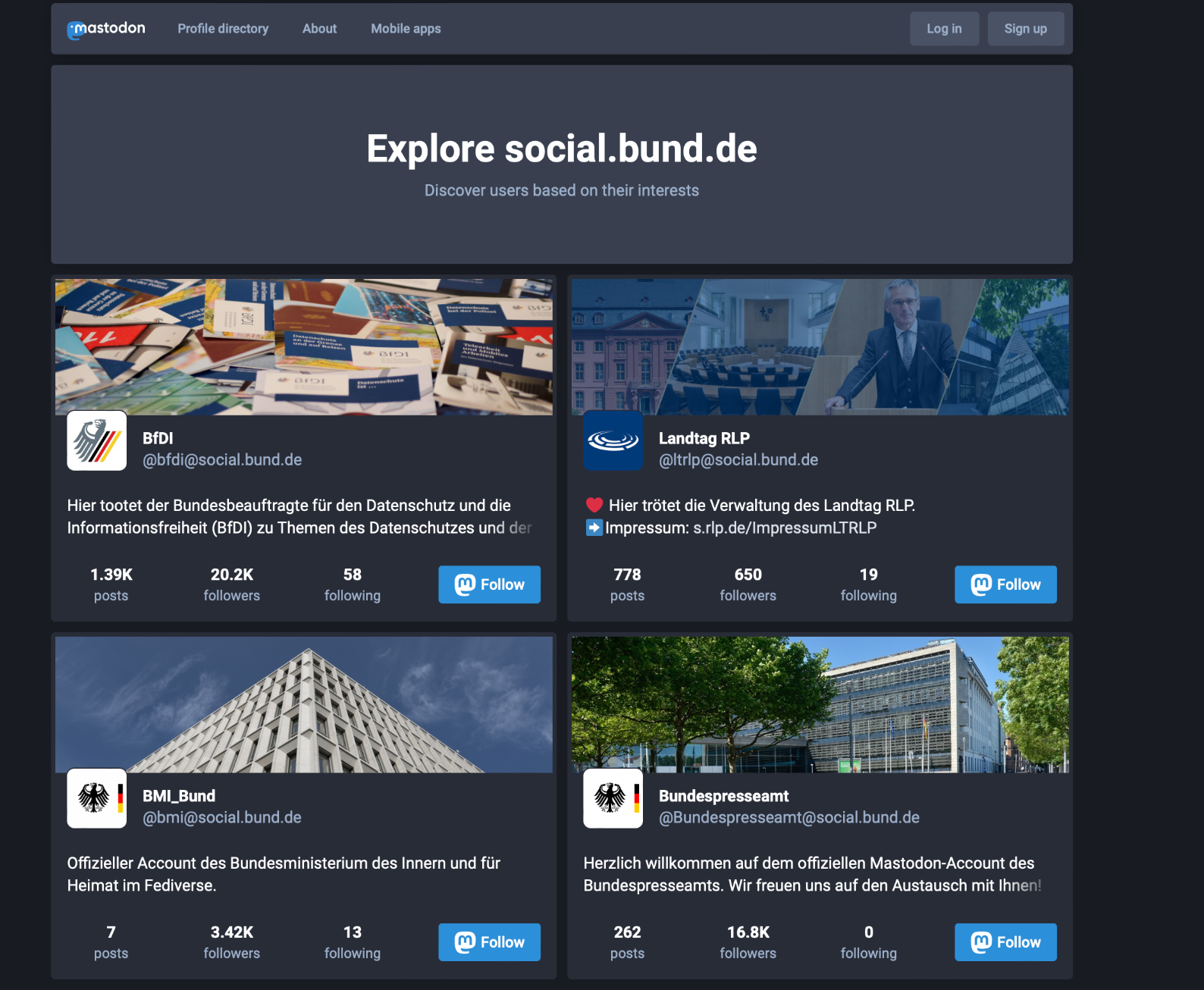
Woah - German government has got its own Mastodon instance and most of the ministries and many agencies already have accounts.
Verification problem at least partially solved - just need to check the domain is right!
I've also seen newspapers like theatlantic.com set up instances themselves. Looks like verification will be worked out sooner or later.
https://social.bund.de/explore
Albert Cardona
boosted

Hi All! Happy to be here - this is my #introduction. I'm an assistant professor at the University of Amsterdam and we are creating and applying fluorescent probes for imaging of cells with microscopes.
I'm also interested in image analysis and #dataViz with #opensource tools.
Albert Cardona
boosted

#introduction #biology #biotech #science #academic
Hi all!
I am Akanksha, currently working as a research tech at HHMI Janelia Research Campus, engineering bioluminescent proteins for functional imaging.
My research interests lie at the interface of chemistry, biology, and engineering 🔬. 'A tool developer' describes me best - in the dry lab, I was working on a systems biology project involving detecting hard-to-find nucleotide changes with certain effects from human transcriptome datasets. Transitioning to a wet lab, I have been engineering proteins for various applications.
Being an avid learner, I spend a lot of time reading articles from across various sub-disciplines in bioscience and biotech. I'm happiest when brainstorming ideas in molecular/synthetic biology or new tools that don't exist with a near-perfect cup of coffee☕ ! Always happy to connect over a crazy idea!
Cheers!
Albert Cardona
boosted

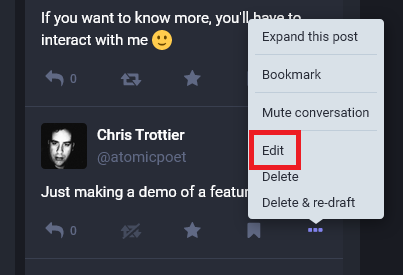
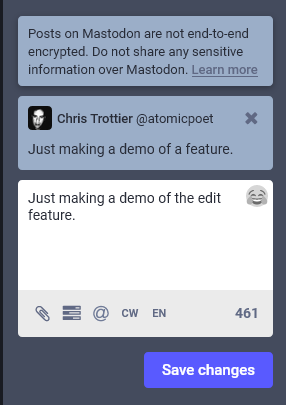
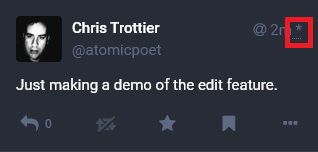
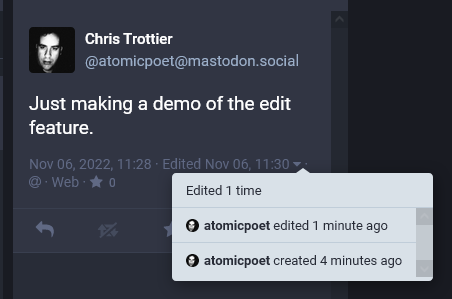
Mastodon has a really nifty edit feature!
Here's how to use it.
1. When you click the ellipsis icon (...), you'll see an option for edit
2. After clicking "Edit", you'll be able to adjust the original message in the Compose box. NOTE: this does not delete the original message
3. In your feed, you can see which messages have been edited by a star on the upper right corner next to the time it was sent
4. You can also view logs of edits by clicking the ▼ icon underneath the message.
Albert Cardona
boosted

I'm a computer scientist / cognitive scientist at the Santa Fe Institute, these days working on conceptual abstraction and analogy-making in AI. Fan of Bongard problems, letter-string analogies, and the Abstraction and Reasoning Corpus, among other domains.
Albert Cardona
boosted

#introduction to the #academic #science we do:
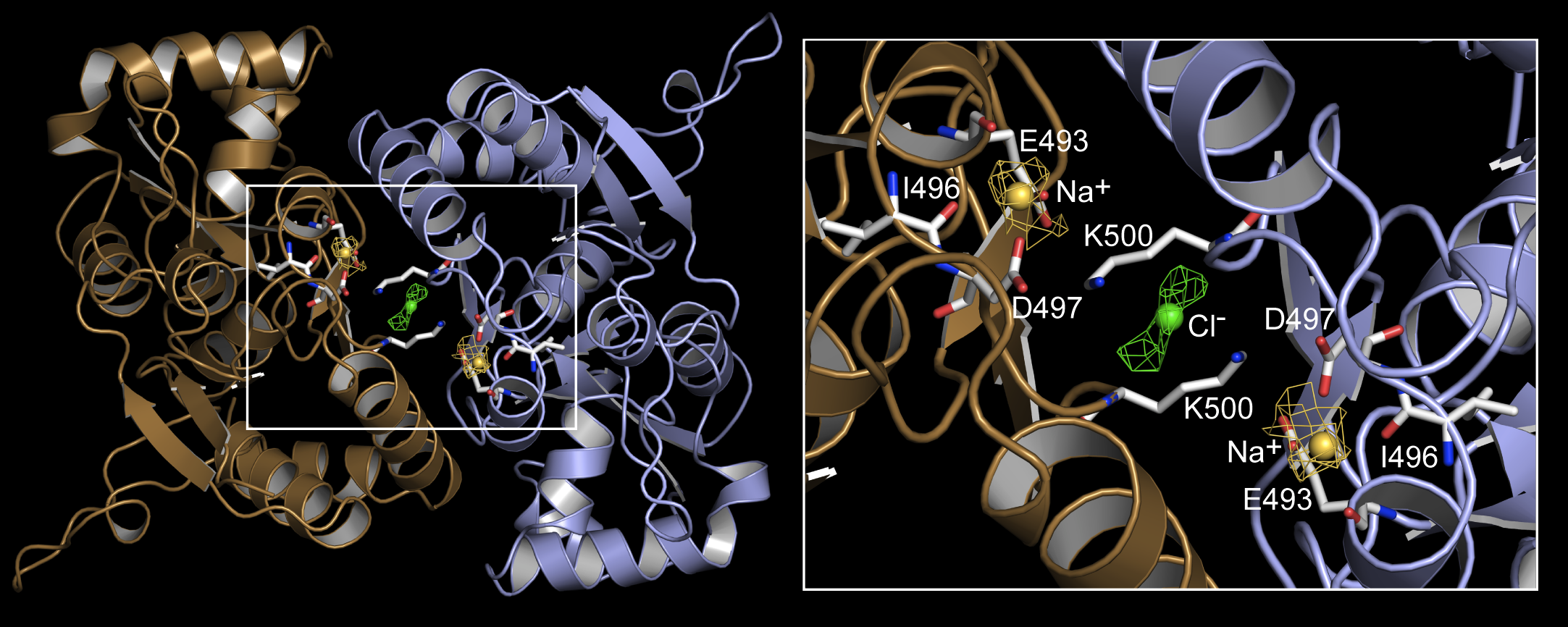
We are interested in developing and applying #computational tools and approaches to study #membrane proteins such as #ion channels and #transporters.
Albert Cardona
boosted

I am researcher working at the interface of artificial intelligence and neuroscience. I really wear two hats.
🎩 I work at Meta Reality Labs, thinking about neuromotor neural interfaces.
🤠 I am also an adjunct professor at Stanford, where I think about neural dynamics and how they give rise to computation and behavior.
Albert Cardona
boosted

Hello #ScienceMastodon et al!
I'm a scientist who researches how ions cross cell membranes. I study ion pumps, exchangers and channels which are all amazing nanomachines. My lab is at the Johns Hopkins School of Medicine in Baltimore, Maryland (US).
I also direct a PhD training program in Cellular & Molecular Medicine so my hands are full with all things relating to grad ed.
Expect prolific #foodposting and pix of my handsome #AustralianShepherd Samwise.
If you don’t know where some of the rules are written, check <yourserver>/about/more such as: https://qoto.org/about/more So far I have only seen sensible advice at such pages across multiple instances.



- Personal website
- https://albert.rierol.net
How does the brain work? Someday, we'll figure it out.
Group Leader, MRC LMB, and Professor, University of Cambridge, UK.
#neuroscience #Drosophila #TrakEM2 #FijiSc #CATMAID #connectomics #vEM
Born at 335 ppm.
Brains, signal processing, software and entomology: there will be bugs.
Joined Oct 2022
