

Apple pie @applepie@social.cleverlibre.org
A student interested in #biochemistry and #bioinfomatics
Joined Nov 2022
Apple pie
boosted

In this week's Editors' Choice piece, I highlight a study in Nature by Weems et al. on how cancer cells "cheat death," to quote Reichman-Fried and Raz. When cells become detached from the extracellular matrix or surrounding cells, they die by a process called anoikis. Weems et al. showed that detached cancer cells resist anoikis because membrane protrusions called "blebs" become hubs for signaling molecules that promote survival. Read my summary here: https://www.science.org/doi/10.1126/scisignal.adh9176 #science #CellDeath
Apple pie
boosted

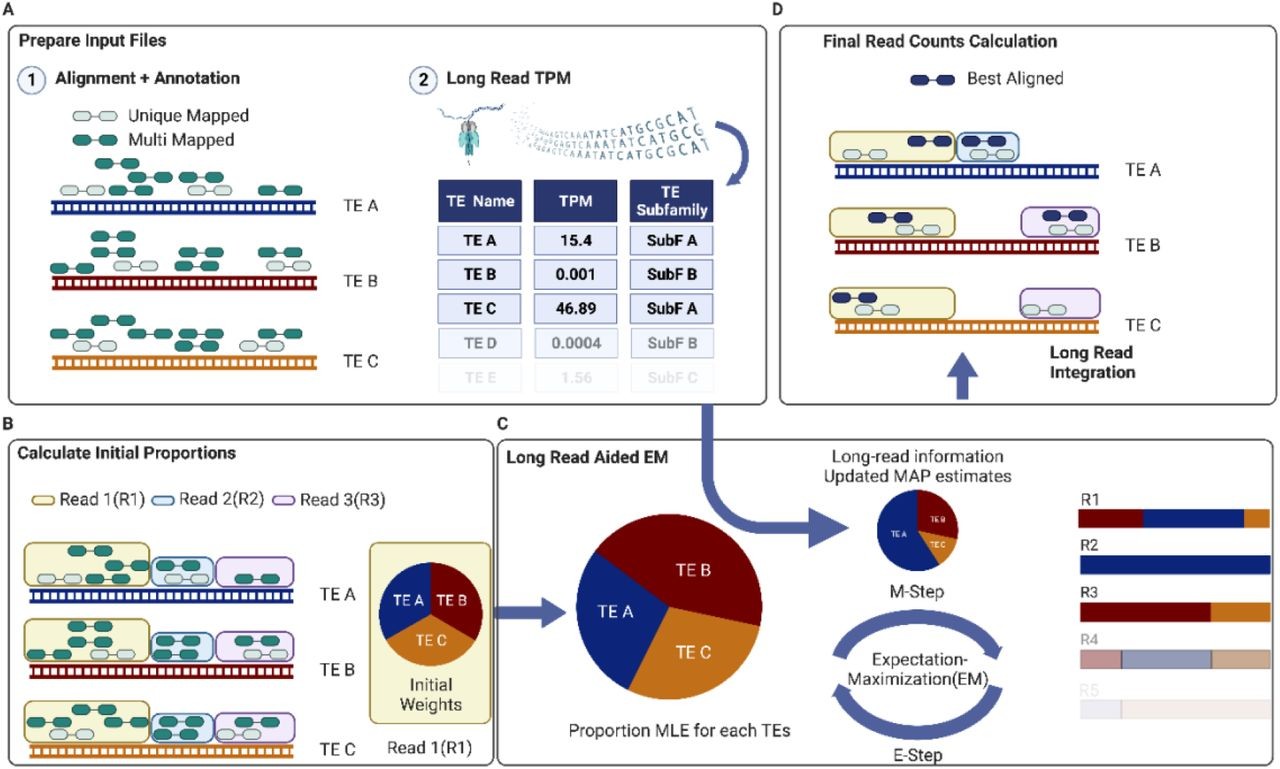
A collaboration work, during my time at Penn State, is published: https://bmcbioinformatics.biomedcentral.com/articles/10.1186/s12859-023-05223-1
Triggers many wonderful memories! 😀
@nicolaromano You can try StringTie2 (https://ccb.jhu.edu/software/stringtie/index.shtml?t=manual) and FLAIR (https://flair.readthedocs.io/en/latest/) to discover transcript isoforms from all samples and quantify them with packages like featureCounts (https://subread.sourceforge.net/) and Salmon (https://salmon.readthedocs.io/en/latest/salmon.html)
You can quantify #transposon expression in your short-read library in #locus level more accurately with LocusMasterTE and long-read count matrix from the same tissue :D
Integrating long-read RNA sequencing improves locus-specific quantification of transposable element expression
https://www.biorxiv.org/content/10.1101/2023.03.21.533716v1
#TransposableElement #transcriptomics #RNAseq #RNA #ShortRead #LongRead #illumina #nanopore
Apple pie
boosted

Primate TRIM34 is a broadly-acting, TRIM5-dependent lentiviral restriction factor
Apple pie
boosted

So @internetarchive scanning books for their digital library is copyright infringement:
http://blog.archive.org/2023/03/25/the-fight-continues/
But OpenAI slurping all of that to train a model that then can generate text and put actual authors out of business (already happening with copywriters), is not.
Figures, there are no $billions of VC / corporate money behind Internet Archive, why would anyone want to support a public service, right? 🤦♀️
IA ≠AI, know the difference!
Apple pie
boosted

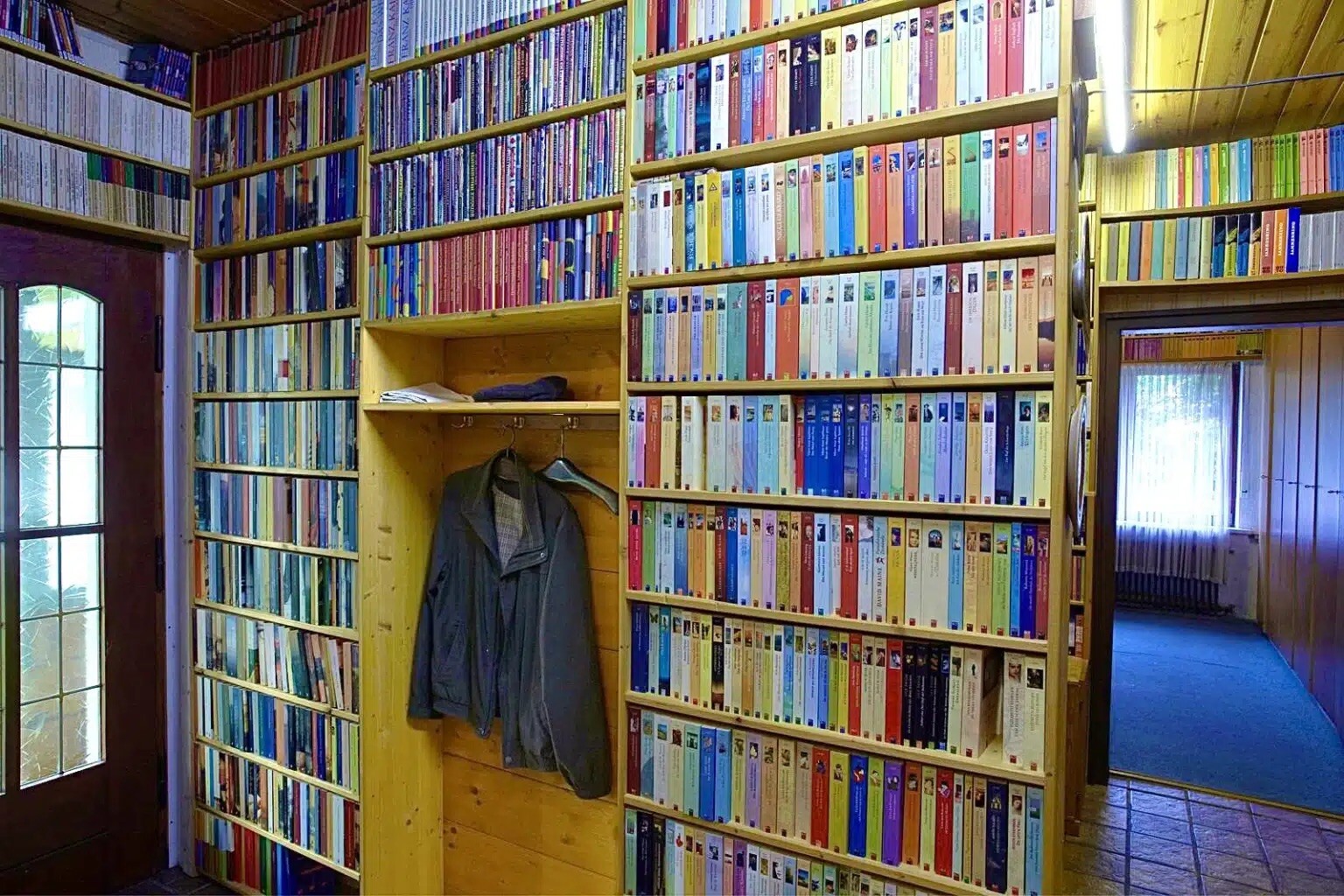
A man named Bruno Schröder, was a mining engineer for most of his life. When passed away in his 80s in June 2022, he had around 60,000 or so books spread out on the 4 floors of his house in Mettingen, North Rhine-Westphalia, Germany. The books likely weigh about the same as 15 modern cars. 📚
#books #library #BookCollection #collection #Germany
h/t @BrianJopek
Apple pie
boosted


#CellMigration for house cleaning!
Immune cell (i.e. #DendriticCell), moves to remove 2 death cells (arrows)
This is pretty much what happens in our body when normal tissue cells die, they are scanned & removed by leukocytes (also macrophages)
#scicomm @cellcommlab @focalplane
Apple pie
boosted

Hey! An update. I've actually made such a Bioinformatics-centered server (see the message I'm replying to!). You can join here: https://discord.com/invite/arPBahn8N6
Boosts are very welcome, even if you're not interested. Thank you!
I'm going to re-tag this: #bioinformatics #discord #algorithm #datascience #tools #r #python #genomics #transcriptomics #multiomics #lab #collaboration #academia #computerscience #biology #science
Apple pie
boosted

The "generalizability" problem is easy to grasp: very few research samples and first authors in the beheavioral sciences are from the Global South
image 1: world map scaled by population
image 2: world map scaled by published research
Apple pie
boosted

Announcing papertooter. Papertooter is a simple script that takes the URL of a biorxiv preprint, and posts the title and link to the paper on Mastodon using the Mastodon Python API. It also posts a unique hashtag it generates from the paper's DOI.
Feature requests and bug reports welcome.
Apple pie
boosted

RT @RegGenomics@twitter.com
Happy New Year! Happy New #postdoc job?
Please join us in London seeking to determine the role of nascent RNAs in chromatin regulation!
To apply, please visit: https://www.ucl.ac.uk/work-at-ucl/search-ucl-jobs/details?nPostingId=1528&nPostingTargetId=4168&id=Q1KFK026203F3VBQBLO8M8M07&LG=UK&mask=ext
Deadline: Jan 31st
🐦🔗: https://twitter.com/RegGenomics/status/1610249649050337281
Apple pie
boosted

Apple pie
boosted

Mastodon friends! I will probably post this over on twitter next week, but you're special people and get a sneak peek :) We're hiring a bioimage analyst in my team! This is a "junior" position best suited for someone who knows an image analysis tool or two, can code to a novice/intermediate level, and wants to learn a lot. Remote work (in the US) possible depending on circumstances. Please share widely! https://thejacksonlaboratory.wd1.myworkdayjobs.com/External_JAX/job/Farmington-Connecticut/Systems-Analyst-I_JR002913
Apple pie
boosted

Great news for python lovers: A python version of DESeq2 is out! @biorxivpreprint #bulk #RNAseq #python #bioinformatics
https://www.biorxiv.org/content/10.1101/2022.12.14.520412v1
Apple pie
boosted

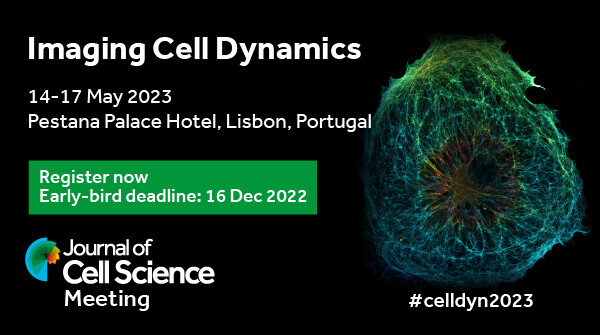
It’s cold and snowy here in Cambridge so we’re thinking ahead to our “Imaging Cell Dynamics” journal meeting in Lisbon next year! The early-bird registration deadline is tomorrow (Friday) so apply now to avoid missing out (and please spread the word to anyone who might be Interested).
https://www.biologists.com/meetings/celldynamics2023/ #cellbio #cellbiology #imaging #microscopy
Apple pie
boosted

I will have PhD and RA positions open very soon. There's quite some flexibility for young researchers interested in experimental and #bioinformatics approaches in #MassSpectrometry #proteomics and #singlecell.
Please boost and spread. Feel free to get in touch.
Apple pie
boosted

Ever since the Human #Genome Project got rolling about thirty years ago (!) there's been a lot of hope, and a lot of hype, about "#personalized #medicine" or "#precision medicine." When it became clear that as always, the results weren't going to match the hype, a lot of the hope went away too. This is a mistake.
I'd like to talk about a quiet revolution in precision medicine: #genetic #dosage guidelines, a.k.a. #pharmacogenomic #labeling. The basic idea is that if you carry certain genetic #variants, you may need considerably more or less of a particular medication than the standard dose. Back in the '90s, the kind of genetic #analysis needed to make use of that information was far too expensive and time-consuming for #clinical practice. These days you can get a complete #sequence in a matter of hours, for the same cost as a battery of standard blood tests.
Fifteen years ago or so, the FDA approved the first pharmacogenomic labeling, for #warfarin. I was lucky enough to be in the room when the researchers made the announcement, and you could have heard a pin drop. Now it's routine, and there's a very long list: https://www.fda.gov/drugs/science-and-research-drugs/table-pharmacogenomic-biomarkers-drug-labeling
Everyone reacts to #medications differently. For most patients, most medications, and most diseases, there's a fairly broad range of clinical effectiveness between "too little to do any good" and "way too much." But for a substantial number of all of the above, the range is much narrower—and when you add up all the special cases, you get a hell of a lot of people!
A lot of #drugs never get approved, despite showing promise in clinical #trials, because they only help a portion of the study population. Regulatory bodies like the #FDA are notoriously resistant to #subgroup analysis, and I get why: it's very easy to cherry-pick those subjects in a clinical trial who happen to do well, and then come up with a post hoc explanation for why the test treatment worked for them but not for other participants. Some bad drugs have made it to market because of this kind of chicanery. But of course sometimes there's a real reason one group does better, and as long as genetic testing is part of the study design from the start, it's becoming possible to convince regulators that reason is valid.
My work is mostly upstream of this, in the drug #target #discovery phase: finding disease-related #genes and #proteins that might be modifiable with the right medication. Since it's part of the project from the start, that makes trial design easier, and the results more likely to be accepted. But I'd really like to see more #genomic analysis on drugs that *aren't* designed that way too, and I think we're getting there.
Genetic dosage guidelines, though, are making a real difference in current practice. There are still considerable debates over the merits of many labelings, driven partly by legitimate #statistical concerns and partly by ideology. But the principle is proven beyond reasonable doubt, and it's saving lives and relieving suffering right now, every day. Much more to come.
Apple pie
boosted







RT @tangming2005@twitter.com
23 tools to work with (single-cell) TCR/BCR-seq immune repertoire data 🧵👇
compiled at https://crazyhottommy.blogspot.com/2022/12/23-tools-to-work-with-single-cell.html
🐦🔗: https://twitter.com/tangming2005/status/1600868620128718848
Apple pie
boosted
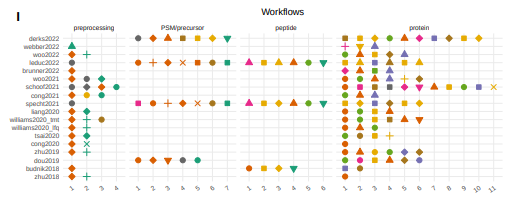
A new version of our "Current state of #singlecell #proteomics data analysis" pre-print is available on #arXiv.
We compare the computational workflows used over the last four years and identify a profound lack of consensus on how to analyse SCP data. There's a clear need for benchmarking, standardisation, and better experimental designs. We cover the current standardisation efforts, list remaining missing pieces, and conclude with lessons learned from replications.
(1/2)
A student interested in #biochemistry and #bioinfomatics
Joined Nov 2022
