

Apple pie @applepie@social.cleverlibre.org
A student interested in #biochemistry and #bioinfomatics
Joined Nov 2022
Apple pie
boosted

!!!! wat
Temperature-dependent RNA editing in octopus extensively recodes the neural proteome
https://www.cell.com/cell/fulltext/S0092-8674(23)00523-8
'Octopus bimaculoides increase A-to-I RNA editing at >20,000 sites in the cold'
(really interesting research into RNA-editing in liverworts too; they have relatively few genes but generate diversity using extensive editing)
Apple pie
boosted

When you post a link to Instagram, this is what it looks like to those of us who don’t mess with Facebook and their properties. Sometimes Instagram is the correct URL for a thing, I get that. But just be cognizant of the experience for a lot of people.
Apple pie
boosted

I have been recommending Miniconda for many years. I updated this recommendation with using Miniconda + Mamba. This is now outdated and the recommended way to install Mamba is using Mambaforge (see https://github.com/conda-forge/miniforge#mambaforge).
I highly recommend Mamba for its speed. Creating the following env:
- jellyfish=2.2.10
- star=2.7.10b
- rsem=1.3.3
- kallisto=0.48.0
- samtools=1.17
- bwa=0.7.17
- ffq=0.3.0
- hisat2=2.2.1
- stringtie=2.2.1
took Mamba 1m25s. Conda took 13m20s.
Apple pie
boosted

Interesting find:
"Despite Mastodon’s decentralized architecture, we found that the 25% of the largest instances on Mastodon contains 96% of the users.
Paradoxically, while larger instances attract more users, smaller ones attract more active users, reinforcing Mastodon’s decentralization."
...We observed the impact of social network in migration, with an average of 14.72% of Twitter followees per user migrating to the exact same Mastodon instance as user."
Apple pie
boosted

log(😅) =💧log(😄)
Apple pie
boosted

RT @PR0GRAMMERHUM0R
Empathy https://www.reddit.com/r/programmerhumor/comments/12inyo2
Apple pie
boosted

RT @Marcos_dlP
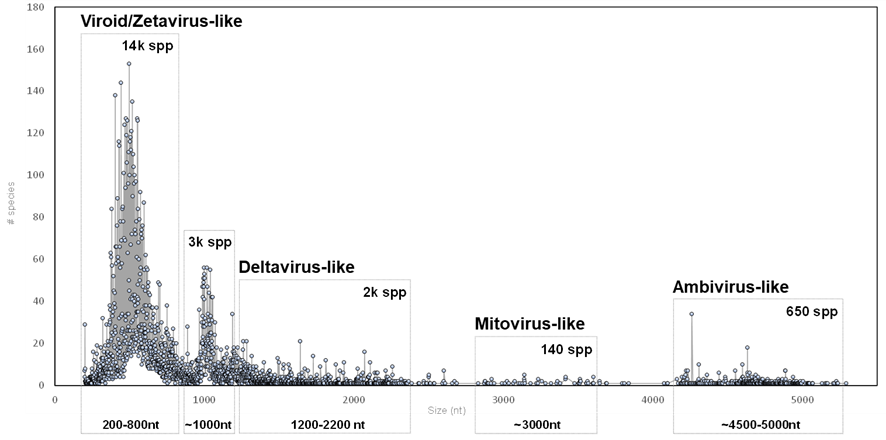
Small viroid-like circRNAs are the simplest infectious agents ever described. To date, only ~50 species affecting plants or animals were known. Now, we reveal the existence of more than 20,000 new species of viroidal circRNAs occurring in environmental samples around the planet
Apple pie
boosted

I'm beginning to see where the comparative advantage is between myself and current-generation #AI tools.
For tasks that I perform on a daily basis, I have developed enough techniques to optimise my workflow that AI tools don't add much for me. Most obviously with regards to research mathematics, but also for instance in composing emails; I installed a plugin that lets GPT4 write email responses for me at the click of a button, but I almost never use it, because I already can write suitable email responses rapidly through decades of practice.
For tasks that I have some expertise in, but little practice, AI tools are helpful: often I can use them profitably to create a first draft of the output, which I can then verify and polish, or at least use as inspiration. (In some cases the inspiration is due to deficiencies in the AI product, in the spirit of Cunningham's law, but it can still be a more productive process than if I tried to work things out on my own). Examples in this category include data processing, translating to a foreign language, or writing text in a format that I rarely use (e.g., a public speech, a rules document, etc.)
For tasks that I have little expertise in, and do not require extremely high quality and reliable output, one can simply ask the AI tool and follow its advice more or less blindly. Here the AI functions as a slightly more convenient version of a traditional search engine.
Finally, for tasks that I do not have expertise in, but for which quality and reliability are needed, neither the AI or myself can resolve the task, and I have to consult a human expert. An example would be a repair of a complicated, expensive, and delicate piece of equipment.
Apple pie
boosted

There are two philosophies in #programming toward handling questionable #data. The first is to check the #integrity of the data every time it's used. This takes a fair amount of #programmer time, and depending on the size of the data may also take a fair amount of #computer time. It's a PITA to write, test, debug, and run.
The second is to say "I've already checked this data a bunch of times in the program, it's fine" and skip the integrity checks after the first time. In #scientific programming, this is particularly tempting: the data sets are huge, and writing checks is annoying. The whole thing feels like a waste of time when you're reasonably sure your code will never run on anything except this particular data set which you already see more of than your family and your pets and you just want to get the damned thing done.
About 95% of the time, I take the first approach. Every time I do it, I'm grumbling to myself. Just finish it, already! And I am uneasily aware that those who take the second approach get their work done faster than I do.
Yes. This is true.
They also get a lot of #garbage results—many of which don't look like garbage at all. Here comes the ritual chest-thumping ... in #bioinformatics, and #biomedical #research generally, those mistakes don't just lead to flawed publications, as bad as that is. Garbage results kill people.
I just received a lesson in why the first is a really good idea. Let's be careful out there.
Apple pie
boosted

I remember reading and doing exercises about ***determinants*** in high school.
The name was scary, and sadly not much context was given at the time. 😞
For a long time, I thought a *determinant* was just a value I had to blindly compute using a formula.
Here's what I would like know about *determinants* when I first started... 🧵
Apple pie
boosted

For anyone on the fence about #eLife's new publishing model, note there is no such thing as an "eLife paper", since the purpose of the review process in scientific publishing is to provide accurate, constructive reviews to authors. In modern times, dissemination doesn't depend on mailed-in printed periodicals.
Each eLife publication has an evaluation attached to it in the form of an assessment–be it negative or positive. Critically, authors decide whether to go forward with assessments as they are and go public, or to revise the manuscript and request re-review to improve both manuscript and, consequently, the reviews and assessment.
In other words, nothing changed, except, its authors who decide how to move forward with their own manuscript, rather than editors.
Apple pie
boosted

RT @virtual_embryo
Can we predict cellular forces just from microscopy ?
We are happy to release a robust method by @SachaIchbiah to create 3D atlases of relative cell mechanics in embryos or tissues from fluorescent images of cell outlines:
https://tinyurl.com/5fj2c4b8
A thread (1/n)
AGC: compact representation of assembled genomes with fast queries and updates
https://academic.oup.com/bioinformatics/article/39/3/btad097/7067744?login=false
Apple pie
boosted

Recent updates to my GitHub repo of successful job applications in academia and industry. CVs, cover letters, research, DEI and teaching statements, etc. if you’re on the job market a pretty useful resource. If you’ve gotten a job recently please consider contributing! https://github.com/RILAB/statements
Correcting PCR amplification errors in unique molecular identifiers to generate absolute numbers of sequencing molecules
https://www.biorxiv.org/content/10.1101/2023.04.06.535911v1
Nice introduction of the paper here :D
https://nitter.1d4.us/AdamCribbs/status/1644270946528755712#m
Slide-tags: scalable, single-nucleus barcoding for multi-modal spatial genomics
Apple pie
boosted

Update. This fear is coming true.
We tested a new ChatGPT-detector for teachers. It flagged an innocent student.
https://www.washingtonpost.com/technology/2023/04/01/chatgpt-cheating-detection-turnitin/
"Five high school students helped our tech columnist test a #ChatGPT detector coming from #Turnitin to 2.1 million teachers. It missed enough to get someone in trouble."
Apple pie
boosted

AI computing startup Cerebras releases open source ChatGPT-like models
Apple pie
boosted

People are having fun with #peptides and #MassSpectrometry. Using 6 different proteases, peptide coverage of human proteins dramatically increased. This allowed observation of translation from alternative spliced transcripts and an estimation of the potential deleterious effect of SNPs in coding sequences.
As expected, inclusion of a stop codon led to a lack of detection of peptides originating from transcripts degraded by #NMD.
Fantastic resource.
Apple pie
boosted


Just a reminder, in the eukaryote nucleus:
RNA polymerase I: makes ribosome structural RNA (except for 5S rRNA);
RNA polymerase II: makes primary transcript mRNA; &
RNA polymerase III: makes all other RNA, including 5S rRNA.
A student interested in #biochemistry and #bioinfomatics
Joined Nov 2022
