

Bibliolater 📚📜🖋📐 @bibliolater@social.cleverlibre.org
Not a bot; a rather corpulent male approaching fifty years of age; married; father; a very very slow reader; barely reaching up to the level of mediocrity; an ignoramus who reads occasionally.
Toots are humanities, sciences, books and maps related. Toots or follows or boosts or mentions ≠ endorsements of any particular notion or notions. Expect many typing errors.
Addendum: for those wondering, I do not physically resemble a fountain pen.
Joined Nov 2022
🏴 Pye, T. (2023). The Scottish Enlightenment and the Remaking of Modern History. The Historical Journal, 66(4), 746-772. doi: https://doi.org/10.1017/S0018246X23000225 #OpenAccess #OA #Journal #Article #History #Histodon #Histodons #Scotland #Scottish #Enlightenment #Academia #Academic #Academics @histodon @histodons
Jolowicz, D. (2023). Spartans in the ancient Greek novels. The Journal of Hellenic Studies, 1-26. doi: https://doi.org/10.1017/S0075426923000630 #OpenAccess #OA #Journal #Article #Antiquity #Ancient #Greece #Greek #Novels #Sparta #Academia #Academic #Academics @antiquidons
Bibliolater 📚📜🖋📐
boosted

This may be obvious, but I recently started routinely adding "-youtube" to google searches. This eliminate most pages with links to garbage YouTube-monetized videos that try to attract people looking for basic instructions on how to do simple things. Greatly improves the quality of search results.
"Imperial Federation - Map of the world showing the extent of the British Empire in 1886. Statistical information furnished by Captain J.C.R. Colomb, M.P. formerly R.M.A. Mclure & Co. Queen Victoria Street, London. British territories coloured in red. (Published as) Supplement to ''The Graphic'', July 24th, 1886. (Inset) Map of the world showing the extent of British territories in 1786." https://www.davidrumsey.com/luna/servlet/s/bz3c3b #Map #Maps #Cartography #History #Histodon #Histodons #British #Britain #Empire @histodon @histodons
"Map of the Medo-Persian Empire: Showing its twenty Satapies. B.C. 529-331. By I.S. Clare. (to accompany) Cram's atlas of the world, ancient and modern: new census edition -- indexed." https://www.davidrumsey.com/luna/servlet/s/0r7ik5 #Map #Maps #Cartography #History #Histodon #Histodons #Antiquity #Ancient #Empire @antiquidons @histodon @histodons
"Map of the Roman Empire at the period of its greatest extent. About the year A.D. 107. Engraved to illustrate Mitchell's ancient geography. (with) Map of Britannia Romanorum of Roman Britain. (with) Map of northern and central Syria. Drawn & engraved by J.H. Young. Entered according to Act of Congress in the year 1844 by S. Augustus Mitchell in the ... District Court of the eastern district of Pennsylvania. (1873)". https://www.davidrumsey.com/luna/servlet/s/87vban #Map #Maps #Cartography #History
#Histodon #Histodons #Antiquity #RomanEmpire #Roman #Empire @antiquidons @histodon @histodons
"In this course, we will survey and analyze the dramatic and much-contested history of money, beginning with the ancient world and proceeding through the early modern period, nineteenth and twentieth centuries, to the present day, with a discussion of where money may be headed in the future." https://youtube.com/playlist?list=PLinliDgP9EbScxfH5wxoX8I_HNRSElqZ_ #Youtube #Video #Videos #Playlist #History #Histodon #Histodons #Economics #Money #Finance #Currency @histodon @histodons @econhist @historyofeconomics
Bibliolater 📚📜🖋📐
boosted

Bibliolater 📚📜🖋📐
boosted

Curious about quantum tunneling? Check out the latest episode of #Quantum101, from me and the Perimeter Institute for Theoretical Physics: https://youtu.be/Yg0LT3n4mYY?si=qru2ItWY14ta8giC
"Traces of Ink. Experiences of Philology and Replication is a collection of original papers exploring the textual and material aspects of inks and ink-making in a number of premodern cultures (Babylonia, the Graeco-Roman world, the Syriac milieu and the Arabo-Islamic tradition)."
(Eds.). (22 Feb. 2021). Traces of Ink. Leiden, The Netherlands: Brill. https://doi.org/10.1163/9789004444805 #OpenAccess #OA #History #Histodon #Histodons #Ancient #Science #Literature #Philology #HistSci #Culture #Book #Books #Ebook #Ebooks #Bookstodon #Academia #Academic #Academics @science @histodon @histodons @bookstodon (57)
Van Rooy, R. (12 Apr. 2023). New Ancient Greek in a Neo-Latin World. Leiden, The Netherlands: Brill. https://doi.org/10.1163/9789004547902 #OpenAccess #OA #History #Histodon #Histodons #EarlyModern #Latin #Greek #Language #Languages #Book #Books #Ebook #Ebooks #Bookstodon #Academia #Academic #Academics @earlymodern @histodon @histodons @bookstodon (56)
"In The Currency of Empire, Jonathan Barth explores the intersection of money and power in the early years of North American history, and he shows how the control of money informed English imperial action overseas."
Barth, J. (2022). The Currency of Empire: Money and Power in Seventeenth-Century English America. Ithaca, NY: Cornell University Press. https://doi.org/10.1515/9781501755781 #OpenAccess #OA #History #Histodon #Histodons #English #England #America #Empire #Book #Books #Ebook #Ebooks #Bookstodon #Money #Currency #Academia #Academic #Academics @histodon @histodons @bookstodon (55)
Roelli, P. (2021). Latin as the Language of Science and Learning. Berlin, Boston: De Gruyter. https://doi.org/10.1515/9783110745832 #OpenAccess #OA #Book #Books #Ebook #Ebooks #Bookstodon #Linguistics #Greek #Language #Literature #History #Science #HistSci #Latin #Semiotics #History #Histodon #Histodons #Academia #Academic #Academics @histodon @histodons @linguistics @bookstodon (54)
von Mallinckrodt, R., Köstlbauer, J. & Lentz, S. (2021). Beyond Exceptionalism: Traces of Slavery and the Slave Trade in Early Modern Germany, 1650–1850. Berlin, Boston: De Gruyter Oldenbourg. https://doi.org/10.1515/9783110748833 #OpenAccess #OA #History #EarlyModern #German #Germany #Europe #Slavery #SlaveryArchive #Histodon #Histodons #Book #Books #Ebook #Ebooks #Bookstodon #Academia #Academic #Academics @histodon @histodons @earlymodern @bookstodon (53)
Valleriani, M., Vogl, M., el-Hajj, H., & Pham, K. (2022). The Network of Early Modern Printers and Its Impact on the Evolution of Scientific Knowledge: Automatic Detection of Awareness Relationships. Histories, 2(4), 466–503. MDPI AG. Retrieved from http://dx.doi.org/10.3390/histories2040033 #OpenAccess #OA #Article #History #Science #STEM #Histodon #Histodons #Printers #Publishers #EarlyModern @earlymodern @histodon @histodons
Bibliolater 📚📜🖋📐
boosted

"English May Be #Science’s Native Language, but It’s Not Native to All Scientists"
' ...There are talented scientists worldwide who do not speak fluent English. We have to accommodate the language barrier or risk losing their potential ...'
Bibliolater 📚📜🖋📐
boosted

The staggering quantity of gold the conquistadors extracted from the Americas allowed Spain to become the richest country in the world. https://www.worldhistory.org/article/2045/the-gold-of-the-conquistadors/ #History #Conquistadors #Gold #SpanishEmpire
Bemmann, J., Linzen, S., Reichert, S., & Munkhbayar, L. (2022). Mapping Karakorum, the capital of the Mongol Empire. Antiquity, 96(385), 159-178. doi: https://doi.org/10.15184/aqy.2021.153 #OpenAccess #OA #Journal #Article #Mongol #Archaeology #Antiquity #Anthropology #Map #Maps #Mapping @archaeodons @antiquidons @anthropology
"Al-Biruni (973-1048) was one of the greatest scientists of all times. He was an astronomer, mathematician and philosopher, and studied physics and natural sciences. In this paper, we will discuss some of his experimental methods and some instruments he used."
Carolina Sparavigna, Amelia. (2013). The Science of Al-Biruni. International Journal of Sciences, Volume 2(2013-12), 52–60. https://doi.org/10.5281/zenodo.3348540 #OpenAccess #OA #Article #History #Science #HistSci #Medieval @histodon @histodons @science @medievodons
Bibliolater 📚📜🖋📐
boosted

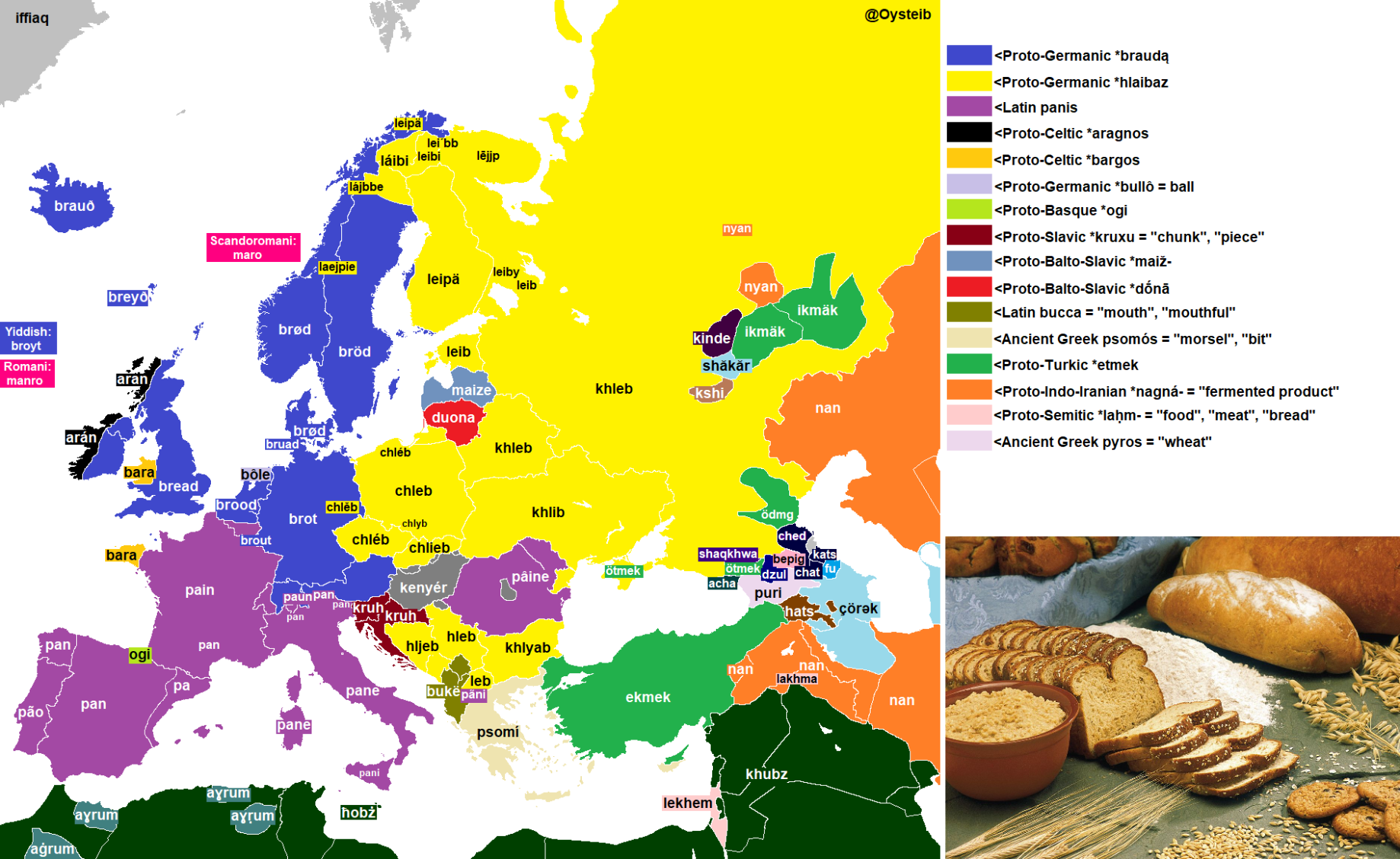
The word for bread in various languages.
Proto-Germanic seems to have had two words for bread, one becoming the present Germanic blue words, the other borrowed into Uralic and Slavic languages and becoming the yellow ones.
One theory is that *braudą was the word for bread with yeast. It is related to the verb "to brew [beer]".
The yellow word survives in English "loaf" and Norwegian "leiv" (piece of bread) and "loff".
Not a bot; a rather corpulent male approaching fifty years of age; married; father; a very very slow reader; barely reaching up to the level of mediocrity; an ignoramus who reads occasionally.
Toots are humanities, sciences, books and maps related. Toots or follows or boosts or mentions ≠ endorsements of any particular notion or notions. Expect many typing errors.
Addendum: for those wondering, I do not physically resemble a fountain pen.
Joined Nov 2022
