

Bibliolater 📚📜🖋📐 @bibliolater@social.cleverlibre.org
Not a bot; a rather corpulent male approaching fifty years of age; married; father; a very very slow reader; barely reaching up to the level of mediocrity; an ignoramus who reads occasionally.
Toots are humanities, sciences, books and maps related. Toots or follows or boosts or mentions ≠ endorsements of any particular notion or notions. Expect many typing errors.
Addendum: for those wondering, I do not physically resemble a fountain pen.
Joined Nov 2022
Bibliolater 📚📜🖋📐
boosted

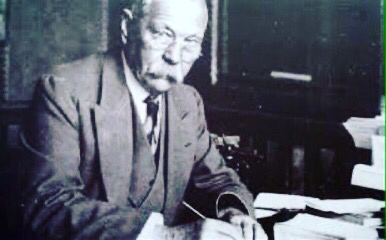
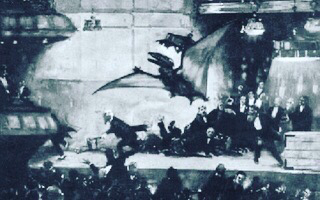
#FossilFriday Sir Arthur Conan Doyle, author of Sherlock Holmes & The Lost World, died #OTD in 1930. In 1994, Arthurdactylus a genus of pterodactyloid pterosaur from the Lower Cretaceous of Brazil was named in his honor.
https://paleonerdish.wordpress.com/2013/06/24/sir-arthur-conan-doyle-and-the-pterosaurs/
Bibliolater 📚📜🖋📐
boosted
Exploring mathematical conjecturing with large language models. ~ Moa Johansson, Nicholas Smallbone. https://www.cs.ox.ac.uk/isg/conferences/tmp-proceedings/NeSy2023/paper5.pdf #LLM #GPT #Math #IsabelleHOL
Bibliolater 📚📜🖋📐
boosted

"Fake online users make up as much as 40 percent of all web traffic."
And that was BEFORE the so called "#AIRevolution".
Bibliolater 📚📜🖋📐
boosted

New post: History of Cartography Project’s Fourth Volume Now Available Online https://www.maproomblog.com/2023/07/history-of-cartography-projects-fourth-volume-now-available-online/
Bibliolater 📚📜🖋📐
boosted

Bibliolater 📚📜🖋📐
boosted

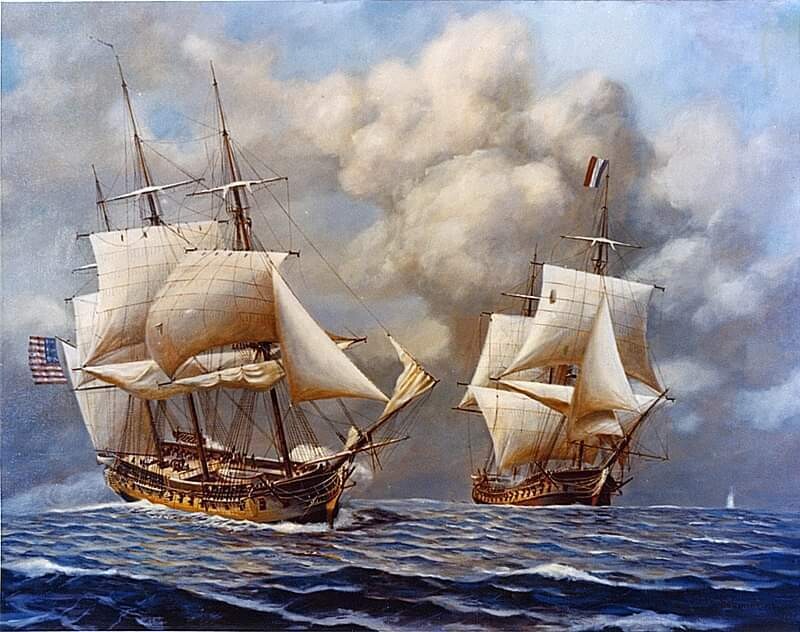
#OTD 7 July 1798 As a result of the XYZ Affair, the US Congress rescinds the Treaty of Alliance with France sparking the "Quasi-War".
Tanasi, D. (2020). Sicily Before the Greeks. The Interaction with Aegean and the Levant in the Pre-colonial Era. Open Archaeology, 6(1), 172-205. https://doi.org/10.1515/opar-2020-0107 #openaccess #oa #history #archaeology #sicily #bronzeage #aegean #cyprus #trade #europe #mediterranean #histodon #histodons #archaedons @histodon @histodons @archaeodons
(Eds.). (23 Apr. 2020). The Land of the English Kin. Leiden, The Netherlands: Brill. doi: https://doi.org/10.1163/9789004421899 #openaccess #oa #book #books #bookstodon #history #histodon #histodons #england #medieval #medievodons @medievodons @histodon @histodons @bookstodon
Bibliolater 📚📜🖋📐
boosted
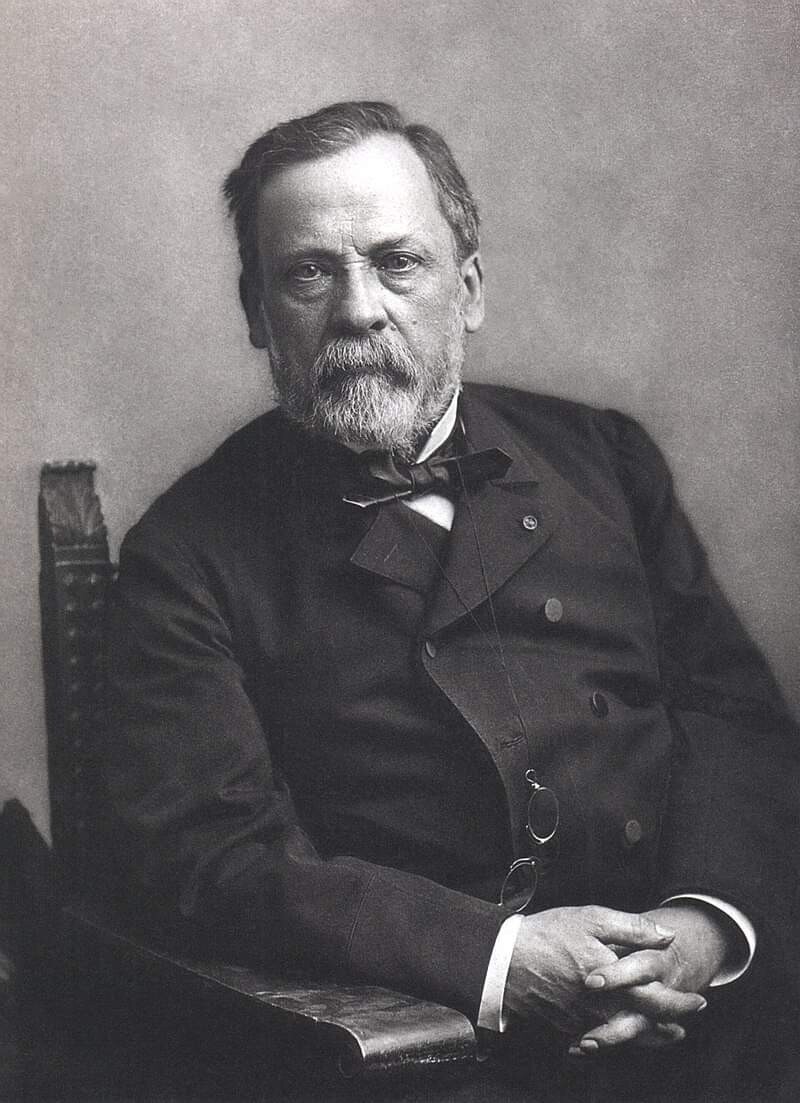
#OTD 6 July 1885 Louis Pasteur successfully tests his vaccine against rabies on Joseph Meister, a boy who was bitten by a rabid dog.
Bibliolater 📚📜🖋📐
boosted

@mcnees The Principia Mathematica was published on 5 July 1687 is not strictly true
https://thonyc.wordpress.com/2014/07/05/published-on/
Bibliolater 📚📜🖋📐
boosted


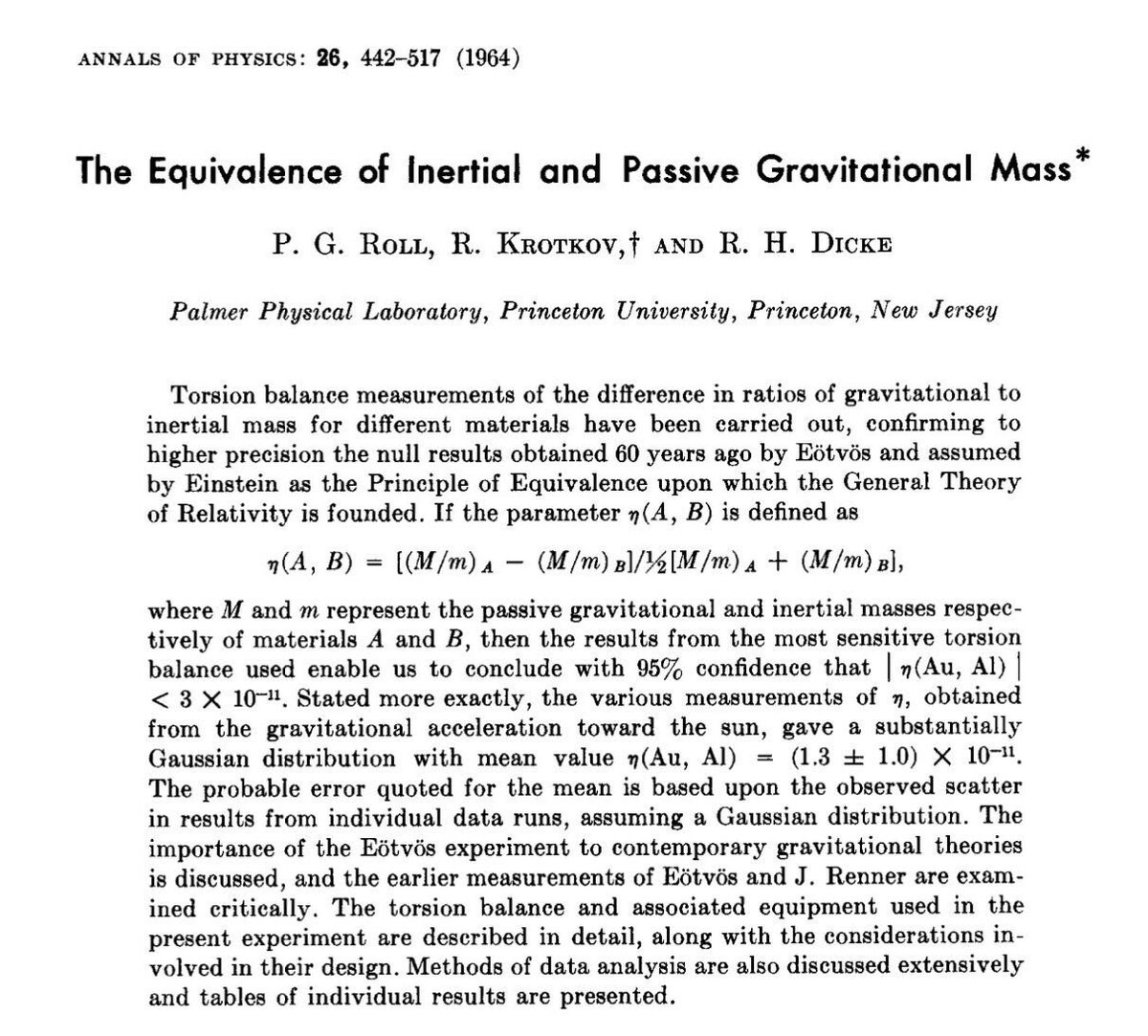
Eötvös showed that the ratio m_g / m_i differed from 1 by no more than a part in 10⁹. This phenomenal agreement between the two quantities begged an explanation, and indeed it is central to one form of the Equivalence Principle that helped Einstein formulate general relativity.
In the 1960s, Robert Dicke and his colleagues at Princeton would push the equality of inertial and gravitational mass to one part in 10¹¹.
https://www.sciencedirect.com/science/article/abs/pii/0003491664902593
Bibliolater 📚📜🖋📐
boosted
I am delighted by the fact that, more than 300 years after it puzzled Newton, the equality of inertial and gravitational mass tells us that we are probably missing something deep about general relativity and/or quantum mechanics.
Bibliolater 📚📜🖋📐
boosted
This and more recent tests are so precise that they constrain the gravitational properties of *quantum mechanical* contributions to the mass of a nucleus.
An unavoidable consequence is what we call the cosmological constant problem. Quantum mechanical effects in empty spacetime should gravitate! If they didn’t, this would show up as measurable deviations in m_g/m_I for different nuclei.
Bibliolater 📚📜🖋📐
boosted
An important note!
The “publication date” of July 5, 1687 is a convenient starting point for a discussion of Principia. But as @rmathematicus explains in this blog post, it is not a publication date in the sense commonly understood today.
Rather than spoil the punchline, I encourage you to read the post:
Bibliolater 📚📜🖋📐
boosted
As far as Newton could tell, the ratio m_g / m_i did not vary with composition. He concluded that the same mass appears in both his laws of motion and his universal law of gravitation.
Of course, this was not a very precise test! Later generations of scientists would scrutinize Newton's claim with increasing precision, most notably Baron Loránd Eötvös in a series of brilliant experiments that began in 1885.
Bibliolater 📚📜🖋📐
boosted
He tested it using pendulums. The period of a simple pendulum – the amount of time it takes to swing back and forth – depends only on its length and the acceleration due to gravity of the mass attached to the end.
If the inertial and gravitational properties of masses depend on their composition, this should show up in the periods of pendulums with identical lengths and masses made of different materials.
Bibliolater 📚📜🖋📐
boosted
Newton appreciated that this should not be taken for granted. He imagined an object might have an "inertial mass" m_i for his laws of motion, and a "gravitational mass" m_g for his law of gravity, and they may not be the same for objects of different composition.
If that were the case, different objects would accelerate at different rates, proportional to their ratio m_g / m_i. Newton knew, based on the work of Galileo and Huygens, that this ratio must be very nearly equal to 1.
Bibliolater 📚📜🖋📐
boosted
Now, Newton's 3rd law of motion says that if object A exerts a force on object B, then B exerts the same amount of force on A, but in the opposite direction. It follows that the gravitational force Earth exerts on an apple must also be proportional to the mass of the Earth.
The dependence on mass is a bit weird. In Newton's laws of motion, mass quantifies how an object resists changes to its motion. But in his law of universal gravitation it controls how much an object participates in gravity!
Bibliolater 📚📜🖋📐
boosted
If gravity causes two objects with different masses to accelerate at the same rate, it follows that the gravitational force each one experiences must be proportional to its mass.
So Earth exhibits a larger gravitational force on a cannonball than on, say, an apple. But it is also more difficult to change a cannonball's motion. Drop them both and, in the absence of air resistance, they accelerate downward at the same rate.
Not a bot; a rather corpulent male approaching fifty years of age; married; father; a very very slow reader; barely reaching up to the level of mediocrity; an ignoramus who reads occasionally.
Toots are humanities, sciences, books and maps related. Toots or follows or boosts or mentions ≠ endorsements of any particular notion or notions. Expect many typing errors.
Addendum: for those wondering, I do not physically resemble a fountain pen.
Joined Nov 2022
