

Bibliolater 📚📜🖋📐 @bibliolater@social.cleverlibre.org
Not a bot; a rather corpulent male approaching fifty years of age; married; father; a very very slow reader; barely reaching up to the level of mediocrity; an ignoramus who reads occasionally.
Toots are humanities, sciences, books and maps related. Toots or follows or boosts or mentions ≠ endorsements of any particular notion or notions. Expect many typing errors.
Addendum: for those wondering, I do not physically resemble a fountain pen.
Joined Nov 2022
"Our approach consists of a pipeline with two components: a sign detector and a wedge detector. The sign detector uses a RepPoints model with a ResNet18 backbone to locate individual cuneiform characters in the tablet segment image. The signs are then cropped based on the sign locations and fed into the wedge detector. The wedge detector is based on the idea of Point RCNN approach. It uses a Feature Pyramid Network (FPN) and RoI Align to predict the positions and classes of the wedges. The method is evaluated using different hyperparameters, and post-processing techniques such as Non-Maximum Suppression (NMS) are applied for refinement."
Stötzner E., Homburg T., Bullenkamp J.P. & Mara H. R-CNN based Polygonal Wedge Detection Learned from Annotated 3D Renderings and Mapped Photographs of Open Data Cuneiform Tablets. GCH 2023 - Eurographics Workshop on Graphics and Cultural Heritage. doi: http://dx.doi.org/10.2312/gch.20231157 #Research #Science #AI #ArtificialIntelligence #Archaeology #Cuneiform #ComputerScience #Modeling @science @archaeodons
Bibliolater 📚📜🖋📐
boosted

The main enemy of the Hanseatic League was the Danish King Valdemar, who had been expanding his power over several years. Particularly threatening to the Hanseatic League was Valdemar's conquest of Gotland, with the Hanseatic city of Visby.
Norway was at this time an ally of Denmark.
In older Nordic history, detailed sources can be hard to come by. To a Norwegian historian (like me) the level of detail of the Hanseatic sources is mindblowing.
Bibliolater 📚📜🖋📐
boosted
#onthisday in 1367, a bunch of cities of the newly formed Hanseatic League, plus some more in Holland and Zeeland, formed an alliance to go to war against King Haakon VI of Norway and King Valdemar of Denmark. In the truce agreement with the King of Norway from 1370, 35 cities are named - the ones on this map. (Present day boundaries and Dutch coastline.) The Hanseatic victory in this war is often considered the height of the power of the Hanseatic League.
#histodons
1/*
🇲🇳 " We observed that our studied Mongolians were structured into three distinct genetic clusters possessing different genetic affinity with previous studied Inner Mongolians and Mongols and various Eastern and Western Eurasian ancestries: two subgroups harbored dominant Eastern Eurasian ancestry from Neolithic millet farmers of Yellow River Basin; another subgroup derived Eastern Eurasian ancestry primarily from Neolithic hunter-gatherers of North Asia."
Yang X, Sarengaowa, He G, Guo J, Zhu K, Ma H, Zhao J, Yang M, Chen J, Zhang X, Tao L, Liu Y, Zhang X-F and Wang C-C (2021) Genomic Insights Into the Genetic Structure and Natural Selection of Mongolians. Front. Genet. 12:735786. doi: https://doi.org/10.3389/fgene.2021.735786 #OpenAccess #OA #Science #Research #Mongolia #Mongolian #Genetics #Anthropology #Population #Asia #STEM #Academia #Academic #Academics @science @anthropology
"The Arctic is warming at almost 4 times the global average rate. Here we reframe this amplified Arctic warming in terms of global climate ambition to show that without Arctic amplification, the world would breach the Paris Agreement's 1.5 and 2 ∘C limits 5 and 8 years later, respectively."
Duffey, A., Mallett, R., Irvine, P. J., Tsamados, M., and Stroeve, J.: ESD Ideas: Arctic amplification's contribution to breaches of the Paris Agreement, Earth Syst. Dynam., 14, 1165–1169, https://doi.org/10.5194/esd-14-1165-2023, 2023. #Research #Paper #Climate #ClimateChange #Science #Arctic #Polar #ClimateCrisis @science
"Since life is itself simply a game in disguise, having a few mathematical tricks up your sleeve can also give you an edge in the game of life. Let me share with you some of my mathematical hacks for tackling some of life’s challenges and coming out on top."
https://www.theguardian.com/science/2023/nov/05/how-maths-can-help-you-win-at-everything #Maths #Math #Mathematics
Bibliolater 📚📜🖋📐
boosted

Hello! #introductions
I'm a #ComputationalBiologist (1st #biochemist, then #ComputerScientist). I'm faculty at UConn Health. I'm interested in many scientific areas such as #SystemsBiology, #ComputationalModeling and #Simulation, #IronMetabolism, #NonlinearDynamics, #SoftwareDevelopment. I'm one of the authors of the @copasi simulation software and its predecessor Gepasi (thus my handle). I care about #OpenAccess & #OpenSource. I am also interested in #photography, #Linux, and #EVs.
"The industrialisation and commercialisation of food have transformed our diets, whereby most of our calories now come from an entirely novel set of substances. Ultra Processed Food (UPF) now makes up 60% of the average diet in the UK and USA. It is highly processed, highly addictive, and largely unhealthy." https://youtu.be/5QOTBreQaIk #Youtube #Video #Science #Food #Diet #Health @science
Bibliolater 📚📜🖋📐
boosted

@bibliolater AFAIK, all bookstores can order every title that is currently in press. Foreign books can be trickier.
(If that doesn’t work, antiquarian/second-hand bookshops are the only option anyway, and those books will have traces of their previous owners.)
Bibliolater 📚📜🖋📐
boosted
@bibliolater Suggestion: Buy local, carry the books home in your own hands, then only one person is responsible for damages (plus it supports local businesses and is generally better for the environment)
Recently, I brought a #book from an online seller. I had to the return it due to the low level damage that it had suffered in transit. This is not the first time that this has happend. I have noticed a marked deterioration in the quality of packaging used to transport #books bought online. Before envelopes were used that had bubbled wrapping inside and gave some sort of protection. Now one has to be thankful if paying 'top dollar' for a brand new #book and it arrives without any minor scrapes especially if it is just stuck in a standard cardboard envelope.
Bibliolater 📚📜🖋📐
boosted

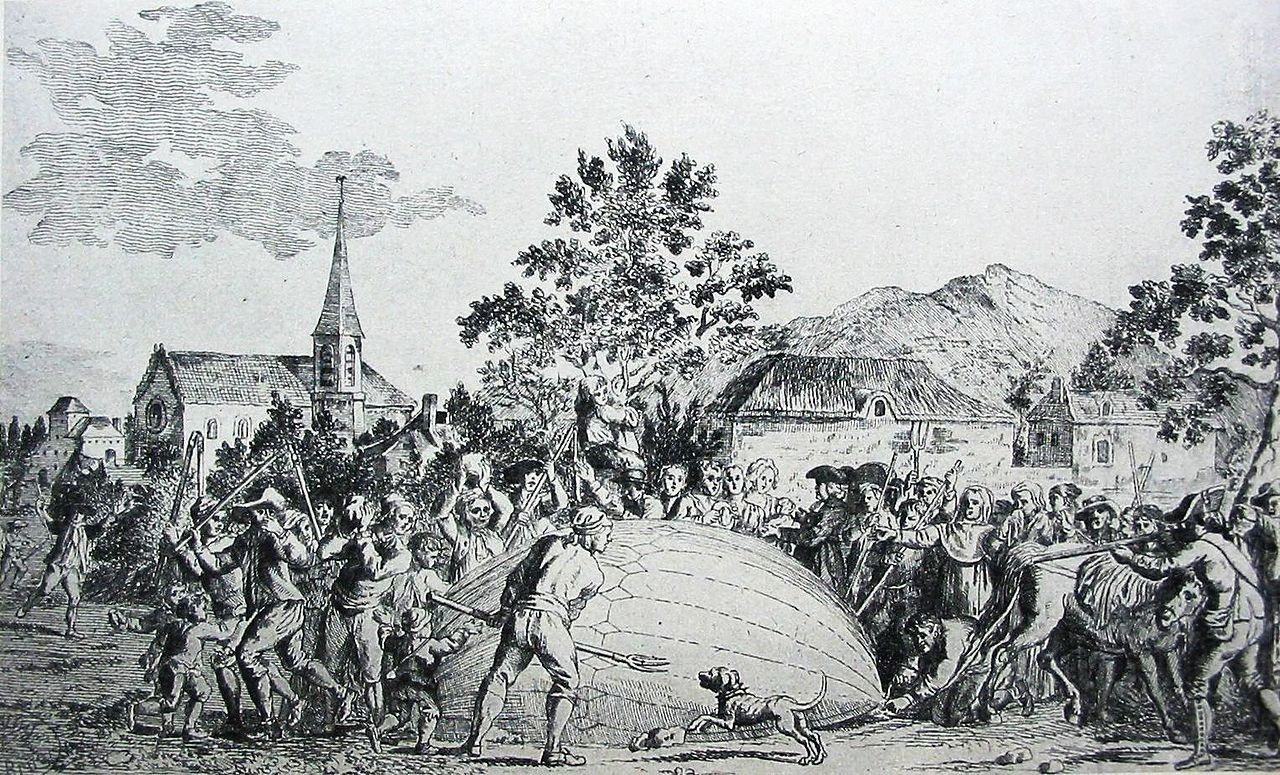
French mathematician, physicist, and inventor Jacques Charles was born #OTD in 1746.
Charles and the Robert brothers launched the world's first hydrogen-filled gas balloon in August 1783; then in December 1783, Charles & his co-pilot Nicolas-Louis Robert ascended to a height of about 1,800 feet (550 m) in a piloted gas balloon. Their pioneering use of hydrogen for lift led to this type of gas balloon being named a Charlière (as opposed to the hot-air Montgolfière). via @wikipedia
Bibliolater 📚📜🖋📐
boosted

Human Empire: Mobility & Demographic Thought in the British Atlantic World 1500–1800- "a major point of the book is the importance of marginal groups– the displaced, impoverished, criminalized & colonized –to formation of ideas about what populations were"
Bibliolater 📚📜🖋📐
boosted

@mhedney @bibliolater Exactly that map, but differently coloured, is the first map in my facsimile copy and the introduction by William Ravenhill says it should be there! It has the index to the atlas in the upper left corner
Bibliolater 📚📜🖋📐
boosted


@rmathematicus @bibliolater well, no. It’s a we
All map compiled from the maps in Saxton’s 1579 atlas, but the map itself not in the atlas … unless it’s the one-sheet, then all bets are off
MAIOCCHI, M. (2019). WRITING IN EARLY MESOPOTAMIA: The Historical Interplay of Technology, Cognition, and Environment. In A. C. LOVE & W. C. WIMSATT (Eds.), Beyond the Meme: Development and Structure in Cultural Evolution (pp. 395–424). University of Minnesota Press. https://doi.org/10.5749/j.ctvnp0krm.13 #OpenAccess #OA #Writing #Mesopotamia #Culture #History #Technology #Cognition #Environment #Academia #Academic #Academics
Bibliolater 📚📜🖋📐
boosted
@bibliolater @mhedney The hand drawn is wrong but the description states that the map is taken from Saxton’s atlas
Bibliolater 📚📜🖋📐
boosted
@mhedney @bibliolater @histodon @histodons
If I’d seen it first I would have been that guy 🙃
Bibliolater 📚📜🖋📐
boosted
@bibliolater @histodon @histodons -- sorry to be that guy, but this is a printed map, with hand-applied water color.
Not a bot; a rather corpulent male approaching fifty years of age; married; father; a very very slow reader; barely reaching up to the level of mediocrity; an ignoramus who reads occasionally.
Toots are humanities, sciences, books and maps related. Toots or follows or boosts or mentions ≠ endorsements of any particular notion or notions. Expect many typing errors.
Addendum: for those wondering, I do not physically resemble a fountain pen.
Joined Nov 2022
