

🎓 Dr. Freemo  🇳🇱
@freemo@social.cleverlibre.org
- UFoI Member
- http://UFoI.org/u/freemo/
- Website
- http://JeffreyFreeman.me
- Gitlab
- https://git.qoto.org/freemo
Admin
Jeffrey Phillips Freeman
Innovator & Entrepreneur in Machine Learning, Evolutionary Computing & Big Data. Avid SCUBA diver, Open-source developer, HAM radio operator, astrophotographer, and anything nerdy.
Born and raised in Philadelphia, PA, USA, currently living in Utrecht, Netherlands, USA, and Thailand. Was also living in Israel, but left.
Pronouns: Sir / Mister
(Above pronouns are not intended to mock, i will respect any persons pronouns and only wish pronouns to show respect be used with me as well. These are called neopronouns, see an example of the word "frog" used as a neopronoun here: http://tinyurl.com/44hhej89 )
A proud member of the Penobscot Native American tribe, as well as a Mayflower passenger descendant. I sometimes post about my genealogical history.
My stance on various issues:
Education: Free to PhD, tax paid
Abortion: Protected, tax paid, limited time-frame
Welfare: Yes, no one should starve
UBI: No, use welfare
Racism: is real
Guns: Shall not be infringed
LGBT+/minorities: Support
Pronouns: Will respect
Trump: Moron, evil
Biden: Senile, racist
Police: ACAB
Drugs: Fully legal, no prescriptions needed
GPG/PGP Fingerprint: 8B23 64CD 2403 6DCB 7531 01D0 052D DA8E 0506 CBCE
Joined Jul 2018
@klossykodekamp Happy to :) Glad you are enjoying it.
@khird Also keep in mind the canadian dollar being a petrodollar is only loosely connected. the stock market isnt showing the CAD value directly it is showing the stock market.
If the candian dollar crashed due to petrol but everything else remained the same then the stock market index wouldnt go down as it is displayed in canadian dollars, even though its effective value has went down. So it is somewhat a moot point since we did not normalize the stock market to the candian dollars value.
@khird Yes there is some truth to that, lockdowns hurt not just local economies but global ones as well.. But the point still stands lockdowns result in pretty big hits to economies.
@khird We see the same pattern across europe as well with a 6% yearly drop in stocks too.
Also the air travel, as you mentioned, is entirely connected with the lockdown. There is a much more dramatic reduction in air travel in large part due to the lockdown (travel restrictions).
Thats a very different argument. How and if we help those who are financially speaking a burden to society is a very important discussion but it is different from if we are talking about economic growth of society as a whole.
You could argue, and I'd agree, we could and should do more to help those in poverty, but doesnt really change the fact that for all those who have sockets (lower middle class and above) they are seeing pretty good results.
@bryanreynolds My claim was not "measure to measure virus activity".. What we are trying to measure is if a policy change from strict lockdown to early and quick locking up is an effective policy change (what USA did).. vs if the canadian policy of implementing strict lock down over a longer period with an extremely gradual reopening is more effective.
For that, as you should know as a data-scientist, means you employ causality tests like the granger causality test. For that you would not compare the numbers in the way you did instead you would compare the rate of change in the virus following the change in policy, which is what I did.
@rbe_expert No not at all, smallpox has none of the attributes I just described. With smallpox if you get infected even with a reduced immune response you still gain lifetime immunity in most cases, which is exactly the type of virus a vaccine is well suited for, and totally different than the nature of corona class viruses.
@rbe_expert Urgency cant circumvent basic biology. A vaccine will always produce a weaker immune response than the actual disease, that is the whole point. No getting around that.
@bryanreynolds Thats not how you properly analyze statistics. For one you cant look at numbers, they must be "normalized" (adjusted according to the base rate) to be meaningful.. Second, since we are looking at the effectiveness of a policy change (ending lockdown quickly) you would the valid and accurate measurement would be the percentage rate of change of infected cases, not the absolute numbers. It is the only way you can show actual causality against a policy change as well as adjust for the population size and other factors.
I am not saying the US is doing better "purely because of the value of the stock market".. I am stating they are doing better because since lockdown was let up there was a 50% decrease in the rate of infection while Canada had a 700% increase in rate of infection after letting up lockdown. The stock market is simply an added bonus on top of that.
@rbe_expert you are assuming a vaccine can and will be developed. But every indication is that is unlikely.. for starters we have been trying to create vaccines for corona virus class viruses for many decades now and have never created a successful long-lasting vaccine for a single corona-class virus in the 30+ years we have tried.
Second the nature of this virus suggests even if we do create a vaccine it iis likely to not be very effective. We have seen this virus has exceptionally short immunity time when you have a weak immune response with asymptomatic carriers being able to be reinfected on an order of weeks. It is only with massive immune responses (people sick enough to be in the hospital) do we see any appreciable immunity which current numbers suggest would be on the order of only a year.
Since vaccines by their nature tend to create weak immune responses, and especially given our failure to produce particularly effective vaccines in the past on this class of virus anyway, in all liklihood we will not see a vaccine that will be of any substantial benefit here.
@seb You too, thanks for the conversation.
@seb As I pointed out earlier there is generally very strong correlation between stock market indexes and all the other indicators of economic growth, for example GNP.
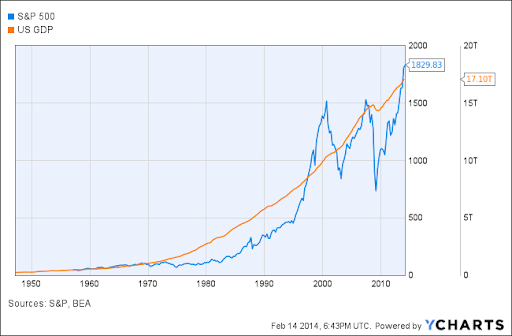
@seb No thats not how data analysis works. You do not count the number of people That would be a dishonest and inaccurate representation. It is what we would call non-normalized data in the trade (remember this is what I do for a living).
As for looking at it against the population percentage, again, thats not an honest way to present the data either when we talk about cause and effect tests (things like the Granger Causality test). since we are trying to measure the causality between a change in policy (ending lockdown quickly) and its effect on the infection rate then the honest and accurate way to look at that is the rate of change of infection rate. It is the only way to make a case that suggests causality rather than simple correlation. Read up on the Granger Causality test to understand this idea a bit more if you'd like.
@seb Teh dates werent picked arbitrarily, they were picked very specifically in relationship to each countries re-opening schedule from about 2 month after reopening as the starting point in each case, which based on the R0 number for this virus is when it should peek outside of a lockdown.
The USA had the majority of its states reopen between may1st to may 30th, therefore mid July was selected. Canada's reopening was much more gradual however starting at the earliest in mid april with minimal openings, but not really reaching the level of reopening of the USA until much letter. So the trend for canada was picked 2 months after the reopenings began, and indeed we see the increases are more gradual at first since the reopening was slower, but ultimately cases just continued to increase.
So no, the dates were not picked arbitrarily but rather very specific for the case being made here.
@seb The numbers don't lie, Canada has had a 700% increase in COVID infections since June/July and the USA has had a 50% reduction in the same time period. Can't argue with numbers like this IMO.
I've already explained why infection rate is the valid number to observe if we talk about how well we handle the spread of this virus, death rate is related to entirely different factors, namely the health of americans whom have twice the comorbidities of any other country and with much more severe cases of both obesity and diabetes for the most part. that is largely unrelated to how we have handled the spread of COVID, so is not a meaningful number to quote where infection rate is.
@rbe_expert No your analogy is completely naive to the points of the argument, it isnt like that at all.
The point made here is exactly that lockdowns **do not** reduce the spread overall spread, it will only **delay** the spread. That is the key.
Its easy to understand why that is if you imagine an ideal lockdown where there is absolutely no spread of the virus locally, but where the virus remains in the wild. All that would do is put things on pause, you'd have no cases of any kind but eventually lockdown gets lifted. When it does you are right back at square one, the lock down had no benefit as now you have the whole population in the wild, no immunity, and the vir5us spreads exactly as it would when it was first introduced if no lock down were instituted. So it would effectively do nothing to reduce the spread of the virus in the long term.
If you consider partial (imperfect) lockdowns the scenario is the same except instead of completely pausing the spread it only temporarily slows it down and once the lockdown is lifted it goes back to spreading at its normal pace again and the overall numbers infected long-term would be the same as if the virus had never spread.
Now in the above scenario the total number infected would be the same long-term in both a full lockdown, partial lockdown, or no lockdown, if we were talking about a virus like measles where once you get it you are immune for life, because with such a virus you can develop a perfect herd immunity once a certain level of spread is reached, thus you an upper level which is always a constant for long-term end results.
However in this case we do not have the normal immunity properties we expect with measles, instead we have the same immunity properties we have with all other coronavirus-class viruses (for example the common cold is about 50% of the time a type of coronavirus). What we see is that when someone has a very mild case, particularly asymptomatic, then their immunity lasts only on the order of weeks. In a severe case the immunity appears to be in the ballpark of a year max, just like we see with types of coronavirus.
This changes the dynamics of herd immunity significantly. Consider the simple case where everyone had a severe infection (just to make the mental exercise easier to understand). Also lets pick a random number of 70% population immunity could theoretically cause herd immunity. If 70% of the population got infected overnight we would have herd immunity for a year and no new infections would be seen for a year after that. However if you slowed down the infection so that you stopped all new cases for a whole year and locked down everyone, then when they were released there would be no herd immunity, you'd see the same overnight spike, and you just wasted a year of your life in lockdown with no benefits, in the end the people still got infected.
So in the end the lockdowns dont help. There is in fact only one argument for the lock down, if your hospitals go over 100% capacity then a partial lock down makes sense to slow the virus just enough to get capacity below 100%. But in such a case you want a minimal lockdown such that it is just barely enough to get the numbers under 100% but no more than that. The USA hospitals on average have maintained a margin under 100% so this has not been an issue.
@mpjgregoire@mamot.fr No thats incorrect and not what I am saying.
What I am saying is the reason the USA has had significantly declining COVID **infection** rate since June/July compared to Canada and Europes significantly increasing **infection** rate is because europe and canada had much stricter and longer lockdowns.
The **death rate** is a seperate matter and how infection rates translate to death rate is mostly unrelated to the lockdown. the Factors that effect that are largely obesity and diabeties in the population which is the top comorbidity of COVID-19 and something america has at at least twice the rate of Canada and Europe.
So you have two factors at play, america is ahead of the game in terms of infection rate, but this still translates to more deaths per infection due to unrelated factors.
As for the lockdown comparison the United states was one of the earliest to lift the strictest aspects of the lockdown (where people were required to stay indoors except for essential business), in fact it is one of the biggest criticisms against him.
@Quansv This feels like it might be self promotion and/or spam.. Bear in mind if all your posts are limited to or strongly focus on promoting this one channel (which seems to promote products) your account will be suspended.
- UFoI Member
- http://UFoI.org/u/freemo/
- Website
- http://JeffreyFreeman.me
- Gitlab
- https://git.qoto.org/freemo
Admin
Jeffrey Phillips Freeman
Innovator & Entrepreneur in Machine Learning, Evolutionary Computing & Big Data. Avid SCUBA diver, Open-source developer, HAM radio operator, astrophotographer, and anything nerdy.
Born and raised in Philadelphia, PA, USA, currently living in Utrecht, Netherlands, USA, and Thailand. Was also living in Israel, but left.
Pronouns: Sir / Mister
(Above pronouns are not intended to mock, i will respect any persons pronouns and only wish pronouns to show respect be used with me as well. These are called neopronouns, see an example of the word "frog" used as a neopronoun here: http://tinyurl.com/44hhej89 )
A proud member of the Penobscot Native American tribe, as well as a Mayflower passenger descendant. I sometimes post about my genealogical history.
My stance on various issues:
Education: Free to PhD, tax paid
Abortion: Protected, tax paid, limited time-frame
Welfare: Yes, no one should starve
UBI: No, use welfare
Racism: is real
Guns: Shall not be infringed
LGBT+/minorities: Support
Pronouns: Will respect
Trump: Moron, evil
Biden: Senile, racist
Police: ACAB
Drugs: Fully legal, no prescriptions needed
GPG/PGP Fingerprint: 8B23 64CD 2403 6DCB 7531 01D0 052D DA8E 0506 CBCE
Joined Jul 2018
