

🎓 Dr. Freemo  🇳🇱
@freemo@social.cleverlibre.org
- UFoI Member
- http://UFoI.org/u/freemo/
- Website
- http://JeffreyFreeman.me
- Gitlab
- https://git.qoto.org/freemo
Admin
Jeffrey Phillips Freeman
Innovator & Entrepreneur in Machine Learning, Evolutionary Computing & Big Data. Avid SCUBA diver, Open-source developer, HAM radio operator, astrophotographer, and anything nerdy.
Born and raised in Philadelphia, PA, USA, currently living in Utrecht, Netherlands, USA, and Thailand. Was also living in Israel, but left.
Pronouns: Sir / Mister
(Above pronouns are not intended to mock, i will respect any persons pronouns and only wish pronouns to show respect be used with me as well. These are called neopronouns, see an example of the word "frog" used as a neopronoun here: http://tinyurl.com/44hhej89 )
A proud member of the Penobscot Native American tribe, as well as a Mayflower passenger descendant. I sometimes post about my genealogical history.
My stance on various issues:
Education: Free to PhD, tax paid
Abortion: Protected, tax paid, limited time-frame
Welfare: Yes, no one should starve
UBI: No, use welfare
Racism: is real
Guns: Shall not be infringed
LGBT+/minorities: Support
Pronouns: Will respect
Trump: Moron, evil
Biden: Senile, racist
Police: ACAB
Drugs: Fully legal, no prescriptions needed
GPG/PGP Fingerprint: 8B23 64CD 2403 6DCB 7531 01D0 052D DA8E 0506 CBCE
Joined Jul 2018
No wrong again. The money supply actually **decreased** from 1920 to 1921 significantly from 7.3 billion to less than 6 billion. This was a direct result of the debt I had already mentioned.
they did try to respond to that by increasing the money supply back to nominal levels but because it was backed by gold that had to be locked away and couldnt be spent, and because the government was already in debt this is exactly what I said earlier where it caused extreme debt and economic stress in an attempt to do this due to the gold standard. As a result the money supply did increase slightly from 1921 to 1925 but at great economic cost (huge spending with marginal effects on debt) that lead to the very crash I mentioned, all thanks to the gold standard. It should be noted that the expansion of money supply from 1922 to 1925 only increased the supply by about 0.8 billion leaving it at 6.8 billion which was still half a billion less than it was in 1920.
So your comment is not just flat out wrong but the exact opposite happened, the money supply decreased significantly and the government was desperately trying to keep it from doing so (and failing due to the gold standard).
Incorrect, history clearly records the timeline of events the month before black thursday (the day of the stock market crash and official start of the great depression).
The previous month before the crash the first move that sealed the fate of the great depression was in august when **banks** rose the discount rate in an attempt to defend the gold standard and make up for the shortage in physical fiat. Effectively a bailout for the already crashing banks.
It wasnt until a few weeks later when the actions of the banks bailout which failed did the stock market begin to crash with an 11% fall on black thursday which eventually led to margin calls.
There was no crisis on wall street until banks started failing, no one could cover their debts, and the margin call kicked in.
All of which was the direct result of the gold standard.
It is quite clear how and why the gold standard caused us to collapse under any appreciable debt. Its also clear why **not** having a gold standard meant that despite having more debt in 2008 than during the great depression the financial crisis that ensued wasnt even close to the levels of the great depression. So yes you might say the debt in 2008 played a factor then too but it is literal proof of why moving off the gold standard saved our asses despite that.
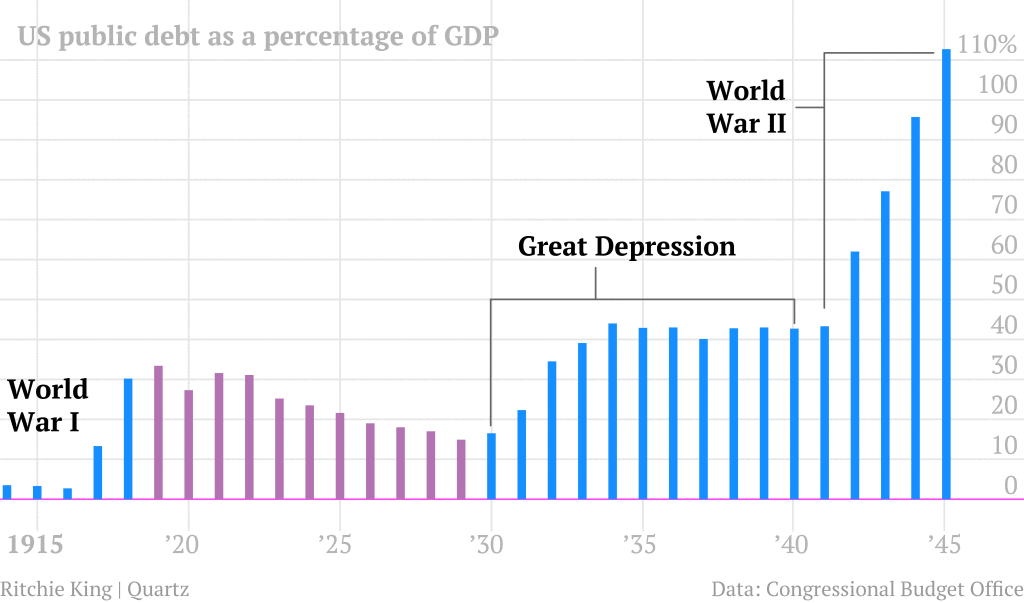
Yes WW1 ended about a decade earlier. You do realize that doesnt matter.. As I said our spending skyrocked to 3x our tax income in WW1 in an attempt to fix our debt, this lasted for a decade because, since we couldnt raise money through printing money, it was slow an ineffective. By 1929 a decade later we had not even reduced the debt we incurred in WW1 by 1/3 and the decade long spending depleted our gold reserves in the process.
See the attached chart showing how the debt incurred in WW1 was only 1/3 reduced by the time the great depression hit.
Funny, its almost like events in the past effect the present. Who woulda thunk.
Incorrect and completely ignorant of history.
What happened was due to WWI the governments spending was more than 3x over what its income due to taxes happened to be in an attempt to recover from the war effort. In addition our loans to foreign countries went into default since Britain and other countries couldnt pay us back. This put the US government in significant debt.
Because the supply of money was fixed to the supply of physical gold, and since the government was poor in government terms and in debt our supply of gold was particularly low at the time. As a result the number of physical fiat in existance was also at a all time low (they would have to destroy fiat if they wanted to spend gold).
Banks stay in business by loaning out money. The amount of money they can loan out is limited by what they have on hand, what they have on hand is limited by how much money is in existance. So most banks had far fewer physical bills in their vaults than usual even though the amount of their deposits remained the same. Plus the banks continued to loan out money to afford their rent, so there was very little cash.
As a result of this between the media reporting on the situation, and banks going out of business (at this point in low numbers) due to being unable to generate enough income off the small reserves it had people started to panic. They knew there wasnt enough money to go around and many people lost hteir life savings as a few banks already went bankrupt. People started to withdraw their money, convert it to gold, and began hoarding gold instead.
The hoarding of gold caused gold prices to go up, making it harder for the US govt to obtain new gold needed to print new dollars, combine this with the run on banks and now banks were going out of business left and right. Some people got their money, many went from rich to debt overnight.
As a result of the insolvency of many and the fact that brokers were loosing access to their own money resrves they did a mass margin call, no one could meet the margin and the stock market collapsed as well.
Now witht he banks and stock markets in full collapse the great depression is a reality..
In short, yes it was due to gold standard.
I mean, the gold standard was a huge factor that created the great depression, the worst depression in history. We literally moved off the gold-standard in part due to the depressions it caused.
While we have been off the gold standard for a long time, and thus have a good number of depressions under our belt. None of them have come close to being as bad as the great depression.
So would seem the data and history would disagree with you.
All the alternatives to fiat money seem to work out much much worse for various reasons. Unless you are using an unusual definition of fiat, or even just one different than my own.
🎓 Dr. Freemo 🇳🇱
boosted
🇳🇱
boosted

I've been on my first GNU/Linux distro for almost 3 months now. I picked Linux Mint (and I am okay with my choice, but I do think about how Manjaro as a first distro would be like), but now I have the need to switch to a different distribution, especially something rolling release.
I do not care about choosing every package that my system will have; I am fine with a little bit of software not being used on my system (This makes the incoming list preferred over Arch Linux). I care about an user distributed package manager (?) being there, such as AUR. I care about installs supporting a Window Manager such as i3. I care about my system not breaking due to an update on the OS (I have heard that this kind of stuff happens on Arch Linux, and that for this reason Manjaro filters the Arch Linux updates and gives a more stable experience (I also heard that they just delay the updates and call it stability).). So with these in mind, I have these distros and Arch Linux installers to choose from:
1- Manjaro
2- ArcoLinux
3- Garuda Linux
4- Endeavour OS
5- Anarchy Linux
I would highly appreciate any suggestion / discussion!
@melovida Well the issue with that is that the poorest people get paid through a price-fixing scheme (minimum wage) and thus there is a compounding factor there that will make the graphs harder to interprit.
Consider if a persons natural-wage (the wage they would get without minimum wage) is at 2$ an hour and inflation would raise it to 4$ an hour, if minimum wage was in place during that time at 5$ an hour then you would see their actual pay stay the same, which effectively is the same as lower pay in inflation adjusted dollars. So in order for it to work for the minimum wage population then the minimum wage would need to follow inflation, since it is manually determined this is rarely the case.
That said historically at least we have raised minimum wage enough to ensure that those on minimum wage either gained wealth and wages (along with the rest of society) in adjusted dollars, or at a minimum broke even (were no worse off than before). Attached you will find a chart showing the minimum wage as a inflation adjusted value. You will see from about 1940 to 1985 the inflation adjusted minimum wage actually mostly trended up (showing those at minimum wage were benefiting from inflation). However from 1985 to 2016 they then leveled of and bounced up and down by about a dollar, on average being no worse or better off.
So would seem from the data that at least with our current handling of the low-income sector they arent hurt by inflation either. However we could have managed the minimum wage a bit better so they benefited as much as the rest of society the past few decades, but at least they didnt loose out in that time.
@melovida Its not about coercion. Not matter what we do we are "coercing" people to do something. If we create systems that dont have healthy inflation then we are encouraging people to hoard and not invest, if we create a system with healthy inflation we are coercing them not to hoard and to invest.
The best proof we have is early economic systems that tried to fix the wealth/value behind a unit of fiat. These caused devestating poverty and economic depression which is largely why we moved away from it to the current model.
Yes and it does all those things, except it acts as a short term (order of years not decades) store of value (value should be wealth here).
Who said anything about sneaky monetary monkeyings. Inflation can occur completely naturally, no monkeying needed, no printing of money needed. It happens naturally when the wealth of a country increses and its monetary supply stays fixed as well. Printing money can accelerate it of course, but not needed.
No it doesnt assume all stocks are net interest.. any investment will do doesnt have to be stocks really.
People do not invest **in money** when it looses value.. They hold their wealth in other assets other than money to avoid their wealth loosing value.. I'm not sure why you cant get this really simple idea but I wont keep repeating it.
This conversation is over now.
We were talking about investments, not just putting money in a bank and sitting on it.. but yes you proved my point, deflation encourages hoarding of money in banks or under your bed in a sock or wherever. Inflation encourages investment of it in things that generate more wealth.
two reasons
1) Because it takes wealth out of an economy and causes it to be stagnant. It takes wealth to produce new wealth and investments are how that is done. Money being locked in a box is the exact opposite of that and thus harms the economy.
2) because it huts economy in the long run it will lead to people loosing wealth and induce greater proverty.
Again your not understanding basic terms. I said hoarding money is bad, I didnt say hoarding wealth is bad.. having your wealth in investments that grow, and thus create new wealth is a good thing.
You seem to really be struggling with the separation between wealth and money. This is like half a dozen times I had to correct you.
You clearly dont even understand the terms in the conversation... inflation != printing money.
- UFoI Member
- http://UFoI.org/u/freemo/
- Website
- http://JeffreyFreeman.me
- Gitlab
- https://git.qoto.org/freemo
Admin
Jeffrey Phillips Freeman
Innovator & Entrepreneur in Machine Learning, Evolutionary Computing & Big Data. Avid SCUBA diver, Open-source developer, HAM radio operator, astrophotographer, and anything nerdy.
Born and raised in Philadelphia, PA, USA, currently living in Utrecht, Netherlands, USA, and Thailand. Was also living in Israel, but left.
Pronouns: Sir / Mister
(Above pronouns are not intended to mock, i will respect any persons pronouns and only wish pronouns to show respect be used with me as well. These are called neopronouns, see an example of the word "frog" used as a neopronoun here: http://tinyurl.com/44hhej89 )
A proud member of the Penobscot Native American tribe, as well as a Mayflower passenger descendant. I sometimes post about my genealogical history.
My stance on various issues:
Education: Free to PhD, tax paid
Abortion: Protected, tax paid, limited time-frame
Welfare: Yes, no one should starve
UBI: No, use welfare
Racism: is real
Guns: Shall not be infringed
LGBT+/minorities: Support
Pronouns: Will respect
Trump: Moron, evil
Biden: Senile, racist
Police: ACAB
Drugs: Fully legal, no prescriptions needed
GPG/PGP Fingerprint: 8B23 64CD 2403 6DCB 7531 01D0 052D DA8E 0506 CBCE
Joined Jul 2018
