

🎓 Dr. Freemo  🇳🇱
@freemo@social.cleverlibre.org
- UFoI Member
- http://UFoI.org/u/freemo/
- Website
- http://JeffreyFreeman.me
- Gitlab
- https://git.qoto.org/freemo
Admin
Jeffrey Phillips Freeman
Innovator & Entrepreneur in Machine Learning, Evolutionary Computing & Big Data. Avid SCUBA diver, Open-source developer, HAM radio operator, astrophotographer, and anything nerdy.
Born and raised in Philadelphia, PA, USA, currently living in Utrecht, Netherlands, USA, and Thailand. Was also living in Israel, but left.
Pronouns: Sir / Mister
(Above pronouns are not intended to mock, i will respect any persons pronouns and only wish pronouns to show respect be used with me as well. These are called neopronouns, see an example of the word "frog" used as a neopronoun here: http://tinyurl.com/44hhej89 )
A proud member of the Penobscot Native American tribe, as well as a Mayflower passenger descendant. I sometimes post about my genealogical history.
My stance on various issues:
Education: Free to PhD, tax paid
Abortion: Protected, tax paid, limited time-frame
Welfare: Yes, no one should starve
UBI: No, use welfare
Racism: is real
Guns: Shall not be infringed
LGBT+/minorities: Support
Pronouns: Will respect
Trump: Moron, evil
Biden: Senile, racist
Police: ACAB
Drugs: Fully legal, no prescriptions needed
GPG/PGP Fingerprint: 8B23 64CD 2403 6DCB 7531 01D0 052D DA8E 0506 CBCE
Joined Jul 2018
@thor While i will get drunk on rare occasions, and have had a lot of fun when I have... in general I just dont like how alcohol makes me feel. Makes me feel sickly
The truth is, this is my field, I am an expert in it.. we can disagree on the conclusions of course, Im not saying you have to share my conclusion by any means.. but I can say it absolutely is in line with how granger tests work.
When i say you need enough data points it has nothing to do with the length of the timeline. The number of data points you care about is how many times the gun laws have changed. So for a single chart its only counting as a single data point.
And to your credit your questions are very valid. Nothing is proven from a single chart in isolation, of course. The problem is when you do this same analysis over many dozens of examples the results all turn out the same, which becomes very telling.
Unfortunately that sort of analysis is almost useless simply because you have no way of controlling a rather long list of unknown confounding factors. Its one reason why scientists avoid this very sort of analysis... well, if they are serious and objective anyway.
Then it seems you misunderstood the article.
To get a proper result from the granger test youd need to run it across a larger dataset of this nature for sure. But the images here would be individual examples in that regard of it passing the granger test.
No thats not how granger causality works. It doesnt need to be shown as seperate time series. But if you orefer to think kf it that way you can think of the tine series representing changes in gun laws being the other time series (which in this example is just overlayed onto one)
Of course its incomplete, this is social media afterall. It took me a life tine of study to become an expert on this subject, so that cant be conveyed in full over social media. But yes it does test for predictive causality. Which is a fancy way if sayibg does the existance of one event (gun law changes) predict another event (change in homicide). This is usually what we mean when we talk about causality.
It does indeed show the banning of broad classes of guns (handgubs). So id say its more than close enough
As long as they are comparing a state against itself both pre-law change and post, and they do that analysis correctly, then yes that would be fine science.
I think if your beating your wife or husband then you should go to jail. Sinc eit is a violent crime and if you served jail time then I would be fine with them having their gun rights revoked. More generally anyone who has went to jail for a violent crime probably should be denied a gun.
When forcing suicidal people to wait because you want to dictate what they can or cant do with their body and when.. at the expense of a woman not being able to protect herself against a rapist... Id lean towards letting the woman protect herself.
Let it be an opt-in thing.. everyone at the age of 18 must register witht he government if they want to be forced to wait for a gun or if they want the privilage not to.. Then if they want to be protected against possibly being suicidal they now have that protection. For those who dont want the "protection" of a wait then they wont have it.
Its probably less about embarassment and more about wanting to appeal to the masses.
thats just bad science.. To get accurate date you must monitor the same state before and after a law change.. comparing similar states results in us statisticians doing our best to guess at what "similar" even means and even if can define all the datapoints you the states will be far from identical and simply not the way we do this sort of science.. again, the only way you can truly show causation is with stuff like granger causality.
Its more so you misunderstood both the math and the case.. With granger causality you can not look at absolute numbers between different entities, thats not how it works. You need to look at how homicide rates chantge in the immediate time after a change in gun laws. If you looked only at homicide rates across countries you'd be doing "bad-science" as it isnt showing temporal causality.
#1 is something i reject as even being valid in the debate.I beleive absolutely on bodily autonomy to be a fundemental right. This is why I support the right to abortions by the same logic I support the right for people to commit suicide. If we want to prevent suicide the focus needs to be on access to proper health care (something poorly lacking).
#2 is of course concerning, and in the narrow case of talking about domestic abuse, yes there is some causality there. But for one its not representative of the full picture and also we would need to address how often is saves a life to offset this, either in general, or even in women protecting their own lives against an abuser.
Now we are getting into the weeds (in a good way).. I think its valid and important to discuss what, if any, we want to place limits on guns...
#1 I can support in principle, but in practice based on specific implementations I often oppose it more than support it... If a person is **charged** with a crime I think that crime should and can be used to judge if they can have a gun.. But to take a gun away from a person who has not commited a crime, that adds more problems than it solves and is particularly concerning slippery slope.
#2 This can be ok, but again needs to be nuanced. As long as you can ensure someone has quick access to the gun while still being able to secure it I would say this will work well. Obviously the laws need to provide restrictions that can allow for easy access.
#3 As long as those background checks are strictly limited to criminal records I can support this.
#4 This one is dangerous, one of the biggest reasons to allow guns is so women can protect themselves, its the great equalizer. If a rapist or stalker is thrteatening a woman a waiting period can cost her her life.
@rrb @protecttruth As an expert int he field I'd be happy to pick apart studies and go back and forth if thats what your after? There are quite a few rather fundemental problems with these studies, namely that they arent attempting in any way to show causation, only point out certain correlations. We do causation through the analysis of granger causality as a starting point which we arent seeing here.
For example take a simple study like your first one that seems to claim owning a gun wich *cause* you to be more likely to die in a violent death. Yet it doesnt address quite a few things:
1) it is just as likely people in high risk areas with violence tend to buy guns. Therefore it is not that having tyhe gun puts you at risk but rather being at risk tends to cause you to buy a gun.
2) It doesnt analyze the overall effect on society.. The underlying explanation for why guns reduce overall homicides is because the whole of society benefits, people are more reluctant to engaged in violence, even against unarmed people, when they dont know who or who is not armed in the first place.
3) As I stated no attempt was made to do causality analysis where one can use techniques like granger causality to suggest the cause-effect relationship
@protecttruth Thats like saying "fewer vaccines means fewer vaccine death", while technically true its also very poor logic. Sadly no, banning guns generally means more homicides overall.
Also who said anything about Canada. Sadly the body of the american data on this clearly disagrees with the assesment.
Here is an image of ther effects of one such gun ban within Jamaica.. sad to say this isnt na isolated pattern. If you really want to get into the nitty gritty I can show a dozen or two similar charts across many countries. The pattern is quite obvious sadly.
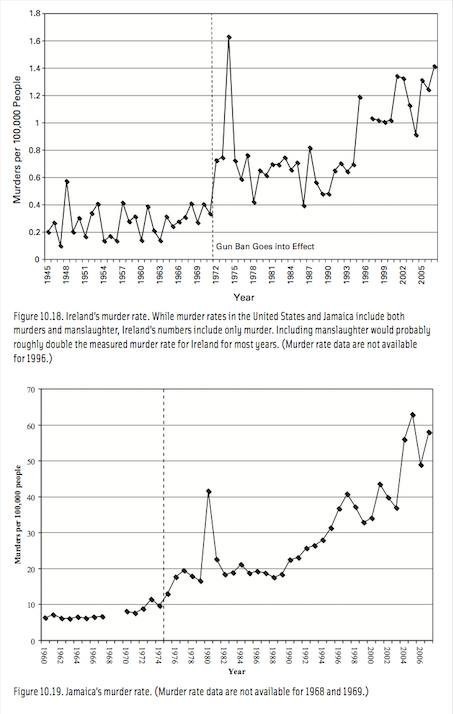
Quite a few I've read about and even did studies on myself.
You can find 4 images showing this across 4 countries as an example here: https://qoto.org/@freemo/103766692274567523
I can share many more examples if you'd like.. in fact the vast majority, with just a few exceptions of countries which banned guns show pretty much the same pattern.
- UFoI Member
- http://UFoI.org/u/freemo/
- Website
- http://JeffreyFreeman.me
- Gitlab
- https://git.qoto.org/freemo
Admin
Jeffrey Phillips Freeman
Innovator & Entrepreneur in Machine Learning, Evolutionary Computing & Big Data. Avid SCUBA diver, Open-source developer, HAM radio operator, astrophotographer, and anything nerdy.
Born and raised in Philadelphia, PA, USA, currently living in Utrecht, Netherlands, USA, and Thailand. Was also living in Israel, but left.
Pronouns: Sir / Mister
(Above pronouns are not intended to mock, i will respect any persons pronouns and only wish pronouns to show respect be used with me as well. These are called neopronouns, see an example of the word "frog" used as a neopronoun here: http://tinyurl.com/44hhej89 )
A proud member of the Penobscot Native American tribe, as well as a Mayflower passenger descendant. I sometimes post about my genealogical history.
My stance on various issues:
Education: Free to PhD, tax paid
Abortion: Protected, tax paid, limited time-frame
Welfare: Yes, no one should starve
UBI: No, use welfare
Racism: is real
Guns: Shall not be infringed
LGBT+/minorities: Support
Pronouns: Will respect
Trump: Moron, evil
Biden: Senile, racist
Police: ACAB
Drugs: Fully legal, no prescriptions needed
GPG/PGP Fingerprint: 8B23 64CD 2403 6DCB 7531 01D0 052D DA8E 0506 CBCE
Joined Jul 2018
