

Nick @internic@social.cleverlibre.org
- Pronouns
- he/him/his
Theoretical physicist by training (PhD in quantum open systems/quantum information), University lecturer for a bit, and currently paying the bills as an engineer working in optical communication (implementation) and quantum communication (concepts), though still pursuing a little science on the side. I'm interested in physics and math, of course, but I enjoy learning about really any area of science, philosophy, and many other academic areas as well. My biggest other interest is hiking and generally being out in nature.
Joined Nov 2022
@JosephMenn Oh, perhaps not. I guess the scam and the reality were more similar than I expected.
@JosephMenn Apparently some journalistic organizations got duped by the hack.
Nick
boosted

Spain makes face masks mandatory in hospitals as flu and Covid cases surge
https://www.theguardian.com/world/2024/jan/09/spain-facemasks-mandatory-hospitals-flu-covid-cases-surge?CMP=Share_iOSApp_Other #COVID
Nick
boosted

The old #Firefox for Android was internally known as Fennec, and when we rewrote it to ship the current one (Fenix) the mobile team made a huge effort of making it modular and its components easy to assembled and embed.
It was a very successful move IMHO as quite a few people forked it, picked up the various bits and made other browsers.
I know because they often forget to point the crash reporter elsewhere so we see their bugs too 😜
@zackwhittaker I don't use Twitter anymore, but I haven't deleted my account (to block others from using my username). Last I logged in I was still able to use Yubikey FIDO 2FA. It seems like it would be best If large accounts used something like that, though my guess is that most organizations don't do what they could to facilitate more secure solutions like that. @JosephMenn
Nick
boosted
Really good reporting by @JosephMenn on the SEC's X account hijack.
The fact that the hackers got control of the phone number of the SEC's X account is by far the most important detail in this story.
https://www.washingtonpost.com/technology/2024/01/09/sec-hack-x-crypto/
Nick
boosted
I know I've probably no reach on this thing but I'll post this nonetheless in case somebody who does can boost it.
If you are interested in a summer internship in astrophysics with me check out the following for info and how to apply:
https://github.com/evanocathain/ILOFAR/blob/master/SummerInterns/Summer_Interns_2024.pdf
https://seti.berkeley.edu/Internship.html
Nick
boosted

Nick
boosted

Timely reminder that, for most people in most circumstances, bottled water is simultaneously an environmental obscenity, a total rip off, and no better (often worse) quality than tap water.
Way back I made a decision to try to plan ahead and make use of a stainless steel bottle I had bought for hiking on a day-to-day basis. About 10 years later, the bottle has a lot of dents but I'm pleased to say saved £100s, many tons of carbon and plastic.
Nick
boosted

Today's Annie Jump Cannon Prize Lecture at #AAS243 was given by my former officemate Eve Lee, on theories of planet formation.
The physics of how dust and gas interact helps explain the types and locations of planets we observe in exoplanet systems.
For example, giant planets are hard to form outside of 10 AU because it’s harder for rocky cores to pull in enough gas. Inside of 1 AU, they tend to migrate outward. We may need different physics to explain hot Jupiters.
@spacetelescope I notice this post doesn't have alt-text for any of the images. I mention it because your posts usually do have alt-text, so I thought it might have been an oversight.
Nick
boosted

Nick
boosted

Important departure from the Nazi bar as @molly0xfff moves her indispensable newsletter, previously on Substack, to a self-hosted (open-source) Ghost setup. If you already subscribe and pay, as I do, it should just work for you with no visible change.
Kudos, and I look forward to more current Substack users making the same ethical decision. https://mollywhite.substack.com/p/citation-needed-has-moved?utm_source=post-email-title&publication_id=1109312&post_id=140394052&utm_campaign=email-post-title&isFreemail=true&r=qs4z&utm_medium=email
Nick
boosted

Scottish scientist Mary Somerville was born #OTD in 1780.
During her long life, she occupied an important place in the physical sciences. Her books brought readers up to date with subjects ranging from astronomy & anthropology to microscopy & geology. She introduced the English-speaking world to Laplace’s celestial mechanics, wrote an outstanding survey of physical geography, & elucidated the common bonds between the sciences @ a time when they were being carved up into distinct disciplines. 1/
Nick
boosted

We just released version 2.0.0 of the #ActivityPub plugin for #WordPress (WordPress.com release is planned for tomorrow).
Main feature: Full bedirectional/threaded comment federation 🎉
Full Changelog: https://github.com/Automattic/wordpress-activitypub/releases/tag/2.0.0
Thanks #Automattic @mattwiebe @kanru @linos @mediaformat @mat @webrocker @sentynel and @janboddez for your contributions
Nick
boosted

The New York Times has launched a Flash player for their archived content. Figuring out how to make old flash content usable in archived sites is a big problem for web archives. Hope the approach here could also be used elsewhere. https://eagereyes.org/blog/2024/nytimes-web-flash-player
Nick
boosted

What Happened to Quora? "A large number of the questions are junk. Many are not really questions at all; they’re provocations. On those occasions when users do seem to be in search of useful answers, the ones they receive are, to put it mildly, uneven." https://www.theatlantic.com/technology/archive/2024/01/quora-tragedy-answer-websites/677062/
Nick
boosted
Me: "Every time I see someone make a sweeping generalization on the Internet, all I can think is how desperate for attention they must be to try to turn half-baked personal experience into a law of nature."
Her: "Um, honey…"
Me: "What?"
Nick
boosted


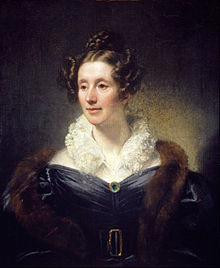
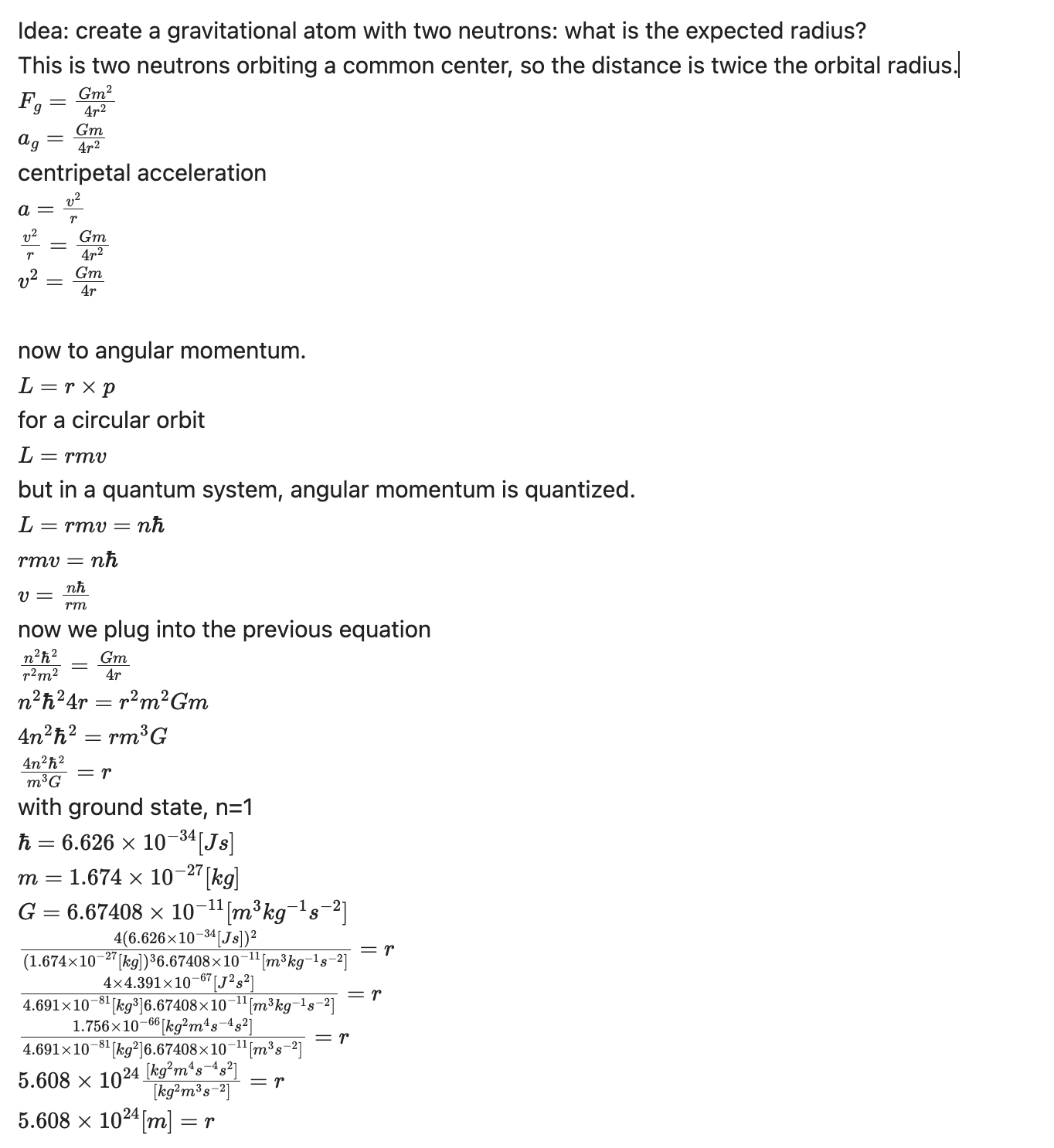
Yesterday I asked: if you made an "atom" out of two neutrons bound together by gravity, how big would it be?
HUGE.
@lilacperegrine worked it out and got an orbital radius of 5.608 ⋅10²⁴ meters, or about 1/100th the radius of the observable universe. Their calculations are below.
Let me check. The Bohr radius of a hydrogen atom is r = ℏ²/me² where m is the mass of the electron, e is its charge and ℏ is Planck's constant. We need to use the same formula with the force of gravity replacing the electromagnetic force, and the neutron mass replacing the electron mass.
Making the force weaker makes the atom larger in inverse proportion. Making the mass of the orbiting particle larger makes the atom smaller in inverse proportion.
The Bohr radius is about 10^{-10} meters.
The force of gravity between two electrons is about 10⁴⁰ times weaker than the electromagnetic force between them. But the neutron mass is about 1000 times the electron mass, so the force of gravity between two neutrons about 1000 × 1000 times bigger than between electrons. Thus the force of gravity between two neutrons is 10³⁶ than the electromagnetic force between a proton and electron.
But the mass of the orbiting particle is about 1000 times larger for our gravitational atom.
So, the radius of our gravitational atom is roughly 10^{-10} meters times 10³⁶ divided by 1000, which is 10²³ meters.
This very rough calculation matches @lilacperegrine's calculation well enough to make me trust their work.
This is why we never see gravitational "atoms" made of neutrons!
@notsle Seems more like Gödel's dumpster to me.
- Pronouns
- he/him/his
Theoretical physicist by training (PhD in quantum open systems/quantum information), University lecturer for a bit, and currently paying the bills as an engineer working in optical communication (implementation) and quantum communication (concepts), though still pursuing a little science on the side. I'm interested in physics and math, of course, but I enjoy learning about really any area of science, philosophy, and many other academic areas as well. My biggest other interest is hiking and generally being out in nature.
Joined Nov 2022
