

Luis M. Rocha @lmrocha@social.cleverlibre.org
- Complex Networks and Systems
- https://casci.binghamton.edu/publications.php
- Social and Biomedical Complexity
- https://casci.binghamton.edu/research_interests.php, https://csbc.indiana.edu/
- Politics and Rants
- https://hey-city-zen.blogspot.com/
Post-identity earthling working on complex systems, networks, biomedicine, AI, evolution. Music, politics, DJ as E-Trash. Life through parrhesia. "E se mais mundo houvera, lá chegara".
Professionally, I'm the George J. Klir Professor of Systems Science at the Thomas J. Watson College of Engineering and Applied Science (Department of Systems Science and Industrial Engineering), Binghamton University (State University of New York), where I lead the Complex Adaptive Systems and Computational Intelligence (CASCI: https://casci.binghamton.edu/) lab. I'm also Principal Investigator at the Instituto Gulbenkian da Ciencia in Portugal.
Joined Sep 2018
@pholme I generally agree, but the best models of COVID spread (e.g. to predict casualties per location) do include multiple levels in what one may call a computational theory of actionable conked systems models (cf Vespignani). In such multiscale models (or theory) you have simultaneously variables to model molecular transmission, human contact, transportation networks and psychological behavior like mask adherence according to political preference data (per US state, for instance.) True, the tongue-in-cheek link to Godel is not there, but certainly approximations to deal with computational complexity are very much part of such computational models and implicit (complexity) theory :)
Luis M. Rocha
boosted

'One problem with personalized medicine is the cost. As the bills for his biopsies, surgeries and radiation piled up, we started to call my father the “million-dollar man.” The real eyepopper was the erlotinib, priced at over $5,000 for a one-month supply of the tiny pills.'
#drugdiscovery #drugdevelopment #publichealth
@pholme very cool. I agree with being very careful to not evoke many levels in explanation, unless one needs to. But I do think that a complex system is one where you need more than one level to explain a phenomenon---which becomes pragmatically, epistemologically irreducible to a single mode of explanation (Pattee's control hierarchies). Wave-particle duality is an early example. But the pandemic is a great recent example, whereby a biochemical event (zoonotic transfer) led to very long multi-level control/causal chains from immune response and organ failure, to human transport networks, social and political change.
First hour of a live DJ set last July at Roterdão Club in Lisbon's Pink Street. It starts with respect for the great #TinaTurner, for a party aimed mostly at shaking the #booty.
‘Shake it!’ by E-Trash is on #SoundCloud https://soundcloud.com/placebooracle/shake-it
"Elite institutions have become so politically progressive in part because the people in them want to feel good about themselves as they take part in systems that exclude and reject."
What if We’re the Bad Guys Here? https://www.nytimes.com/2023/08/02/opinion/trump-meritocracy-educated.html?smid=nytcore-android-share
Luis M. Rocha
boosted
If you're off on vacation soon, you can mine this episode of the #EMBOPodcast for reading tips, as Pavel Tomancak suggested some of his favorite Czech #SciFi authors
Luis M. Rocha
boosted

Hello there! For a brief #introduction, we are the young researchers of the Complex Systems Society, and we strive to enable all early-stage researchers interested in complexity science to integrate into the community. We do so by offering grants, and by organizing events, such as the warm-up of the Conference on Complex Systems (picture of seemingly happy participants from Palma's edition below).
Let's hope we can bring the community together here as well 🤗
Luis M. Rocha
boosted


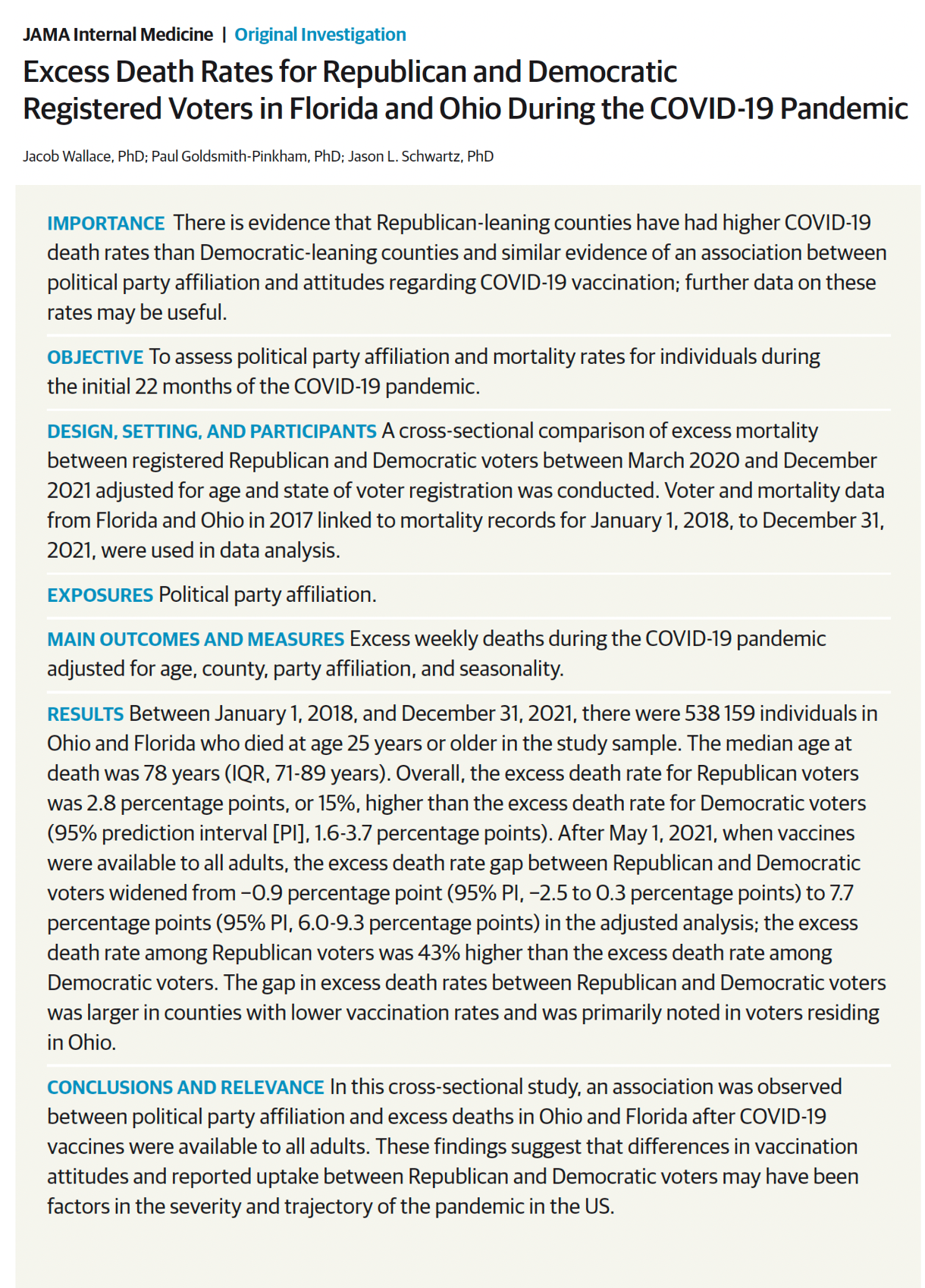
"Our study found evidence of higher excess mortality for Republican voters compared with Democratic voters in Florida and Ohio after, but not before, #COVID-19 vaccines were available to all adults in the US."
https://jamanetwork.com/journals/jamainternalmedicine/fullarticle/2807617
When I speak publicly about cigarettes being much worse than psychedelics, no one takes me seriously (maybe because I'm DJ on the side :) But, seriously, we are letting too many people die of #depression when there is at least a chance here.
newstatesman.com/encounter/2023… #mentalhealth
Al Gore on Extreme Heat and the Fight Against Fossil Fuels https://www.nytimes.com/2023/07/18/climate/al-gore-on-extreme-heat-and-the-fight-against-fossil-fuels.html?smid=nytcore-android-share
Are biological systems really at the #edgeofchaos? Jordan Rozum presents our recent work @netsci2023 on how #canalization in #bionetworks makes them much more stable than critical.
12:15 #Network #Dynamics (Sync & Control) (BIG Room)
https://www.mdpi.com/1099-4300/25/2/374
https://www.biorxiv.org/content/10.1101/2023.06.30.547297v1
Super excited to give invited talk at "Network Science for the #sustainabledevelopmentgoals" satellite @netsci2023 tomorrow, Tuesday July 11th at 14:55 (Horsaal 3). I will speak about our NIH-NLM funded work on #epilepsy and other #networkmedicine #socialmediamining #reducedinequality #goodhealthandwellbeing #genderequality #partnershipsforthegoals #netsci2023
https://sites.google.com/view/netsci4sdgs23/
And in case your are interested, giving a (4th!!) talk at the "The Statistical Inference for Network Models Satellite", tuesday July 11th at 12:10(Horsaal 4), on statistical and causal models of #dynamics in #automatanetworks models in #systemsbiology https://sinm.network/sinm2023/ #netsci2023
Are biological #complexnetworks near critical? Existing #systemsbiology models are not, as shown in our recent work with Jordan C Rozum, Reka Albert, Kyu Hyong Park, and Felipe Costa.
,
#Robustness of biomolecular #networks suggests functional modules far from the #edgeofchaos
https://www.biorxiv.org/content/10.1101/2023.06.30.547297v1
While many are afraid of vaccines, their clothes go untested. https://www.theguardian.com/fashion/2023/jul/02/fashion-chemicals-pfas-bpa-toxic
@Radical_EgoCom@kolektiva.social at least the CEO asks what he should do. In Academia Dean's & co totally expected it. No questions asked....
- Complex Networks and Systems
- https://casci.binghamton.edu/publications.php
- Social and Biomedical Complexity
- https://casci.binghamton.edu/research_interests.php, https://csbc.indiana.edu/
- Politics and Rants
- https://hey-city-zen.blogspot.com/
Post-identity earthling working on complex systems, networks, biomedicine, AI, evolution. Music, politics, DJ as E-Trash. Life through parrhesia. "E se mais mundo houvera, lá chegara".
Professionally, I'm the George J. Klir Professor of Systems Science at the Thomas J. Watson College of Engineering and Applied Science (Department of Systems Science and Industrial Engineering), Binghamton University (State University of New York), where I lead the Complex Adaptive Systems and Computational Intelligence (CASCI: https://casci.binghamton.edu/) lab. I'm also Principal Investigator at the Instituto Gulbenkian da Ciencia in Portugal.
Joined Sep 2018
