

LucifarGundam @lucifargundam@social.cleverlibre.org
- Buy Me A Coffee
- https://www.buymeacoffee.com/lucifargundam
- Politics\Religion
- Irrelevant
- Steam\IRC
- LucifarGundam | DerLG
- Matrix
- lucifargundam:matrix.org
Ask me about my keyboard
Joined Nov 2020

LucifarGundam
boosted

LucifarGundam
boosted

LucifarGundam
boosted

@iska@mk.starnix.network you're my 200th follower. To commemorate the moment, I'll update my pfp later. Thanks.
LucifarGundam
boosted

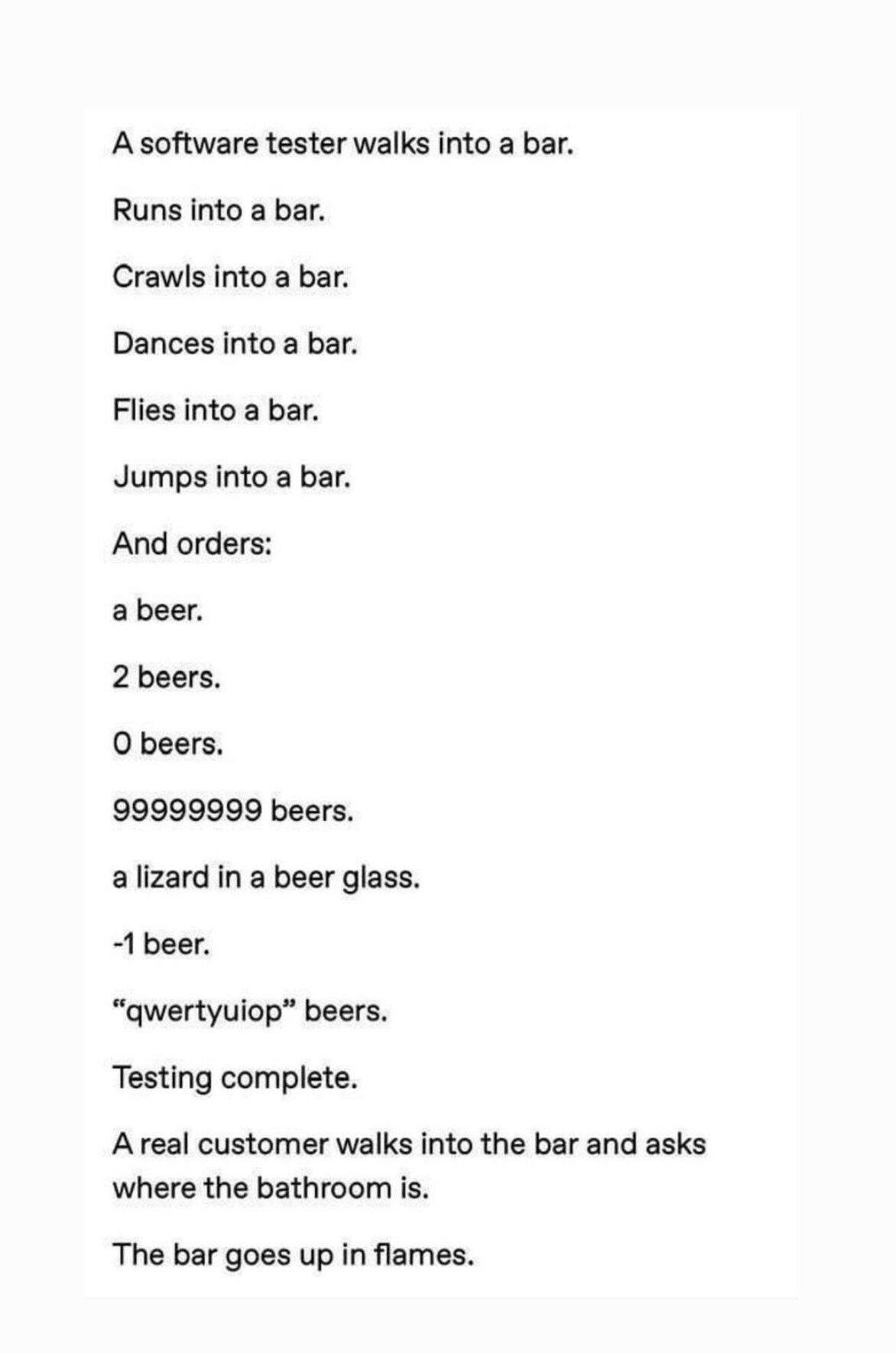
"Not sure if I’ve seen this one here before"
submitted by MattRubin
https://reddit.com/r/ProgrammerHumor/comments/y9a161/not_sure_if_ive_seen_this_one_here_before/
I don't know where to put this, so I'll just linkdump here and search later when I need it...
#notetoself
History Of Lisp
http://jmc.stanford.edu/articles/lisp/lisp.pdf
Linux Handbook::
https://0xax.gitbooks.io/linux-insides/content/Booting/linux-bootstrap-2.html
Linux IO Interface::
https://kernel.dk/io_uring.pdf
Online GIF Tools::
https://onlinegiftools.com/
MIT Class on Adv Data Structures::
https://courses.csail.mit.edu/6.851/spring21/lectures/
Stanford Class on Algorithms::
https://web.stanford.edu/class/cs168/index.html
##llamas irc channel is dead.... #cyberpunk is relatively active... time to cause mayhem in my own registered channels...
LucifarGundam
boosted

I just learned that Natasha Snow needs our help!
Her house burned down and she and her family are safe but they lost everything.
Please donate to their fundraiser to help out!
https://www.gofundme.com/f/donate-to-help-natasha
She designed the Psychic Underground covers and is amazing at her job!
LucifarGundam
boosted

Fun fact about trademarks - US copyright laws have, rightfully, a high threshold of originality, making most corporate trademarks public domain and uncopyrightable, as basic geometry shapes and fonts (even fancy ones) are too simple. Wikimedia has collected many copyright office rejection letters over the years for reference, and it's pretty hilarious to read. https://commons.wikimedia.org/wiki/Commons:Threshold_of_originality#United_States_of_America
This allowed Wikipedia to collect a large number of high-resolution logos, sometimes you can even see SVG recreation made by editors for ancient logos from now-defunct companies. Trademark laws still apply, but using them to describe the entities they represent is always legal...
Getting ghosted on a virtual job interview...









I think I'll make some sugar cookies tomorrow...
Maybe something else as well if I can find a simple recipe
Even though I didn't get the job, #PostHog gave me a sticker. That's classy rejection right there!

https://www.swansontec.com/sregisters.html
tldr::
Each register name is really an acronym. This is true even for the "alphabetical" registers EAX, EBX, ECX, and EDX. The following list shows the register names and their meanings:
EAX - Accumulator Register
EBX - Base Register
ECX - Counter Register
EDX - Data Register
ESI - Source Index
EDI - Destination Index
EBP - Base Pointer
ESP - Stack Pointer
-------------------------------------------------
Conclusion
The eight general-purpose registers in the x86 processor family each have a unique purpose. Each register has special instructions and opcodes which make fulfilling this purpose more convenient or efficient. The registers and their uses are shown briefly below:
EAX - All major calculations take place in EAX, making it similar to a dedicated accumulator register.
EDX - The data register is the an extension to the accumulator. It is most useful for storing data related to the accumulator's current calculation.
ECX - Like the variable i in high-level languages, the count register is the universal loop counter.
EDI - Every loop must store its result somewhere, and the destination index points to that place. With a single-byte STOS instruction to write data out of the accumulator, this register makes data operations much more size-efficient.
ESI - In loops that process data, the source index holds the location of the input data stream. Like the destination index, EDI has a convenient one-byte instruction for loading data out of memory into the accumulator.
ESP - ESP is the sacred stack pointer. With the important PUSH, POP, CALL, and RET instructions requiring it's value, there is never a good reason to use the stack pointer for anything else.
EBP - In functions that store parameters or variables on the stack, the base pointer holds the location of the current stack frame. In other situations, however, EBP is a free data-storage register.
EBX - In 16-bit mode, the base register was useful as a pointer. Now it is completely free for extra storage space.
=====================================
In conclusion, using the registers as #intel intended has several advantages. In the fist case, it allows your code to take advantage of many optimizations and special instructions. It also makes the code more readable, since registers perform predictable functions. Finally, using the registers consistently leads to better compression by promoting more repetitive instruction sequences.
#nowplaying
Led Zeppelin - Stairway To Heaven (HQ)
https://www.youtube.com/watch?v=CPSkNFODVRE
- Buy Me A Coffee
- https://www.buymeacoffee.com/lucifargundam
- Politics\Religion
- Irrelevant
- Steam\IRC
- LucifarGundam | DerLG
- Matrix
- lucifargundam:matrix.org
Ask me about my keyboard
Joined Nov 2020
