

mandlebro @mandlebro@social.cleverlibre.org
Current math phd student. Also likes games and working out.
Joined Dec 2019


mandlebro
boosted

mandlebro
boosted

Won’t be able to get a professional to clean up my mess til Monday lol. Prime diy shame
Soldering pipes is harder than it looks and I have created a disaster.
@coolboymew This is only true when using python as a glue language for libraries written in c and Fortran. Large projects actually written in python can be nightmareish.

Just discovered that my soy sauce has high fructose corn syrup in it. Did not expect it there...

@augustus This seems more doable with a hand designed plugin. I have seen some cool stuff where people were using neural networks to “tween” sounds to generate samples.
mandlebro
boosted

EXTREMELY RARE footage of the elusive box jellyfish Chirodectes. Larger than a soccer ball, this jelly is a true ocean mystery, and this video is one of the only in existence, filmed off the coast of Papua New Guinea in 2021.
📽️Scuba Ventures Kavieng bit.ly/3FE29tL
@augustus not to mention e flat instruments…
@post @freemo @antares @fourmajor Sounds like complete woo. Anything that connects the philosophy of consciousness to quantum theory is highly suspicious. It either has additional metaphysical assumptions , an additional dubious assumption about an identity between consciousness and some physical thing, or is complete nonsense.
mandlebro
boosted

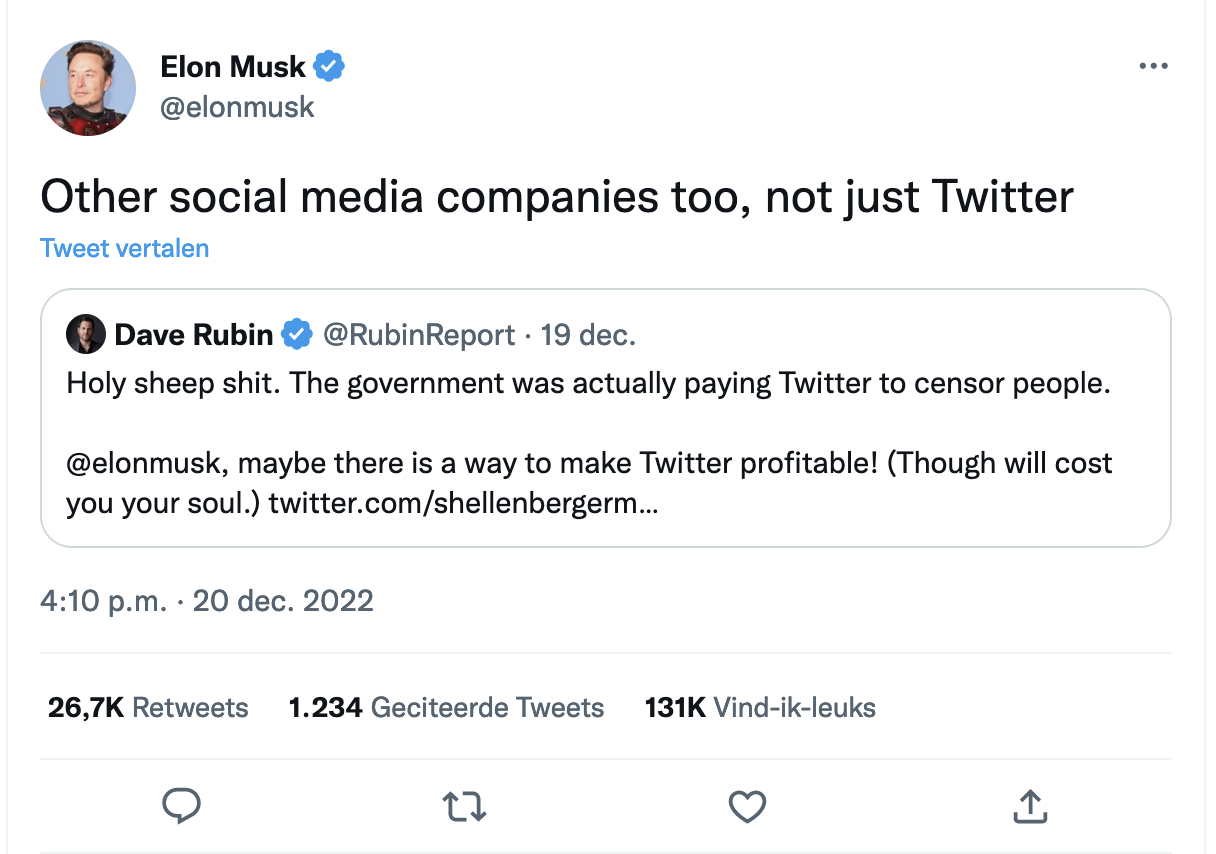
Not all social media platforms are 'companies' that can be bought Elon..
Stop pointing and take resonsiblity
mandlebro
boosted

@freemo @antares @fourmajor It's really the only thing in and of itself we have access to.
@freemo @antares @fourmajor I feel all aspects of the mind can be plausibly explained by evolutionary pressures and biological and physical constraints, except for actual conscious experience. The thing I am experiencing right now as I write this, that I cannot share with anyone else, that I cannot even communicate about because it is uniquely mine and language requires commonality to form semantics. Some aspects of this thing can be understood by the aspects of the mind, but its existence and the innate nature of the primitive elements that constitute it are utterly beyond examination.
@freemo @antares @fourmajor I have read neuroscience papers where they talk about consciousness. In these papers, they are really implicitly assuming an identity between certain reported experiences and certain functions of the brain. These papers were focused on perception. Really, scientifically we can't talk about the "experiences" in and of themselves, but we can talk about the presence of the report which is evidence of some state of the system which we might call a "conscious" state by its ability to be reported. Additionally, these papers often used consciousness as a synonym for "awareness" which is why I talked about integrating information. In other words, neuroscience is the study of the relationship between the states of the brain and the behaviors of the agents in possession of the brain. We can say a subset of the information contained in the brain is information the agent is "aware" or "conscious" of by the agent's ability to report this information and to some degree their ability to otherwise act on it. This is the way I have seen "consciousness" used in some neuroscience papers.
@antares @freemo @fourmajor There are a lot of conflated ideas in this area that confuse people. The existence of consciousness, as in the incorrigible experiences of being, the qualia, the pure experience that make up ones existence, is something inaccessible to anything other than the being experiencing it and as thus the discussion of its existnece or nonexistence is pointless. What has a point is the question of whether something has personhood and thus should be treated as an agent with rights within our society. A side question is whether something is consious in the sense that neuroscientists talk about consiousness, which is really a discussion of a systems capacity to process information and integrate it into itself. The latter two topic deal with observable things while the first does not.
mandlebro
boosted





Current math phd student. Also likes games and working out.
Joined Dec 2019
