Paweł Lenartowicz @plenartowicz@social.cleverlibre.org
- Profile in Polish:
- @plenartowicz@lewacki.space
Aspiring statistician and meta-researcher, sailor and activists.
#PhilosophyofScience
#OpenScience
#Uncertanity
Joined Nov 2022
Paweł Lenartowicz
boosted

Could this be the paradigm shift all of #OpenScience has been waiting for?
Council of the EU adopts new principles:
"interoperable, not-for-profit infrastructures for publishing
based on open source software and open standards"
https://data.consilium.europa.eu/doc/document/ST-8827-2023-INIT/en/pdf
and now ten major research organizations support the proposal:
https://www.coalition-s.org/wp-content/uploads/2023/05/JointResponse2CouncilScholCommConclusions.pdf
What they propose is nearly identical to our proposal:
https://doi.org/10.5281/zenodo.5526634
Does this now get the ball rolling, or is it just words on paper?

This is big. No #embargoes. No #APCs. "The #EU is ready to agree that immediate #OpenAccess to papers reporting publicly funded research should be...
Paweł Lenartowicz
boosted

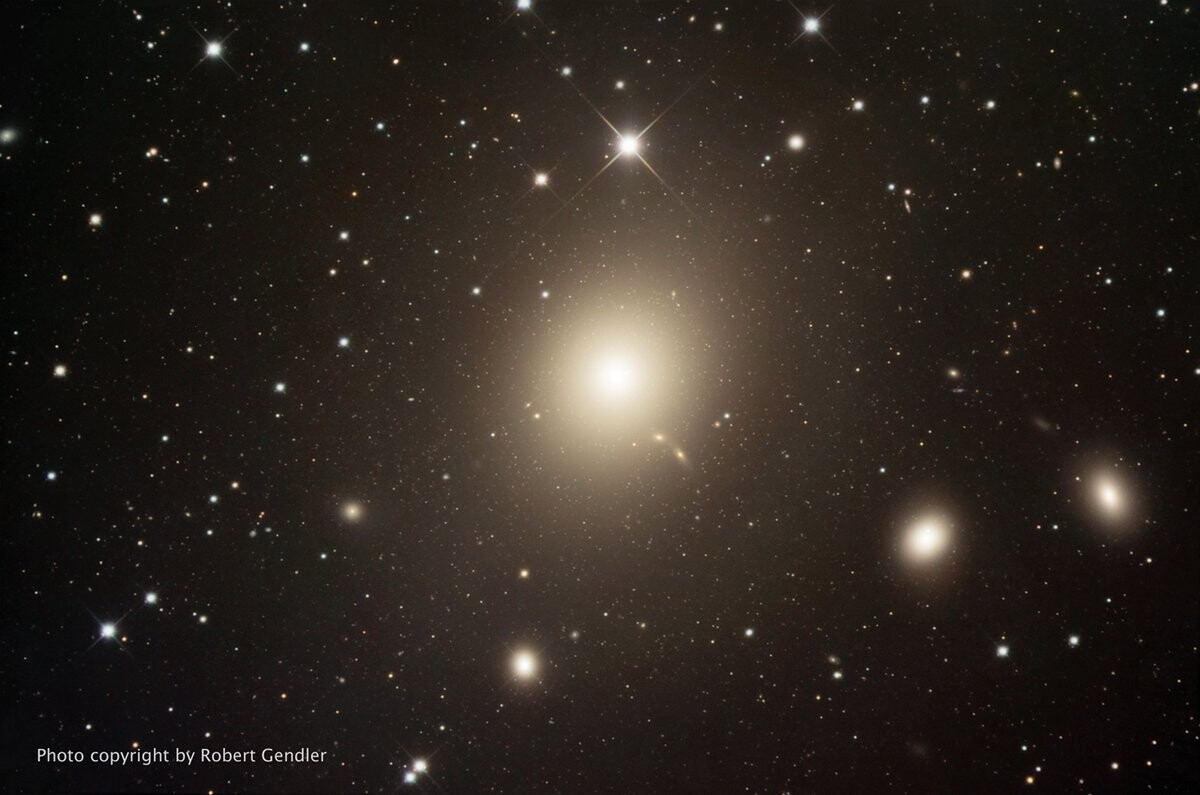
When you look out to cosmic distances, it's difficult to have any sense of 3D shapes. Take this bright galaxy, M87: Is it shaped like a ball, an egg, a pancake?
Turns out, there is now a way to tell! (1/2)
#perspective #space
Also, first general AI programs is 66yo (General Problem Solver) ;)
@freemo @louiscouture
I always thought, that qoto logo is green onion with eyes!
@lakens
Assuming of normal distribution under h0 (simply because of the CLT), can be perfectly valid, so t-tests for h0 also. But at the same time, equivalence test could be not!
@lakens @lakens
Yeah, I know your article about it. Bahrens Fisher problem is heavily discussed for years :)
But both tests have assumption of normal distribution of means. And the same problem of ignoring heavy tailed distribution /vviolation of normality / skewed distribution / heteroscedascity/ mediation / moderation. However called situation, where sample is to small to be efficiently affected by CLT.
Let me repeat, equivalence testing can't provide conclusion, that effect is small, when it's relatively rare comparing to sample, regardless significance of results.
Estimation effect size and CI via Welsh's t-test assumes normal distribution of effect :) I mentioned that :)
@JorisMeys
But we never know if sample is big enough to detect rare (but strong) effect. EqTesting is easy way to underestimate sample size (it is why probably EqTesting is so popular in pharmaceutical studies).
1) Of course, you can assume any distribution. (And that procedure is called "Neyman-Pearson theory of statistical testing".)
'Equivalence testing' is procedure almost always connected to t-test. Like in your textbook (photo 1) or TOST procedure (Schuirmann, D. J. 1987) .
2) "Violations of normality mostly have very little impact on error rates", violation of normality have biggest impact on estimation of variance, so also on error rates and effect estimation. (It's why heteroscedasticity is so important.)
1) It'll be easy to show how easily 'equivalence tests' can be very wrong, if assumptions ignores non-normality of effect (by using t-test).
I think I can make some simulation after 22:00 GMT. For now, I can show what happens to p-distribution, when effect is (very) not normal. (photo 2 - no effect, non normal distibution when h1=true, 3&4 valid use of t-test, effect big but moderated).
Schuirmann, D. J. (1987). A comparison of the two one-sided tests procedure and the power approach for assessing the equivalence of average bioavailability. Journal of pharmacokinetics and biopharmaceutics, 15, 657-680.
https://link.springer.com/article/10.1007/BF01068419
The solution for such problem is already known for 90 years.
1) specify your model
2) test your model against probable alternatives
@lakens
Oh, my god, NO!
If we make strong assumptions about normality (Welch's) or uniformity (Student's t-test) of effect, as we do in equivalence testing, we can only conclude that that certain model is unlikely.
In other words, if the real effect is moderated or mediated, this procedure fails. Frequency-based statistics is very sensitive to model misspecification. It is a problem, It's not an advantage to use it. We can't conclude h0 because data is unlikely in specific h1.
Paweł Lenartowicz
boosted

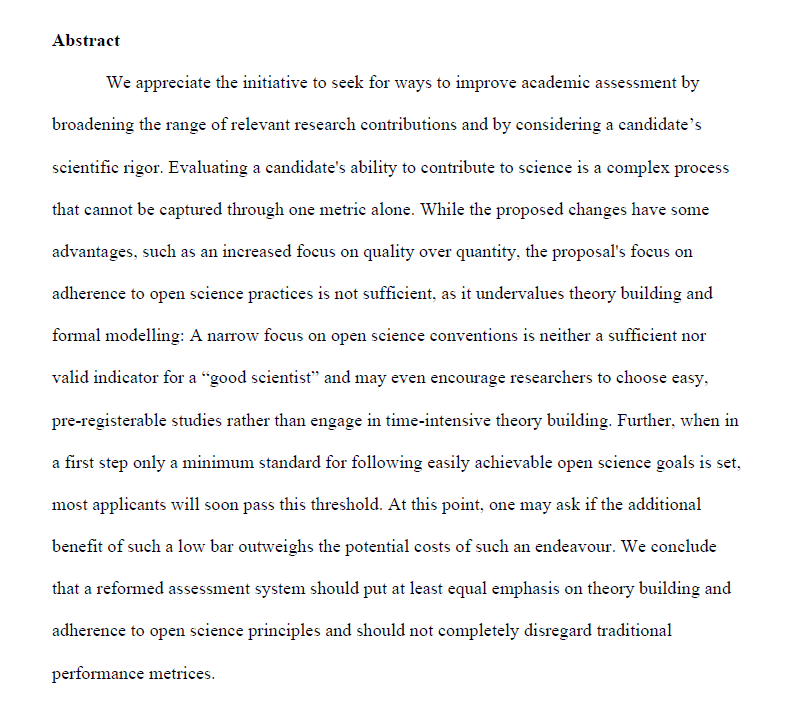
“Responsible research assessment should prioritize theory development and testing over ticking open science boxes”
New preprint comments on proposals to change hiring and promotion in psychology to become more oriented to open science.
Few quotes follow: 🧵👉
#Science
#Psychology
@psychology
#OpenScience
#MetaScience
#MetaResearch
#SociologyofScience
#ScienceofScience
#STS
@stsing
#PsychJobs
@academicchatter
@academicsunite
Paweł Lenartowicz
boosted

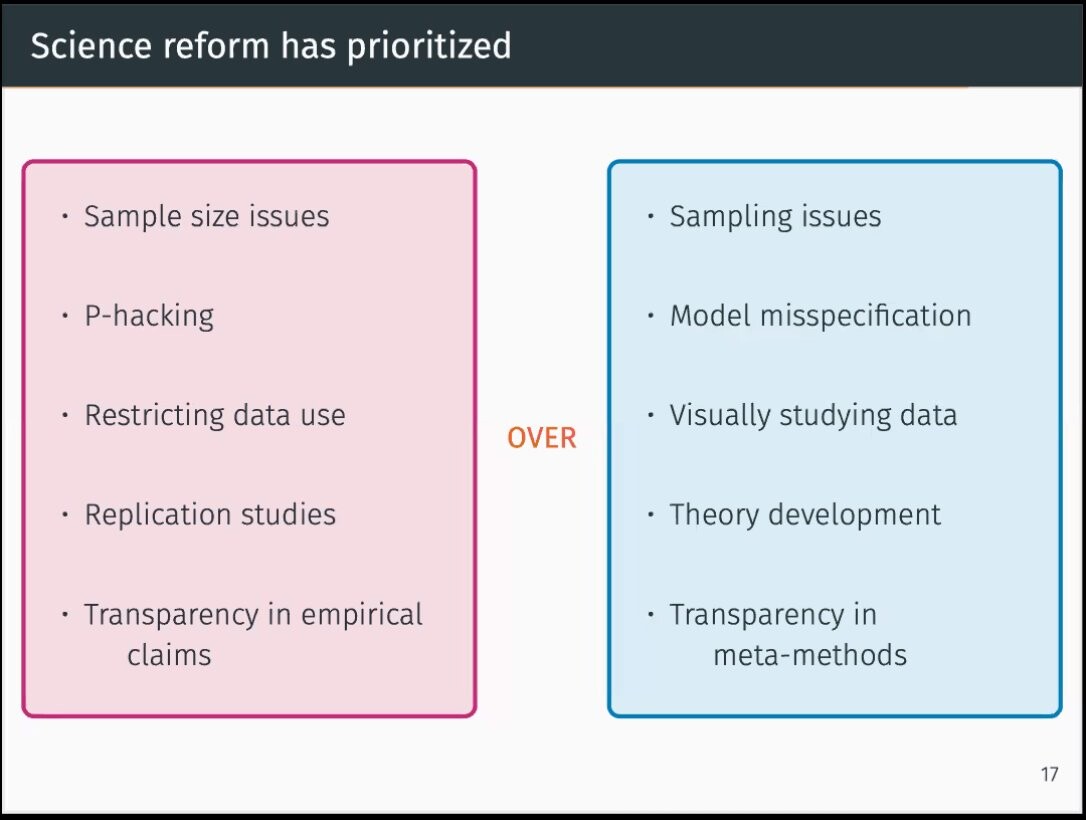
This slide is from a talk I gave at an OSF symposium a few years back. It's still relevant and I think we should have prioritized, we should still prioritize, the set of issues on the right over those on the left. But I would now want to add measurement on the right side as well.
And a clarification: My prioritization is not because I think right side issues are more important (which I do) but because fixing the left ones won't make much of a difference until the right side makes sense.
Paweł Lenartowicz
boosted
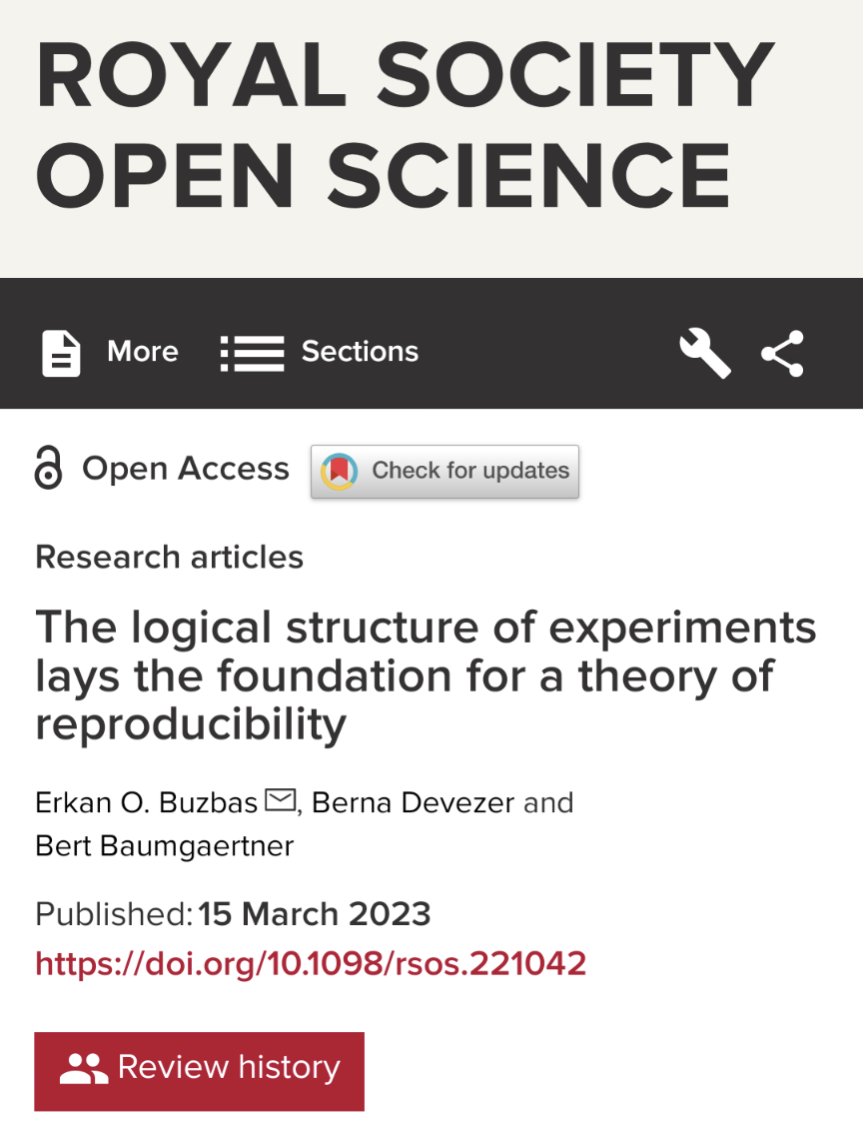
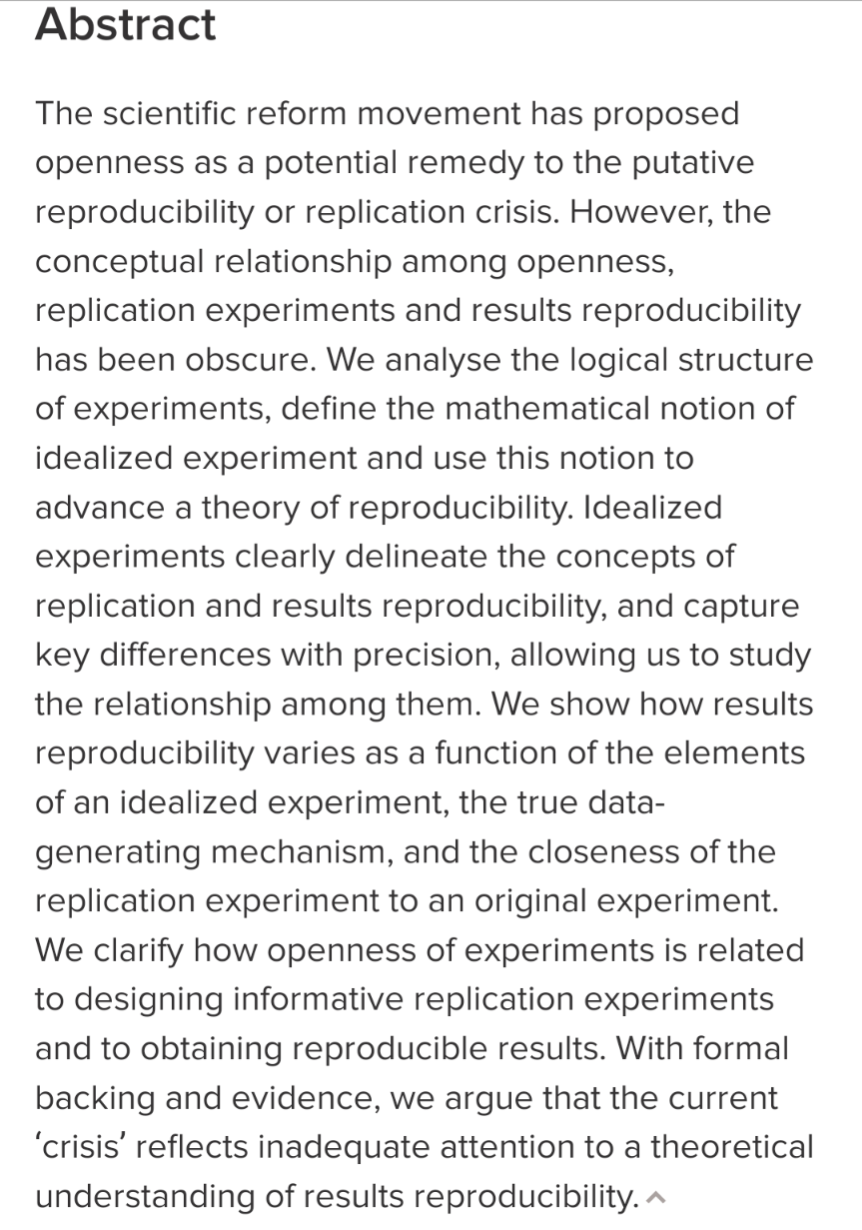
Our work on the theoretical foundations of results reproducibility is out at #RSOS and is open access. We dissect the relationship between open science, replication experiments, and reproducible results and challenge many deep-seated assumptions. We specifically show why meaningful replications need to be based on deeper theoretical understanding and stronger empirical foundations.
https://royalsocietypublishing.org/doi/10.1098/rsos.221042
Paweł Lenartowicz
boosted
Conclusion: We need to design better experiments. For that, we need a theoretical understanding of what an experiment is and does.
Paweł Lenartowicz
boosted

@danhon I see you’re a man that also has good taste in mice 👀
I think that's a fair summary:
Looking for at the "reported p-values around 0.05" is a flawed process because:
1) It assumes different scientific process than really happen
2) it has especially and tendency to flag slightly biased reports that are not problematic
3) there is too much trust in simulation
Do you agree?
I'm trying to make sure I understand.
- Profile in Polish:
- @plenartowicz@lewacki.space
Aspiring statistician and meta-researcher, sailor and activists.
#PhilosophyofScience
#OpenScience
#Uncertanity
Joined Nov 2022
Paweł Lenartowicz's choices: