

Post @post@social.cleverlibre.org
#Mathematics #Macroeconomics #Engineering #ComputerScience #Programming
#Ecology #Environment #Democracy #Freedom #Equity #Liberal #Socialism #PostKeynesian


 #Inkscape ·
  #Gimp ·
  #Blender ·
  #VLC
#VLC
 #WordPress ·
  #Mastodon ·
  #PeerTube:


 searchable
Joined May 2019
Post
boosted

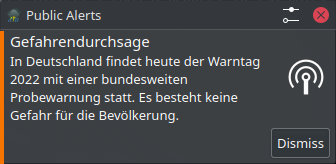
German nation-wide emergency alert exercise message delivered via UnifiedPush as KDE Plasma desktop notification, within a minute of the cell broadcast :) #kde #unifiedpush
Post
boosted

We just published a guest blog post on F-Droid!
You can find it here: https://f-droid.org/fr/2022/12/18/unifiedpush.html
Thanks @fdroidorg !
Post
boosted

A castle in Italy has braille etched in the railing that describes the view for blind people🤎
"Inhaled CO2 Concentration While Wearing Face Masks: A Pilot Study Using Capnography"
"Serious harms of the COVID-19 vaccines: a systematic review"
https://www.medrxiv.org/content/10.1101/2022.12.06.22283145v1
"Discriminatory Attitudes Against the Unvaccinated During a Global Pandemic"
Post
boosted

I am 100% not shitting you when I say scientists named mastodons after their teeth which they thought looked like nipples. “Mastos” as in breast. “odont” as in tooth.
We’re on a website that, in Greek, literally means “Booby Tooth.”
Post
boosted

I wrote a blog post about the progress we’ve been making on the Block Protocol. https://www.joelonsoftware.com/2022/12/19/progress-on-the-block-protocol/ What is it? Why do we need it? We’re also announcing a Wordpress plugin that makes it easy to insert Block Protocol blocks into Wordpress posts.
Post
boosted

Hi, I am a theoretical physicist working in #statisticalphysics of disordered systems, #machinelearning, #informationtheory etc.. Interested in #science, #littérature (mostly in French, but also in English and Italian), #classicalmusic. I have been working on quite a few different topics, my two books "Spin glass theory and beyond", written with G. Parisi and M.A.Virasoro and "Information, Physics and Computation", written with A. Montanari, give some partial idea of my center of interest
Post
boosted

The new whiteboard feature of #Logseq looks nice but it won’t be a replacement for the #Excalidraw integration, which is still very buggy that it is almost unusable. We really need a good way for quickly drawing some shapes with arrows and lines between them.
@logseq
Post
boosted

Opinions from #ToolsForThought folk desired:
Many of the recent spate of PKM tools are outliners or at least very graph oriented.
What impact do you suppose this has on getting to the narrative, story, or even gestalt of a thing?
I sometimes worry that outlines are great at facts and deduction but less great at tales, induction, intuition.
Thoughts?
Post
boosted

With all the new mastodon instances, I'm wondering how many admins are prepared for law enforcement (or other) agencies to come asking for people's information. In many cases the law enforcement is not entitled to this information, nor needs it, but how many admins know what to do and how to be sure they only respond to legitimate requests? And even what their own rights are in these situations? (Which will vary according to local laws.)
Post
boosted

hey did you know the roots of a cubic polynomial can be visualized using an equilateral triangle?
🔵 vertices are roots
🔴 the incenter is the inflection point
🟢 the incircle boundaries are the local minima/maxima
Post
boosted

I've updated my "Marden’s theorem " code to handle arbitrary numbers of points and angles. Here six points are evenly spaced at some angle that is an irrational multiple of $2\pi$ and slightly less than \frac{2\pi}{5}$
Browsing through the literature I wasn't able to find this anywhere. Can someone point me in the right direction? If not not I'll also take it to math stack exchange.
Post
boosted
Got nerd sniped by @acegikmo when I found out that "if a cubic polynomial has three real roots, the roots can be thought of as a projection of the vertices of an equilateral triangle. That triangle is constructed from the roots of the first and second derivative of the polynomial"
Post
boosted

Process:
1. Sketch
2. Color flat, neutral light
3. Shading
4. Contrast and Glow
- Software: Krita
- Source: https://www.peppercarrot.com/en/viewer/artworks-src__2022-12-07_it-s-decorating-time_by-David-Revoy.html
- Wallpaper: https://www.peppercarrot.com/en/wallpapers/index.html
License: CC-By
Post
boosted

Since Mastodon saw its initial popularity circa 2017, I've noticed that most users and those reporting on it either don't think about the Fediverse as anything more than Mastodon, or treat its history as beginning with Eugen Rochko and the beginning of Mastodon. In fact, Mastodon is the latest in a long line of federated social networks, going at least back to Identi.ca, and though I wasn't around for all of it,I find this history pretty interesting. (Thread; boosts welcome!)
Post
boosted

Here's your irregular reminder that:
Twitter was a multi-billion dollar company with thousands of employees.
Mastodon is a niche hobbyist product run by volunteers
The fact that we're being seen as a viable alternative to them is an admission that a federated, decentralized future is not only possible, but desirable.
Mastodon is not one thing, or one place. It's a network of many things and many places. We don't have a spokesperson (I mean, there's me. I'm the official spokesperson for 💯 of the fediverse, but beyond me there is no spokesperson) we don't have consensus on moderation or blocking or tools or what is good and what is bad. Some of us are professional SREs and Sysadmins, some of us aren't. Some of our instances have been around for 5+ years, some won't be here in six months.
And that's good! All of it, every last bit of it is good.
We're wrestling power away from the billionaire class, in real time, and reclaiming it for the People.
Post
boosted

@ajroach42 Exactly this 👆the fediverse is political. It’s not just an alternative to billionaire controlled social media platforms, it is a complete rejection of them. Everyone who comes here, especially those wonderful folk who delete their bird accounts, are making a political and ethical choice. It feels good it feels right and it’s the future.
Post
boosted







CW Long post. Original content.
How Covid curbs on church-going harmed public health
During the Covid-19 pandemic, people were barred in many countries from attending religious worship for long periods, and nowhere more so than in Ireland. When they were not barred, severe restrictions were put on the numbers who could attend. But strictly from a public health perspective, was it worth it? An important new study (https://www.sciencedirect.com/science/article/pii/S0014292122001672) suggest it was not, and the restrictions may have done more public health harm than good.
The research, just published in the European Economic Review is based on a nationally representative sample of over 100,000 responses from 52,459 individuals in the United States. It was carried out during the period from March 2020 to May 2021, when most American States limited the number who could attend a house of worship.
A crucial finding of the study is that the severe restrictions on religious worship do not seem to have slowed the spread of the virus.
It says: “there is no statistically or economically significant association between restrictions on houses of worship and either COVID-19 infections or deaths regardless of how restrictions are measured”. (p. 12)
The article concludes that “there is almost no evidence that the restrictions had a positive effect on public health, consistent with a growing body of evidence that has evaluated the launch of State quarantine policies.” (p. 12)
But the restrictions or ban on public worship did harm the mental health of some worshippers.
The author focuses on two variables: current life satisfaction and self-isolation.
The study confirmed that religious people have higher level of current life satisfaction overall, compared to the rest of the population. This is partly achieved by being part of a religious community. Therefore, it is no surprise that is also found a “strong negative association between state restrictions and current life satisfaction, particularly for religious adherents.” (p. 6).
If one of the main sources of their wellbeing was removed, how could it be otherwise?
The author notes that going to a church, or attending any other religious venue, offers people the opportunity to forge relationships and grow stronger in their faith. The survey established that the restrictions had “a disproportionate impact on self-isolation among religious adherents.” (p. 7)
Self-isolation among religious people increased by more than among their non-religious counterparts. This is one of the reasons why their well-being suffered more as a result of the pandemic.
The decline in well-being was stronger in Catholic than in Protestant congregations, and non-existent among Mormons, who are concentrated in Utah where no significant restrictions were put into place.
The main result of the study is that “religious adherents experienced systematically lower levels of well-being and isolation following the adoption of such restrictions.” (p. 11)
The study focuses on the United States only. It would be interesting to see such research extended to other countries, particularly to Ireland that had the longest period of worship restrictions in Europe.

#Mathematics #Macroeconomics #Engineering #ComputerScience #Programming
#Ecology #Environment #Democracy #Freedom #Equity #Liberal #Socialism #PostKeynesian
#Inkscape · #Gimp · #Blender · #VLC
#WordPress · #Mastodon · #PeerTube:
searchable
Joined May 2019
