

Paul Smaldino @psmaldino@social.cleverlibre.org
- Website
- https://smaldino.com/wp
- @psmaldino
Paradigmatically promiscuous scientist. Modeler. Curmudgeon. Faculty at UC Merced and Santa Fe Institute.
Web: https://smaldino.com/wp/
Bluesky: @psmaldino.bsky.social
Joined Nov 2022
@Prof_BearB I’ve been similarly hesitant but at this point I think it’s got enough usage and support that I do see it as a good bet. One of my grad students is similarly all-in for it and has been very convincing.
@j2bryson in terms of pedagogy for social modeling, NetLogo has no real competitors, especially if you want embodied agents or structured populations. I generally encourage the grad students in my lab to use another tool for their research projects (which usually involve ABM). Most Python (with or without Mesa) or Julia (Agents.jl). I first learned with Java and MASON, which I don’t teach or encourage anymore.
@edhagen Nice. I’ve been really impressed with Agents.jl, but it’s always faster to not have all that overhead.
I'm really into learning Julia and Agents.jl (mastering these is my top summer goal), but I have really come around to loving NetLogo -- I wanted a stochastic block model with visualization, and made this from scratch in literally 5 minutes.
Paul Smaldino
boosted

Looking much forward to start working with the new colleagues, and an arrivederci to all the great people at the Centre for Culture and Evolution at Brunel University London
Btw, they opened *my* position (deadline 8th March - feel free to get in touch if you have any question):
https://www.jobs.ac.uk/job/CXH095/lecturer-in-psychology-13272-1
@SendintheMonkey Sometimes you gotta speak truth to power.
@Prof_BearB I have a big tattoo of a tree on my shoulder. Trees are amazing.
Trees are cool.
Paul Smaldino
boosted

I went to pub quiz and all I got was this obsession with the idea that "My Best Friend's Girl" is sung from the perspective of an older, sadder Jessie.
Paul Smaldino
boosted
Here’s a new preprint w Zack Dunivin: Dynamics of covert signaling: Modeling the emergence and extinction of identity signals.
We use theoretical modeling to explore the dynamics of identity signals when their use is penalized by a hostile outgroup.
Depending on the benefits of coordination and expected costs of discovery by outgroups individuals, we should expect a wide range of dynamics for the emergence and persistence of identity signals.
Feedback much appreciated.
Here’s a new preprint w Zack Dunivin: Dynamics of covert signaling: Modeling the emergence and extinction of identity signals.
We use theoretical modeling to explore the dynamics of identity signals when their use is penalized by a hostile outgroup.
Depending on the benefits of coordination and expected costs of discovery by outgroups individuals, we should expect a wide range of dynamics for the emergence and persistence of identity signals.
Feedback much appreciated.
Paul Smaldino
boosted

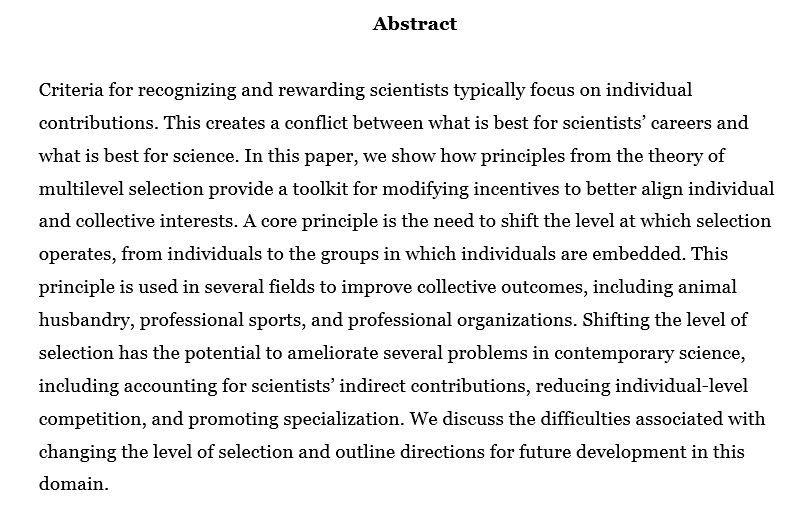
Our preprint "Shifting the level of selection in science" should be an interesting read for anyone interested in recognition and rewards in science. We discuss how moving from rewarding individuals to rewarding teams could have important benefits for science.
I thought I'd remind you - our revision is stuck in review limbo due to the recent drama at Perspectives on Psychological Science, but it's a paper that I think deserves to be read as is.
My last semester teaching my modeling course without a physical copy of my book. This is still probably my favorite figure, from Chapter 5: Opinion Dynamics.
Paul Smaldino
boosted

Oh boy. I already love #TheDecemberists, but Colin Meloy (of The Decemberists) just kicked it up a notch.
He asked #ChatGPT to write a song in his style and then he recorded it.
https://colinmeloy.substack.com/p/i-had-chatgpt-write-a-decemberists
He managed to make the chords work, but some of these lyrics are really hilarious (and bland?) 😂
Paul Smaldino
boosted



#TodaysWork: mixing all day today on the small dinos record! 🎉
i'm starting to finish mixes. it's rewarding to have that starting to happen; we've been working on it for four months, not counting pre-production.
i had a minor triumph with one song; i ended up achieving a super distinct texture by way of two different tape emulations on the mix bus, one of them being a model of cheap cassette tape. i feel like people would pay me less if they knew i do shit like this 😂

Paul Smaldino
boosted
I was recently on the @sfiscience@mastodon.sdf.org #Complexity Podcast with C Thi Nguyen. We had a bonkers far-reaching conversation about selection, incentives, institutions and #CulturalEvolution. Good times. https://complexity.simplecast.com/episodes/101

I was recently on the @sfiscience@mastodon.sdf.org #Complexity Podcast with C Thi Nguyen. We had a bonkers far-reaching conversation about selection, incentives, institutions and #CulturalEvolution. Good times. https://complexity.simplecast.com/episodes/101
@hilljam @shannoncurtis I dunno, it's pretty obvious when you think about it 🤔
- Website
- https://smaldino.com/wp
- @psmaldino
Paradigmatically promiscuous scientist. Modeler. Curmudgeon. Faculty at UC Merced and Santa Fe Institute.
Web: https://smaldino.com/wp/
Bluesky: @psmaldino.bsky.social
Joined Nov 2022
