

Phillip Winn @pwinn@social.cleverlibre.org
- Pronouns
- he/him
- Pronounce
- like "Quinn"
Love conquers fear
#nerdery #books #puzzles #ttrpg #anime #Christian #feminist #antiracist #photography #sudoku #golang #python #OpenWeb #AIart #GenshinImpact #tfr
Joined Nov 2022
Phillip Winn
boosted

Don't forget: Keep up the good work!
One of my kids claimed last night to not know that there have been two Roosevelts as presidents of the USA, not know why people don't like Nixon, and when pushed, not know what the US Senate was. Actually, they asked, "Who is the senate? He sounds important."
🤦♂️
This child tried to blame their school, so they quizzed their younger sibling, who knew the answers to all of the above and claimed to have learned it while attending the same school. So then this child, in desperation, quizzed their other sibling, who knew some answers, but less than they should.
So... last night I explained to my kids how the government works, and what I think actually matters about politics and why (the Judiciary, if you're asking).
Fortunately, my kids did vote! The understood that *this* time was important, but last night I hoped I helped them understand that *every* time is important.
It is worth noting that everyone in that room who was married is in a marriage that is only legal due to a decision by the judiciary, not by law. The US Senate voted last night to change that, so perhaps all of those marriages will be protected by court-proof law soon.
Phillip Winn
boosted

I tried the prompt "A girl with very long pigtails, eating a pear" in Idun.AI's new generator using both the Idun.AI model (red fruit) and the StableDiffusion 1.5 model. The latter seems more photographic, but also uncanny, while the former will never be mistaken for something real, but works as an image. For me, at least.
I've had some challenges with MidJourney adding "stuff" to faces, mostly women's faces, and prompting with "clear skin" doesn't always help. Still, this result for "indian girl, suit and tie, photograph, 32K" turned out pretty nicely. It's using the v4 model candidate.
Phillip Winn
boosted

One of my favorite images I've ever taken. This is the first image that I actually considered signing my name to it.
I saw this tree battling it out against the elements so I leaned out the drivers side window and took a single frame.
I took this image with the #hasselblad X1D MkII
Taken on a cold #nebraska morning on February 22, 2021
Phillip Winn
boosted

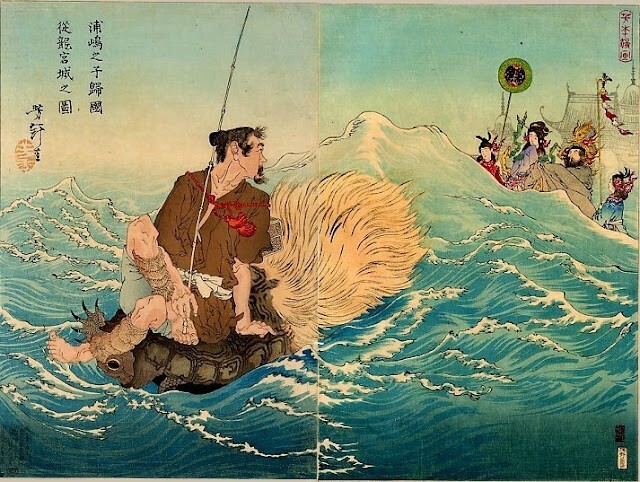
Urashima Taro is a Japanese folktale where the hero takes a journey deep under the sea to visit the legendary palace of the Dragon King. This magical ocean voyage is his reward for saving the Dragon King's daughter. However, when he returns home he opens a magical box and suddenly becomes an old man who realises 300 years have passed since he left. You can read the full tale, with more art here:
https://www.curiousordinary.com/2021/07/urashima-taro.html?spref=tw&m=1
#JapaneseFolklore #folklore #folktales #DailyFolklore #Japan #fairytales
Since I'm listening to older songs on YouTube tonight, I'm reminded of how amazing this Pomplamoose cover of Daft Punk's "Harder, Better, Faster, Stronger" is. The original had editing, but this one is live to tape.
Don't get me wrong, I love the Daft Punk original, too!
The entire "Live from Slane Castle" concert is fantastic, a DVD I've enjoyed watching many times. This particular song is good--but they're all good!
Phillip Winn
boosted

I know most of us are grumpy at the time change, cold weather, and busyness of the winter months. Tell me though, please….What little things do you really look forward too about this time of year, or get to rediscover your love for around this time? For me it’s long sleeve shirts. I feel like I’m wearing armor basically compared to what I wear during the summer months.
Phillip Winn
boosted

“Death blowing bubbles,” 18th century. The bubbles symbolize life's fragility. This plaster work appears on the ceiling of Holy Grave Chapel in Michaelsberg Abbey, Bamberg, Germany. After the monastery’s dissolution in 1803, the buildings were used as the city's hospital.
#histodons #sciart #art #histodon #WeirdHistory #MedMastodon #ScienceMastodon #strangerthings #history #historian #medhistory #histsci #histmed #intro #introduction
Phillip Winn
boosted

Color foliage in northern Japan. I love autumn. #Japan #photography #autumn #nature #color

Phillip Winn
boosted

WHICH GENERATION ARE YOU?
(Boost for reach) ❤
Only four days remain to get in on the Kickstarter for Cracking the Cryptic's Greatest Hits Volume 2!
If you have even a passing interest in #sudoku, you owe it to yourself to develop a deeper interest, and preferably to do so before this campaign ends Friday.
I have the first volume from last year's Kickstarter, and it is fantastic, but many of the puzzles are fiendishly difficult for me, so I haven't finished them all. Also, the campaign hit a stretch goal for spiral binding, so I've upgraded my pledge this time around to get a reprint of that first volume that can lay flat on a table more easily.
I don't get anything out of this pitch, I just love the YouTube channel, love the first book, and want to see Simon and Mark continue to succeed.
I only just learned that posts that mention a tag only in the "CW" content warning label don't actually show up in results for that tag. So my extended post on #mastodon which featured #nerdery ended up not showing up as I expected it to.
https://qoto.org/@pwinn/109343270833122665
#TIL Today I Learned
#blog I don't intend to do this more than once, but here are a few daily word games people might enjoy, along with an example of what is shared when you "Share Results" for each.
The one everybody knows, of course, is Wordle, found at https://www.nytimes.com/games/wordle
Wordle 513 4/6
⬛🟩⬛⬛🟩
⬛🟩🟨⬛🟩
⬛🟩⬛🟩🟩
🟩🟩🟩🟩🟩
Another polished game with a bit more complexity is Waffle, found at http://wafflegame.net
#waffle297 4/5
🟩🟩🟩🟩🟩
🟩⭐🟩⭐🟩
🟩🟩🟩🟩🟩
🟩⭐🟩⭐🟩
🟩🟩🟩🟩🟩
🔥 streak: 24
🏆 #waffleelite
wafflegame.net
That game also offers a weekly "Deluxe" version:
#deluxewaffle25 2/5
🟩🟩🟩🟩🟩🟩🟩
🟩⭐🟩⬜🟩⬜🟩
🟩🟩🟩🟩🟩🟩🟩
🟩⬜🟩⬜🟩⬜🟩
🟩🟩🟩🟩🟩🟩🟩
🟩⬜🟩⬜🟩⭐🟩
🟩🟩🟩🟩🟩🟩🟩
wafflegame.net
It is occurring to me as I write this that I should have picked a day and week in which my results for #waffle were slightly better.
My most recent discovery, thanks to @Spinybadger, is Thirdle. While that game offers a text-only share like the above, and an image+link share, for the sake of mastodon I'm going to post an image.
Phillip Winn
boosted

The thing about Twitter is that it really lacks a lot of the features you'd expect from a true Mastodon replacement.
For example, there's no way to edit your toots (which they, confusingly call "tweets"—let's face it, it's a bit of a silly name that's difficult to take seriously).
"Tweets" can't be covered by a content warning. There's no way to let the poster know you like their tweet without also sharing it, and no bookmark feature.
There's no way to set up your own instance, and you're basically stuck on a single instance of Twitter. That means there's no community moderators you can reach out to to quickly resolve issues. Also, you can't de-federate instances with a lot of problematic content.
It also doesn't Integrate with other fediverse platforms, and I couldn't find the option to turn the ads off.
Really, Twitter has made a good start, but it will need to add a lot of additional features before it gets to the point where it becomes a true Mastodon replacement for most users.
#nerdery #mastodon TL;DR: I believe all companies that run their own email servers today should also be running their own mastodon servers.
Armin Ronacher claims "Scaling Mastodon in Impossible," a claim which may well be true, given how one defines "scaling" (or "impossible").
https://lucumr.pocoo.org/2022/11/14/scaling-mastodon/
But his primary claim, in big letters, is "Decentralization is a Questionable Goal," which seems a pretty bold claim to make during the period of time in which American oligarchs are demonstrating why centralization, using Facebook and Twitter as example, is a goal for which the question has been answered in the negative. Let's try and follow the logic.
> Decentralization promotes an utopian view of the world that I belief fails to address actual real problems in practice.
I'm not sure how decentralization does that. If I believed in a utopia, I would assume that the issues at Facebook and Twitter would work themselves, or never occur in the first place. We're far from a utopia, which is something the writer goes on to acknowledge two sentences later after a contradictory footnote.
> All of these things [including mastodon] have one thing in common: distrust.
So is it utopian, or dystopian? Distrust isn't something I associate with utopia! Also, I skipped over a fascinating footnote, which includes:
> Traditional banks are also decentralized, but they follow shared rules. I can send from my Austrian bank to a bank in Estonia and it will work. The tech behind the scenes is not even all that terrible. It does not really look like a decentralized thing because there is a lot of regulation and you can't just start a bank, but it would be hard to argue that it's not decentralized.
So far in this essay questioning decentralization, we've seen a reversal of utopian and dystopian, plus a great example of decentralization working very well. Without even mentioning telephones or email yet!
Next we get to the meat of his argument, I hope, as the author explains that decentralized package management has been deprecated in the Python programming language in favor of a centralized package management system called PyPI, and makes an isolated reference to NPM to remind us that Node.js has done the same thing. This isn't described as an unmitigated good, and the author is at pains to highlight past complaints about PyPI, and doesn't even mention NPM's infamous left-pad incident, and in fact both PyPI and NPM are often brought up as example of how centralization has hurt both language ecosystems.
Yes, trade-offs aside, there are definitively advantages and efficiencies to centralization. So far no oligarchs have set their sights on controlling Python or Node.js packagement management, so perhaps the biggest issues haven't surfaced yet, but Twitter isn't in that enviable position.
The author seems to understand that they are on very shaky ground at this point, as their several feints against decentralization seem to keep circling back around to praising decentralization, so we shift tactics:
> Mastodon encourages not just decentralization, but federation. You can pick your own mastodon server but you can also communicate with people on other instances. I will make the point that this is the root of the issue here.
Mastodon is brittle. ActivityPub (the protocol which underlies mastodon) is messy.
> The thing does not scale to the number of users it currently has and there is probably no trivial way to fix it up.
If I'd invested a dollar into $TWTR every time someone said something like that during the four years or so before Twitter was moved from Ruby to Java, I'd have bought many, many shares and then cashed them in for $54.20 per share a few weeks ago! And yes, mastodon is written in Ruby also, so it seems likely that a rewrite in something else--a non-trivial task--will be necessary. In fact, mastodon is not the only ActivityPub implementation, and other compatible software already exists written in things that are not Ruby. I'll keep refering to mastodon in this article, but please substitute any other ActivityPub software in its place.
But, the author points out, the real issue is that we can't even universally agree on what things should look like! Some people want huge servers, other people wish everybody would run their own servers-for-one, some servers are designed for trolling and chaos, while others are so tightly managed that they block servers that don't sufficiently bend the knee to their judgement about third parties.
It's true! This "wild wild west" approach that is inherent to mastodon is very different, and is possibly one of the weakest points when compared to a centralized service. I think most people would say it's dramatically outweighed by the stronger points, but if you're the sort of person who assigns zero points to the fact that Facebook and Twitter are now controlly eclusively by two American oligarchs, I guess you're going to focus on moderation challenges more.
I'm on that qoto.org instance he mentions is still blocked by some number of servers. I'll link to the server owner's explainer for why: https://qoto.org/@freemo/109319817943835261
The author now suggests we are unlikely to agree, but there is another issue: Unpaid Labour and Opsec. While Twitter and Facebook have lawyers and can buy and sell politicians, mastodon server owners don't. They give the example of a large company with 140k followers on Twitter joining a small instance, and... wait, why would that ever happen?
It seems like some of these problems are solved by others. Why would a large publicly-traded company ever join an independent mastodon instance in the first place? They don't user elilillyceo@hotmail.com for email, do they? They've run into trouble recently by trusting Twitter.com to protect their brand identity, which turned out to be a mistake on that centralized service. The popular story is that someone paid $8 to get a blue check put on their own Twitter account, impersonated Eli Lilly to highlight the egregiously-high price they charge for insulin, and Eli Lilly lost $16 billion in the stock market as a result. I think the entire pharmaceutical industry took a huge hit around the same time, so I'm not convinced, but it seems to me that decentralization solves both the imaginary scenario the author outlines and the real-life scenario with the centralized Twitter at the same time. The Eli Lilly company controls the lilly.com domain, which they already use for email. Emails that come from elilillyceo@yahoo.com are obviously fake, while emails that come from d.ricks@lilly.com should probably be believed. Similarly, it turns out that tweets from @EliLillyandCo@twitter.com were not to be believed, despite the blue check, but mastodon posts from @pr@lilly.com are clearly official, since they come from the official Eli Lilly domain.
I believe all companies that run their own email servers today should also be running their own mastodon servers.
Any companies paying another company to provide their email service (but using their own domain name) today should also be paying another company to provide their mastodon service (but using their own domain name).
That solves several problems at once, and seems obvious.
The author goes on to suggest they have had very-private conversations on Twitter, which... don't do that! If the conversations are very private, use Signal. Neither Twitter nor any mastodon server is private enough for private messages.
The author is not wrong that mastodon faces challenges. They are only wrong in ignoring the even bigger challenges Twitter faced in the past and present and future. Will things be rough going forward for mastodon? Undoubtedly! Will there be a future mass-migration away from Ruby toward something more efficient, and maybe an incompatible version of ActivityPub with beaking changes, and other assorted technicaly challenges? Probably! But scaling mastodon is no more impossible than scaling Twitter was, it's just difficult. Decentralization is not a questionable goal, it's the only option when oligarchs run roughshod on the world stage. The future is going to be interesting, and the present is wild.
I, for one, am here for it.
Phillip Winn
boosted








Can a photograph lie or mislead? it's an interesting subject.
Here is an example, taken on the streets of Glasgow.
I don't usually photograph homeless people, it doesn't feel right to me. But this exchange caught my eye.
It looks like the man is remonstrating with the young woman, but he's not, he was telling her where she could find help and shelter.
It made me realise that care is needed when taking or presenting street photographs.
#photography #streetphotography #ethics

- Pronouns
- he/him
- Pronounce
- like "Quinn"
Love conquers fear
#nerdery #books #puzzles #ttrpg #anime #Christian #feminist #antiracist #photography #sudoku #golang #python #OpenWeb #AIart #GenshinImpact #tfr
Joined Nov 2022
