

R. A. Dehi @radehi@social.cleverlibre.org
I read a lot. Sometimes I learn things. I like making things. I think reading and doing are complementary.
Joined Nov 2022
R. A. Dehi
boosted

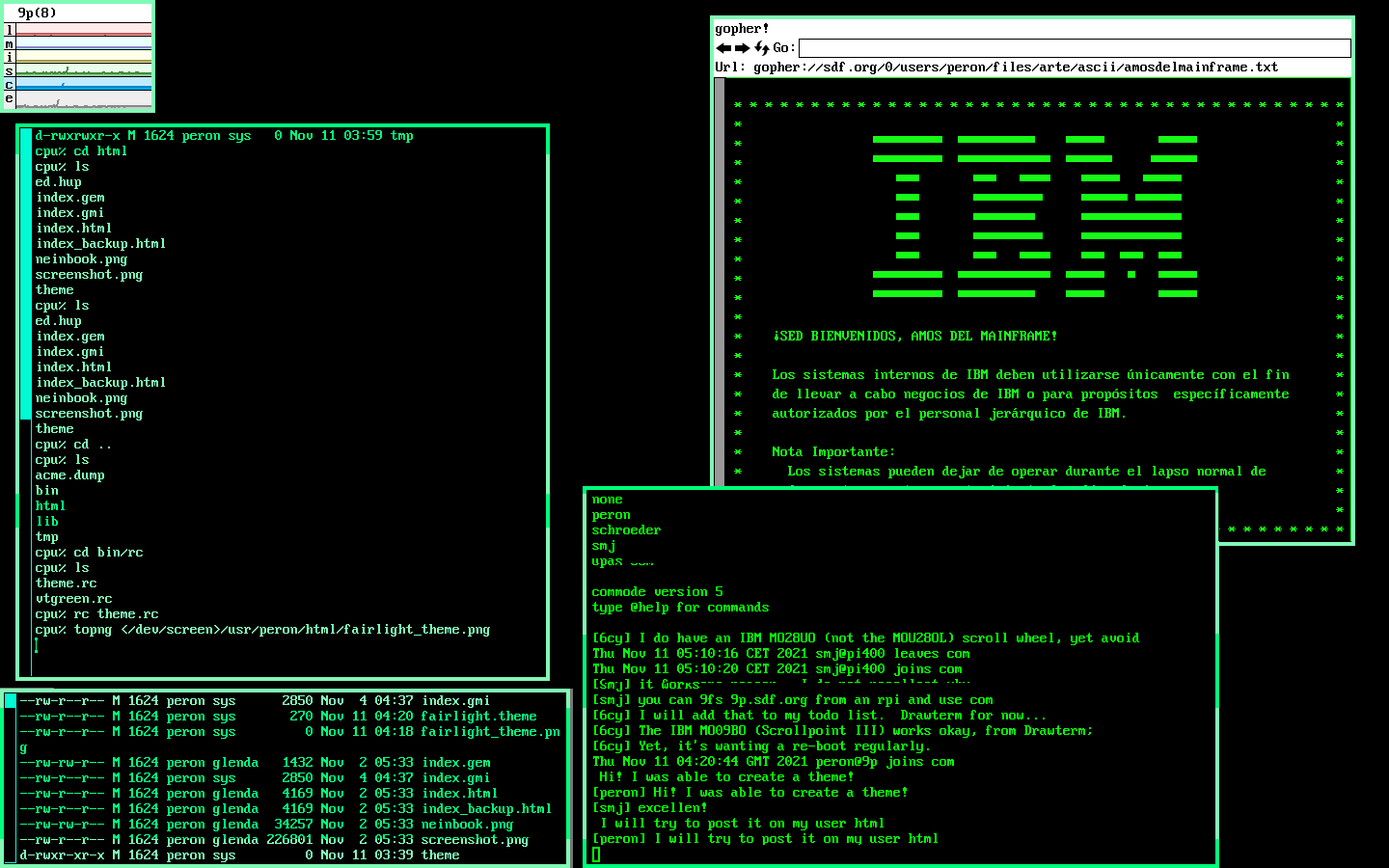
#plan9 from Bell Labs is a research operating system developed at Bell Labs starting in the late 1980s.
Its original designers and authors were Ken Thompson, Rob Pike, Dave Presotto, and Phil Winterbottom. They were joined by many others as development continued throughout the 1990s to the present.
R. A. Dehi
boosted

I just presented Art Spiegelman with the National Book Award Medal for Distinguished Contribution to American Letters, on the same day that PENAmerica put out a letter signed by Art and Margaret Atwood and me, among others, protesting the latest round of book bannings.
https://pen.org/spiegelman-atwood-sign-pen-america-letter-against-missouri-book-bans/
@dec_hl sweet, it's a Mastodon client that runs in DOSBox?
@gregeganSF Sounds like nine out of ten college students.
R. A. Dehi
boosted

If you download your Twitter archive it arrives wrapped as a static HTML page, which is not very useful for doing anything with, and worse: it requires the original account to be still active to do useful things like enlarge the images since they use t.co links.
So here's a Python script to convert a Twitter archive to markdown or other formats: https://github.com/timhutton/twitter-archive-parser
Now you can archive your tweets in any way you want.
@kreyren Hmm, it sounds like you're looking for task-related context-sensitive help, rather than a manual you'd read from beginning to end. But is not clear to me how to do that for a programming language (except in the case of compiler errors, of course, but Scheme doesn't have a lot of compiler errors). Most of what is needed in programming-language documentation is "which language features or library functions do I need to write this program that I haven't written yet" rather than "how do I use library function X", isn't it?
But it sounds like Racket comes closer than Guile?
Example code is super important for programming language explanations.
```
using StringVec = std::vector<std::string>;
std::expected<StringVec, ErrorCode> x;
std::expected<StringVec, ErrorCode> f();
```
I don't know how to see the "Markdown" source you tried. Mastodon's "Markdown" is pretty far from being Markdown but I have been able to get line breaks in code blocks.
@kreyren Hmm, what would you consider to have exemplary documentation? Racket? I've always thought the GNU manuals were first-class.
@allenholub Mystery meat UI has become hip again; 40 years ago knowing how to use it showed you belonged to a technical community, and now it shows you know how to use Instagram. A user community with tight enough cohesion can overcome even the worst UIs.
R. A. Dehi
boosted


@radehi
Yeah.
I don't have the one I did for Xanadu up, since it's not open sourced yet, but here's something that translates between a span-based format and tkinter's mark-based format: https://github.com/enkiv2/misc/tree/master/mtv
(It's more complicated than it needs to be, because tkinter has a coordinate system for text positions that's fiddly and underspecified.)
@freemo I seem to be set to the qoto-no-ticket theme already so maybe changing the default did help people who were already signed up. What are tickets?
@enkiv2 @zens @alcinnz @mathew @BillSeitz Sure, like Xanadu links. Do you have a prototype of your offset-markup layout approach running?
@enkiv2 no, I think it's just the culture-war polarization, something to which he's particularly prone because he tends to be unyielding.
R. A. Dehi
boosted
Layout is really counterintuitive.
Then, when you have an algorithm to do a "good enough" job at it (like an HTML renderer has), all the knobs for changing default behavior end up being even more counterintuitive, because other behaviors will interact with whatever you change in unexpected ways.
I worked on ZZOGL, which had a very simple layout system that I quite like, but it was tough to get grid-like patterns with it unless you created invisible objects that overlapped visible ones (which I introduced to the spec specifically to make these layouts easier).
@enkiv2 @zens @alcinnz @mathew @BillSeitz Maybe DSSSL then? There's no reason this stuff has to be slow or write-only!
@enkiv2 Anti-trans at least. Part of the culture war.
@enkiv2 @zens @alcinnz @mathew @BillSeitz Transformational grammar stylesheets, like XSLT? position:fixed is maybe halfway there already.
I read a lot. Sometimes I learn things. I like making things. I think reading and doing are complementary.
Joined Nov 2022
