

R. A. Dehi @radehi@social.cleverlibre.org
I read a lot. Sometimes I learn things. I like making things. I think reading and doing are complementary.
Joined Nov 2022
@deshipu Sadly true. Suppose you could commit them to Git with GPG-signed tags or something, which is easy for others to replicate with the full history; wouldn't be as transient but then there's no identity other than the (transient!) GPG key.
R. A. Dehi
boosted
@deshipu Hmm, maybe it did work after all.
The archive.org snapshot of the Mastodon thread page does include various posts on the thread. Load progressively, but they load from archive.org and not fosstodon.org. Even the images in the posts load when I click through them.
But the images have URLs like http://web.archive.org/web/20221121163824/https://cdn.fosstodon.org/media_attachments/files/109/382/431/776/270/224/original/a1353c764b25ebad.png. Note that the timestamp embedded in the URL is 16:38:24, while the timestamp in the URL of the original page is 16:22. This suggests that archive.org is archiving the image successfully, but only when my browser loads the archived page and requests the image. The archival only works if I go and click on all the things in the thread that need to be archived!
My initial suspicion, however, was that archive.org only archived the Mastodon SPA and not the posts, and the SPA was requesting the posts at view time *from the original Mastodon server*. And that would have been a completely unsuccessful archival; upon viewing years later, it could have even included new information added by a malicious Mastodon server at that time. Is not so.
Should have known @brewsterkahle's team was pretty on the ball when it comes to archiving Mastodon since they even run their own instance.
@deshipu Hmm, maybe it did work after all.
The archive.org snapshot of the Mastodon thread page does include various posts on the thread. Load progressively, but they load from archive.org and not fosstodon.org. Even the images in the posts load when I click through them.
But the images have URLs like http://web.archive.org/web/20221121163824/https://cdn.fosstodon.org/media_attachments/files/109/382/431/776/270/224/original/a1353c764b25ebad.png. Note that the timestamp embedded in the URL is 16:38:24, while the timestamp in the URL of the original page is 16:22. This suggests that archive.org is archiving the image successfully, but only when my browser loads the archived page and requests the image. The archival only works if I go and click on all the things in the thread that need to be archived!
My initial suspicion, however, was that archive.org only archived the Mastodon SPA and not the posts, and the SPA was requesting the posts at view time *from the original Mastodon server*. And that would have been a completely unsuccessful archival; upon viewing years later, it could have even included new information added by a malicious Mastodon server at that time. Is not so.
Should have known @brewsterkahle's team was pretty on the ball when it comes to archiving Mastodon since they even run their own instance.
@deshipu Don't agree. Those aren't among the goals of the "programming patterns" movement. End-user comprehensibility isn't on their roadmap and never has been. Is an attempt at building something else by the same name.
@deshipu Maybe you could at least post the license on your blog? A link to a nonexistent Mastodon post might not be very convincing evidence of a license a month from now, and think this didn't work: http://web.archive.org/web/20221121162226/https://fosstodon.org/@deshipu/109382687875897192
@deshipu The "programming patterns" in the Portland Pattern Repository are not a pattern language in that sense; they are invisible to users and so fail to enable the "architect" to delegate design decisions to end users. And they do not form a coherent "pattern language".
@deshipu By the way, are these drawings under a CC license? Are fantastic.
@deshipu Some of these, including this one, sound like "design patterns" in Alexander's original conception: a language shared by users and designers that enables them to discuss a design.
Just as can imagine a non-architect saying, "Could we use some Ceiling Height Variation here?", I can imagine a non-programmer saying, "Could we add an Informal Notation space here?"
R. A. Dehi
boosted

Journalist @adamdavidson on moving to Mastodon: "I think we got lazy as a field and we let Mark Zuckerberg, Jack Dorsey, and, god help us, Elon Musk and their staff decide all these major journalistic questions."
https://themarkup.org/newsletter/hello-world/mastodons-moment
R. A. Dehi
boosted

I find it frustrating how user research about how normies prefer algo timelines is floated without acknowledging that it so far has always led to outrage-driven hellholes like Twitter or Facebook.
I don’t want to take it away from anyone just b/c I don’t like it, but if you don’t have a plan for this, I’m ok with the 99% scrolling thru TikTok & arguing with their racist uncles on Facebook about made up news—while this stays a tiny nerd hole.
My adrenal system is tired of outrage baiting.
@samplereality Well, it might be a more conservative estimate to say that Ruby wastes 99.7% of your CPU.
R. A. Dehi
boosted

I've now installed a "RT @" filter so Twitter retweets don't show up in my home feed (shakes fist at clouds)
@scottjenson I've signed up for GitLab using an email from a domain that certainly never "signed up" itself. I assume that still works.
R. A. Dehi
boosted

It's great how well crafted the Mastodon RSS feeds are. Just wrote a blog post about that.
R. A. Dehi
boosted

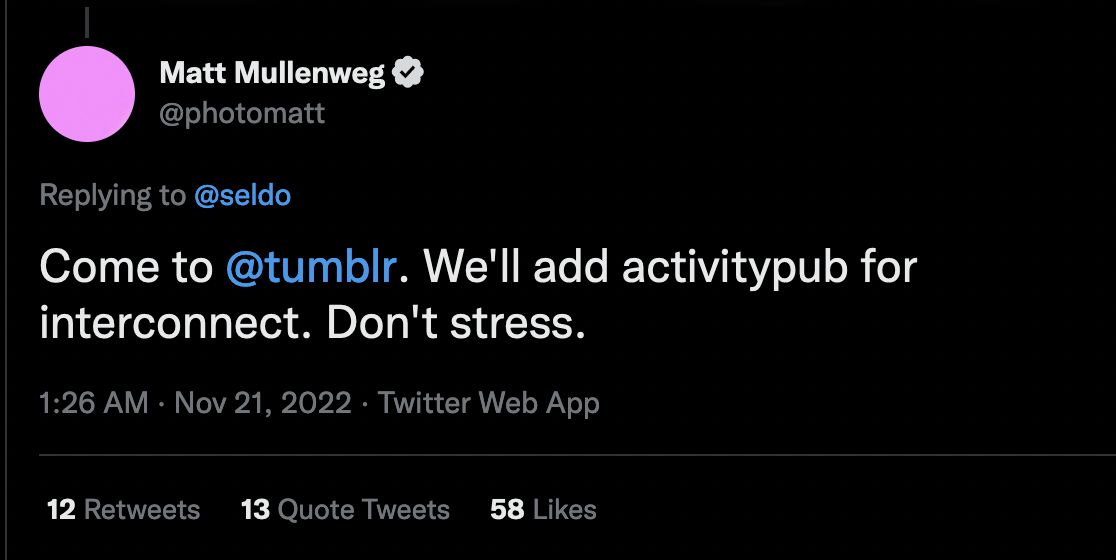
#Tumblr posts that they will be adding #ActivityPub to connect to the #Fediverse ASAP... #Mastodon
R. A. Dehi
boosted

Social media rambling
I actually have an old B&N Nook e-reader that I was able to get autographed by the inimitable @pluralistic - he wrote on the back of it “if you can’t open it, you don’t own it”
Feeling like there’s a corollary there for the modern day: “if it can be bought and destroyed by a billionaire, you don’t own it”
No billionaire can just “buy Mastodon”. They might buy an instance (I got one you can have for $8!), but the protocol is free forever.
@samplereality Twitter was written in Ruby at first too, but Ruby wastes 99.9% of your CPU and 90% of your RAM, so rewrote it in Scala years ago to make the costs much less enormous.
R. A. Dehi
boosted
@scottjenson @jeffjarvis You could simply do a very easy logistic regression of your own decision of "favorite" or "bookmark" or "reply" against the vectors of boost and favorite of all your follows to get a statistical prediction of how likely you are to favorite (or reply to, etc.) a post. Let's call that prediction "quality", acknowledging that is a firmly subjective (intersubjective?) kind of quality.
Then need some way to combine that "quality" metric with recency. I'd favor a quality threshold that varies over time to maintain a roughly constant rate of posts selected from the thousands of candidates per day: 5 per day, say, or 50 per day. Maybe only rate a post 48 hours after posting so all the data is in.
@scottjenson @jeffjarvis You could simply do a very easy logistic regression of your own decision of "favorite" or "bookmark" or "reply" against the vectors of boost and favorite of all your follows to get a statistical prediction of how likely you are to favorite (or reply to, etc.) a post. Let's call that prediction "quality", acknowledging that is a firmly subjective (intersubjective?) kind of quality.
Then need some way to combine that "quality" metric with recency. I'd favor a quality threshold that varies over time to maintain a roughly constant rate of posts selected from the thousands of candidates per day: 5 per day, say, or 50 per day. Maybe only rate a post 48 hours after posting so all the data is in.
R. A. Dehi
boosted


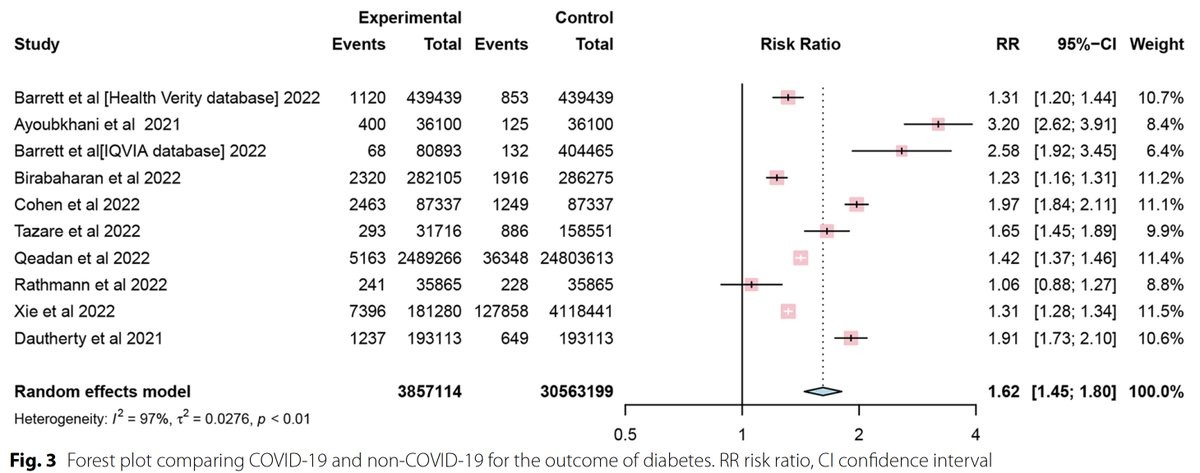
The consistent increased risk of diabetes after Covid across all age groups, highest in the first 3 months after infection, from a systematic review of 9 studies, ~40 million people
https://bmcmedicine.biomedcentral.com/articles/10.1186/s12916-022-02656-y
I read a lot. Sometimes I learn things. I like making things. I think reading and doing are complementary.
Joined Nov 2022
