

R. A. Dehi @radehi@social.cleverlibre.org
I read a lot. Sometimes I learn things. I like making things. I think reading and doing are complementary.
Joined Nov 2022
@davew I think DigitalOcean has them for $4 a month?
R. A. Dehi
boosted

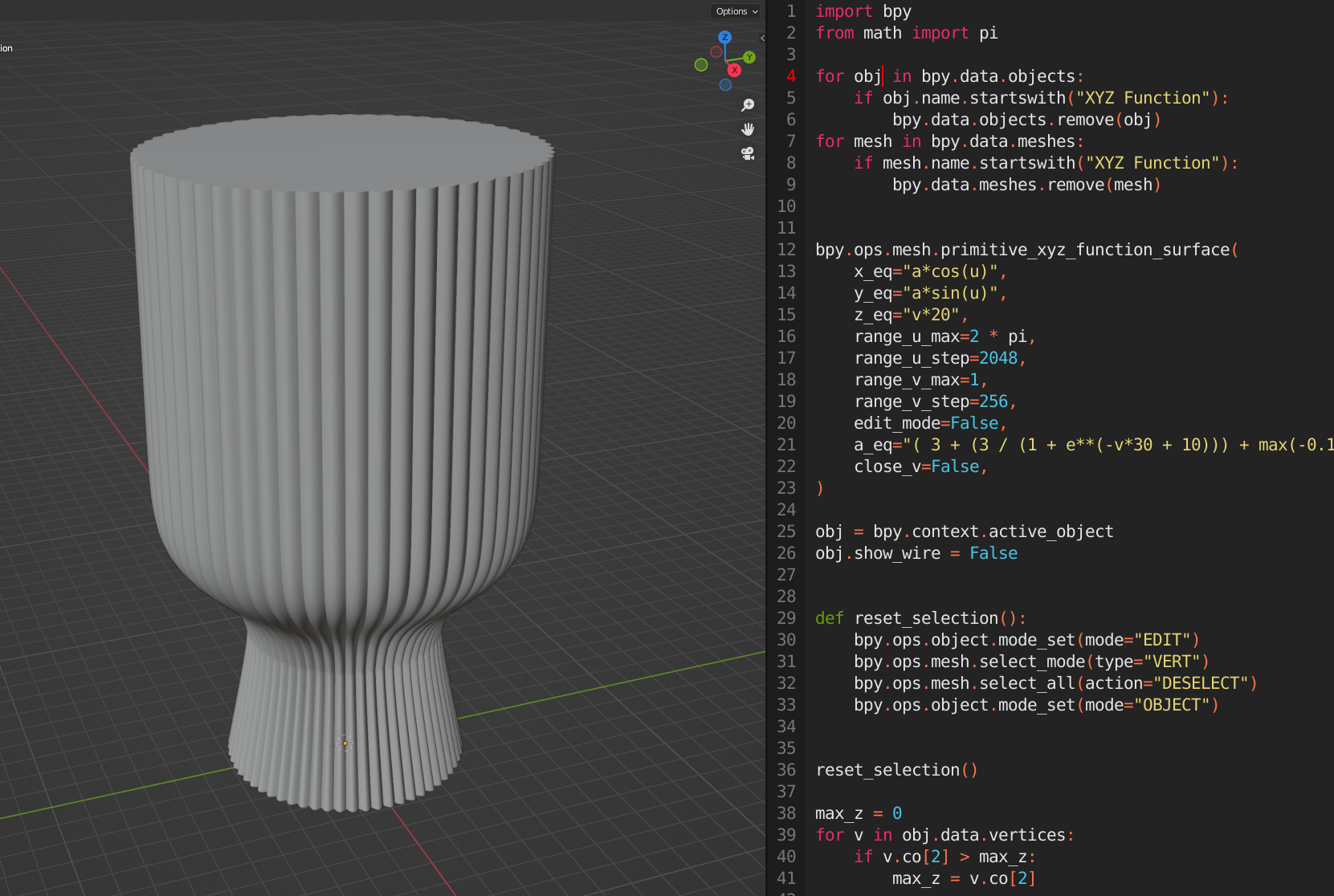
Experimenting with 3D modeling using mathematical functions to define a surface using Python in @Blender. A bit different than my usual go-to modeling tool @FreeCAD, but works really great! #3dprinting
R. A. Dehi
boosted

Touché.
The last thing I learned was TypeScript and the Playwright framework for automation and testing. I learned it because I found it a sound, useful, and innovative new technology.
In the past 27 years, I have seen lots of fancy whiz-bang technologies come and go. At the launch, during the early adoption phase of the technology it seems like, "THIS is IT! The next BIG THING. It's going to be super popular." Then, it runs into problems. and quietly fizzles out.
Use discernment.
@ownlifeful Certainly most new programming languages and tools have limited, if any, advantages over the existing alternatives, and often have fatal flaws. And both Perl and Java are still occasionally the best available alternative. In 95% or more cases, though, Python is a better replacement for Perl for me, and Kotlin looks like a similarly better replacement for Java to me, though the improvement looks to be larger. Python is 31 years old and Kotlin is 11 years old, so they probably won't fizzle out next year.
Rust, Zig, Nim, C#, Javascript, TypeScript, Go, Lua, Clojure, Elixir, Scala, Scheme, Haskell, etc., are sometimes better alternatives to Perl or Java, but none of them have the same nearly-across-the-board advantages over their respective languages that Python and Kotlin do.
And of course none of this is relevant if what you need to do is dive into an existing Perl or Java codebase to make a small change. I fixed a couple of critical bugs in a Perl codebase dating to the 90s last month; even though I hadn't touched the code in years, only took me a few minutes, and I expect it'll be good for several more years now.
@ownlifeful I felt bad about my post and deleted it slightly before your gracious response.
I was looking around to see what open-source alternatives to GPT-3 there are, and I came across something called "GPT-NeoX-20B". Apparently you need a pair of GPUs and 20 gigs of VRAM to run it?
R. A. Dehi
boosted

Responses to some frequent comments:
* I'm certainly not suggesting that algorithmic feeds should be imposed on everyone! Choice is great. I recognize that many, perhaps most current Mastodon users like chronological feeds.
* "Reverse chronological" is an algorithm, albeit a simple one. It's currently the only option. Chronological feeds are not normatively neutral. There is, unfortunately, no neutral way to design social media. https://mastodon.social/@randomwalker/109308664849924122
R. A. Dehi
boosted
@scottjenson @jeffjarvis Also if you're running your own instance you can afford to deploy staggering amounts of CPU power. Like, you could plausibly run GPT-NeoX-20B on your own dual-GPU rig to try to guess which Fediverse posts you'd be most interested in seeing.
The NSA can do this with Twitter, but you're not allowed to.
@scottjenson @jeffjarvis Also if you're running your own instance you can afford to deploy staggering amounts of CPU power. Like, you could plausibly run GPT-NeoX-20B on your own dual-GPU rig to try to guess which Fediverse posts you'd be most interested in seeing.
The NSA can do this with Twitter, but you're not allowed to.
R. A. Dehi
boosted

I was giving a computing ethics lecture about #FOSS and #antifeatures around 2014. Lots of folks there had never even heard of #FDroid. Maybe it's still not well-known?
F-Droid is a repository and platform for FOSS on Android. Their app can manage your other apps, much like you do with the Google Play Store.
When I need an Android app for something, I always check F-Droid first, just because the apps are trustworthy.
I'll reply with a few of my favorite apps on F-Droid... 🧵
R. A. Dehi
boosted

Greetings. I'm an armchair student of history (not just tech history), but given that I've been involved in the development of the Internet continuously since the early DOD ARPANET days (so, technically before there *was* an Internet) I'm watching the Twitter->Mastodon migration (and the nightmarish, shameful disintegration of Twitter itself) with considerable interest indeed. There is no historical precedent that I know of, and what's happening is even more remarkable given that it has been precipitated by a single chaotic individual in a matter of weeks.
The high speed with which I see social graphs rebuilding here is fascinating, and we can be sure that there are a bunch of PhD theses and books in the future that will attempt to explain all of this for future generations.
Sometimes when you're living through significant historical events it's not obvious except in retrospect, often many years later. What we're living through now with Twitter is clearly significant history, from technology, business, social, and other standpoints.
And even if Mastodon turns out ultimately to be a steppingstone on the way to other social media models able to scale far upward more easily, it is playing a crucial role now in providing a "lifeboat" for Twitter users who are unable to stomach what is happening to that firm with every passing day.
For all its many faults over the many years, we built the Internet to be resilient. And what we are seeing today is that not only has the technology met that goal from ARPANET onward, but thanks to the Internet's vast numbers of dedicated and caring users, even a monstrous train wreck like Elon's Twitter can't bring it (or us!) down.
Thank you all! -L
@lauren I haven't seen anything to contradict that point of view except the initial promises.
@bitsavers Hmm, I guess that kind of makes sense.
@lauren Seems to be about 2:1 in favor right now. I'm interested to hear how this interacts with the Twitter moderation policy council decisions.
@bitsavers I've never understood why people programmed in RPG. What's the appeal?
R. A. Dehi
boosted

Turns out you can skip the distance estimate (hard calculations) by considering axis-aligned bounding boxes with a long case analysis of possible box positions (e.g. if all corners are in the cardioid, check if the box crosses the axis and if the right edge of the box is the to the right of the cusp).
There are some irrational coordinates, but nicely you can just square both sides to get a dyadic rational that can be compared exactly.
And you can apply perturbation theory to the implicit cardioid test, provided you have enough precision in the low precision type (24 bits (float) is not enough, 53 (double) seemed ok in one brief shader test, I'm using 64). This increases the cost of the test, so it's good to be able to skip these for the whole view via AABB checks.
If using fixed point (instead of floating point) for high precision reference, you need 4x the fraction bits for intermediate calculations to avoid underflow / truncation error.
Symptoms of the problems were false positives (leading to bad images with too much interior) near the cusp, and some false negatives near the cusp too (correct image but takes longer than necessary).
@mathowie The bigger issue is that you're being manipulated into hating each other for the benefit of those who profit from factional conflict. You're careening headlong into a civil war.
Last year you shot each other to death 20,000 times. When the war starts, twenty million of you will die within two years. It'll be like 1000 years of "Homicide: Life on the Street" compressed into two years. Even if you don't die in the fighting, you'll suffer innumerable losses of freedom, opportunity, and peace of mind.
That's a much bigger risk to you personally than some jerkoff going postal at the supermarket. Right now mass shootings only serve to manipulate you into hating.
@mathowie I don't think that's a realistic fear. You're much more likely to be killed on the road driving by a traffic accident or at church by obesity. How many people do you know who were killed by gun violence? Compared to, say, suicide, heart disease, or cancer.
I also don't think is a realistic causal model, because people have been killing each other much longer than they've had guns. In fact, in most of America, we have less guns than you have in the US, as well as more restrictions on guns, but we kill each other more.
@lauren @mattblaze Sure, but I think Twitter was more important than 4chan, 8chan, Kiwi Farms, Zerohedge, Infowars, and YouTube put together; most of those platforms relied on Twitter for recruiting and for meme propagation. Twitter excels at getting people riled up for mob violence in a way that no other medium ever has. President Trump could never have existed without it.
So, what will the future look like for it?
@lauren @mattblaze Well, at least Space Karen has fired most of the people who built the Twitter that crushed your democracy. Maybe it will get better instead of worse. For example, by not existing.
I read a lot. Sometimes I learn things. I like making things. I think reading and doing are complementary.
Joined Nov 2022
