

robryk @robryk@social.cleverlibre.org
I enjoy things around information theory (and data compression), complexity theory (and cryptography), read hard scifi, currently work in infosec, am somewhat literal minded and have approximate knowledge of random things. I like when statements have truth values, and when things can be described simply (which is not exactly the same as shortly) and yet have interesting properties.
I live in the largest city of Switzerland (and yet have cow and sheep pastures and a swimmable lake within a few hundred meters of my place :)). I speak Polish, English, German, and can understand simple Swiss German and French.
If in doubt, please err on the side of being direct with me. I very much appreciate when people tell me that I'm being inaccurate. I think that satisfying people's curiosity is the most important thing I could be doing (and usually enjoy doing it). I am normally terse in my writing and would appreciate requests to verbosify.
I appreciate if my grammar or style is corrected (in any of the languages I use here).
Joined Nov 2020
robryk
boosted
The book you mentioned (https://www.worldcat.org/title/on-looking-eleven-walks-with-expert-eyes/oclc/820149011) has a very interesting premise: let's see what people with different expertise see in places that we usually see every day. I've only started reading it, so don't have an opinion on execution yet, but I love the premise.
@timorl who might also find it interesting.
TIL that in an ideal gas speed of sound does not depend on pressure (for a fixed gas, it depends only on temperature).
What temperature do various living beings freeze in?
Intercellular fluid of animals is isotonic with cell contents. Intercellular fluid of plants is slightly hypotonic: the cell walls are rigid, so they do not explode and for some reason having higher pressure inside cells is advantageous (perhaps just to avoid the reverse situation, which is fatal to plant cells).
This doesn't create a large different in intecellular fluid tonicity: blood is isotonic with ~0.9% NaCl in water (by weight)[1] and people seem to claim that intercellular fluid in plants is sometimes isotonic with ~1.0% NaCl[2]. I don't know if the cytoplasm tonicity differs to compensate, if the hypotonicity of intercellular fluid is small, or if I'm missing something else.
Anyway, this suggests that both blood and plants should freeze at (no more than) ~-0.6degC -- I expect that any salts that have no sodium nor chloride ions will push it down even further.
[1] https://www.medicine.mcgill.ca/physio/vlab/bloodlab/eryfrag1_n.htm
[2] https://sci-hub.se/10.2307/4447112
[3] https://en.wikipedia.org/wiki/Saline_water#Properties
Qoto's web UI stopped working for me. Attached screenshot is all I get, the stacktrace the error message gives me (hooray for JS minimization /s) can be found at https://pastebin.com/XGFmNtUN. My browser is Firefox 92.0.1 on Linux.
TIL that ignorance of the law doesn't always hurt
In many criminal law systems you are not committing a crime when your (possibly mistaken) view of the factual situation doesn't constitute a crime, even when what you are actually doing does constitute a crime, as long as your mistake is "excusable". For example, if you take someone else's items believing they're your own (e.g. because they are very similar in appearance), you aren't committing larceny. (PL ref: art. 28 KK, CH ref: Art. 13 StGB)
Similarly, if you believe that factual situation matches a situation where a justification (e.g. self defense, or higher need) would cause your action not to be a crime, it is not a crime even if you were mistaken, as long as the mistake was excusable (e.g. if you destroy a car window to reach a realistic looking doll which you believed to be an unconscious child, you aren't committing the crime of property destruction). (PL ref: art. 29 KK, CH ref: Art. 13 StGB)
What I learned today is that you are not committing a crime when you are excusably mistaken _about the law_. Obviously, definition of "excusability" of the mistake does lots of work here -- IIUC the standard test is (a) would a typical person similar to you in education and background suspect it's a crime (b) did you have an opportunity to learn/ask whether this action is legal. (PL ref: art 30 kk, CH ref: Art. 21 StGB[*])
I find this very surprising, because it's a direct contradiction of 'ignoratia iuris nocet'.
[*] the Swiss law narrows it down to people who didn't and couldn't have known that it's a crime; I'm not sure if that should be understood in the everyday literal meaning of that phrase -- the context in StGB seems to suggest that it's intended to be slightly wider, so I suspect that this phrase has some specific meaning.
h/t to @freemo who caused me to look up all those things
I ended up using Bubblewrap to provide omc with a readonly view of the entire filesystem except for the directory where it should write its output....
Production of pliers 50 years ago and today:
https://kinder.wdr.de/tv/die-sendung-mit-der-maus/av/video-frueher-heute-zange-100.html
Weirdest thing I've seen recently: omc, the OpenModelica compiler, tries to open all its input files (including libraries) for writing. It then closes them, reopens for reading, and proceeds as one'd expect.
It turns out that it does that to determine whether they're read-only: https://github.com/OpenModelica/OpenModelica/blob/81537a472c9f54ea14ecf335343005f18f4e83af/OMCompiler/Compiler/runtime/systemimpl.c#L366
Why? Well, it puts that information in some parser data structure: https://github.com/OpenModelica/OpenModelica/blob/cb76b3bfcad9782ea93ef88aa0979e00ad9ca942/OMCompiler/Parser/parse.c#L420
Why? Well, it uses that when printing an error message, so that the error message can say whether the file is writeable: https://github.com/OpenModelica/OpenModelica/blob/187041202b77c6b2c406f27d1e7add6db6016548/OMCompiler/Compiler/runtime/ErrorMessage.cpp#L136
Why? I have no clue.
How do I know? It messes with gittup's determination of what's an output of a compilation command.
Do you know of a succinct description of the mapping between Mastodon concepts (such as "public"/"unlisted"/... sharing modes, or visibility of replies) and ActivityPub activity entries (such as to,cc,bto,bcc,audience fields)? I would like to:
a) understand how various things I could send as a client to a Mastodon server correlate with things that I can do in a typical Mastodon client UI,
b) understand semantics of various Mastodon concepts better.
Why keyswitches for mechanical keyboards are just switches?
Nearly everyone wants to put them in a matrix arrangement, with diodes. I'd expect that including the diode in the keyswitch would cost less than, say, twice the unit cost of a diode, so less than ten cents. The cost of a keyswitch is in the ballpark of 1$, and I expect switches with diodes to be preferred by a lot by many people.
In fact, why not go further? Padauk MCUs cost ~5c each: we could then add one to each keyswitch and have them be addressable. That would make wiring the keyboard up much simpler (you just wire these 3 wires to all the switches in parallel).
Is there a reason why one can't buy such switches? I've only found references to some ancient (and thus rare) switches that had a diode built in, but nothing that can be actually bought for a sane price in quantity of ~100.
robryk
boosted

 🇳🇱
🇳🇱
An airplane that uses soap film for the wings is one of the coolest things I've seen in a while.
robryk
boosted


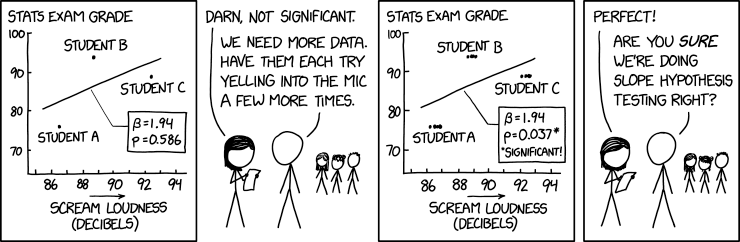
2533. Slope Hypothesis Testing
title text: "What? I can't hear--" "What? I said, are you sure--" "CAN YOU PLEASE SPEAK--"
(https://xkcd.com/2533)
(https://www.explainxkcd.com/wiki/index.php/2533
)
robryk
boosted
A series connection of parallel cells would be prefered over a parallel connection of series cells. The reason being that the control circuitry on a balancing battery management system is much simpler. The downside is that if a battery goes int he form of a short (which is how these things die a lot of times) it will take its parallel buddy with it. So simplicity has its draw backs too but int he end simplicity ultimately wins out.
@freemo MathJax issue: https://qoto.org/web/statuses/107122108820756990 renders as lots of whitespace and broken text in 3 column view for me. Screenshot attached.
When I look at the DOM, I see lots of spans with font size of 800%~900%.

I was slightly wrong. In actuality, \(I = C_1^T*J*C_1 + C_2^T*J*C_2\) for some \(C_{1,2}\). I should write it up fully, which I'll do soon (tm).
An easy way to see why the original was wrong is that this is the difference between \((a^T+b^T)M(a+b)\) and \(a^TMa+b^TMb\). I could have also been clued in by the impossible properties I claimed C has in [1].
Why the standard way to describe rotational inertia of a body is to specify its moment of inertia matrix?
Moment of inertia matrices are somewhat weird: not every symmetric semipositive-definite matrix is a valid moment of inertia matrix (note that there can be no body that has nonzero moment of inertia about exactly one of its principal axes).
Moment of inertia matrix is expected to satisfy I_{around e} = e^T*I*e [0]. At the same time I_{around e} = \sum m_i*r_{perp to e}^2 = \sum m_i*(r_{b1}^2+r_{b2}^2) where b1 and b2 are some orthogonal basis of the surface perpendicular to e.
This creates a natural idea: if we define J := \sum m_i*r_i^T*r_i, then I = C^T*J*C (see [1] for value of C), _and_ every semipositive definite J corresponds to an object that could possibly exist.
So, why don't we use this J instead of I? I think it is less confusing, and seems to be way better e.g. if we're numerically trying to find a moment of inertia that optimizes for something.
[0] So I = \sum m_i*||r_i||^2*Proj_{perp to r_i}^T*Proj_{perp to r_i}
[1] C = \sum_{i != j}e_i^T*e_j (btw. it's not immediately obvious to me that this definition is invariant wrt orthonormal base change, and if you have a succinct description of why it is so, I'd appreciate seeing it)
When a vertical stream of liquid is high enough, usually the stream starts to fragment into drops. The standard explanation for that that I believe is that the falling liquid is sped up, so the stream narrows, and at some point the stream is narrow enough that droplets are a lower energy state from a surface tension POV.
I today noticed that streams of my shower gel either never fragments into drops, or they require a height that I cannot provide before that happens.
Imagine a ball (of uniform density) rolling on a horizontal plane without slipping. Due to its symmetry its angular speed in the reference frame of the plane will remain constant over time if it's not disturbed[1]. Its angular speed has three components. What I found surprising (but is obvious if we present it this way) is that by only nudging the ball horizontally you can't get it to spin around the vertical axis: so, horizontal nudges allow one to explore only a 2d subspace of the 3d space of the angular speeds.
tl;dr I got surprised by a consequence of the fact that while rotations around different axes do not commute, infinitisemal rotations (and thus angular speeds) do commute.
[1] If its density was not symmetric, it could undergo precession and nutation.
@freemo qoto's Webfinger seems not to allow cross-origin requests, or at least Firefox thinks so.
When I try to use PeerTube's remote subscribe feature in Firefox (I tried to use it on video.mycrowd.ca), it fails and I see that a request to https://qoto.org/.well-known/webfinger?resource=acct:robryk@qoto.org has failed due to "CORS Allow Origin Not Matching Origin".
When I inspect response headers that trigger this, I see that they do contain "Access-Control-Allow-Origin: *" header, which should be enough to declare that the response can be provided across origins. However, the header is sent twice.
What I suspect is going on is that A-C-A-O is only supposed to have a single value. Specifying it twice is equivalent (according to HTTP spec IIRC) to specifying it once and concatenating values separated with a comma. "*,*" is not a value of A-C-A-O that allows cross-origin access, so Firefox refuses to provide the response back to the cross-origin requester.
Could you figure out why qoto is sending two copies of A-C-A-O in its responses? You can trigger that behaviour by doing `curl 'https://qoto.org/.well-known/webfinger?resource=acct:robryk@qoto.org' -H 'Origin: https://video.mycrowd.ca' -v`. Note that if the request has no `Origin` header, the reponse has only one A-C-A-O header.
How did spacecraft orient themselves using what was available in 1960s?
The obvious thing for things in Earth orbit is to find the Earth horizon and Sun; maybe find the direction the radio signals arrive from and/or their polarization.
If we are further from Earth, we need to figure it out before we can communicate, so the radio signals approaches don't work. Similarly, there's no horizon to speak of. Yet we managed to do it in 60s.
The first thing we can do is find Sun (simple: the brightest thing around) and Earth. How do we find Earth with no camera and no image processing? We know how far in angular distance we expect Earth to be from sun. So, we point an axis of our spacecraft at the sun and slowly rotate, while a photometer points at the correct angle off that axis. Once the photometer finds something bright enough (and not too bright), we stop the roll and keep tracking that bright thing, assuming it's Earth. We could (I don't know if that was ever done) instead use a radio receiver with an antenna that's angled in the same way.
What if the angular distance between Sun and Earth is too small (so that we wouldn't be able to get any sensible accuracy in the roll direction)? We do the same roll-and-observe-photometer trick to find Canopus, a very bright off-eclipctic star (it's in the southern hemisphere -- -50deg declination -- which is why e.g. I haven't ever knowingly seen it). It being off-eclipctic ensures that occlusions are rare, and it being _very_ bright makes it hard to confuse it with any other start (we discriminate by brightness and angular distance from the sun).
I knew about the concept of star trackers, but for a long time didn't know how they searched for the star. Picking the second brightest star (well, third) and constraining the sun-star angle is what I was missing.
Ref: https://ntrs.nasa.gov/api/citations/19750002096/downloads/19750002096.pdf (+ interesting details on how do we set up remote overrides for systems that are necessary for communication to happen using 60-70s technology
BTW This write-up ignores the questions of accuracy nearly completely; in part because I'm still confused how did the photoresistor-based sun trackers achieve an accuracy of a tenth of a degree (their fine alignment relied on driving the attitude so that two resistors' resistances were equal; I would expect their bias to creep due to some hard-to-predict differences in aging of different photoresistors, whether due to manufacting defects, or something as silly as different amounts of dust impacts, because the direction of motion wrt local dust was pointed in some slowly-changing direction wrt Sun and Canopus).
I enjoy things around information theory (and data compression), complexity theory (and cryptography), read hard scifi, currently work in infosec, am somewhat literal minded and have approximate knowledge of random things. I like when statements have truth values, and when things can be described simply (which is not exactly the same as shortly) and yet have interesting properties.
I live in the largest city of Switzerland (and yet have cow and sheep pastures and a swimmable lake within a few hundred meters of my place :)). I speak Polish, English, German, and can understand simple Swiss German and French.
If in doubt, please err on the side of being direct with me. I very much appreciate when people tell me that I'm being inaccurate. I think that satisfying people's curiosity is the most important thing I could be doing (and usually enjoy doing it). I am normally terse in my writing and would appreciate requests to verbosify.
I appreciate if my grammar or style is corrected (in any of the languages I use here).
Joined Nov 2020
