

sojournTime @sojournTime@social.cleverlibre.org
- GitHub (Personal)
- https://github.com/dataNerd23
Data Science PhD Student
Likes math, stats, space, and board games (especially Dominion: https://dominion.games/).
⬛️⬛️⬛️⬛️⬛️✨⬛️⬛️⬛️⬛️⬛️⬛️
⬛️✨⬛️⬛️⬛️⬛️⬛️⬛️⬛️⬛️✨⬛️
⬛️⬛️⬛️⬛️🛰️⬛️⬛️⬛️✨⬛️⬛️⬛️
⬛️⬛️⬛️⬛️⬛️🌎⬛️⬛️⬛️⬛️⬛️⬛️
⬛️⬛️🌒⬛️⬛️⬛️⬛️⬛️⬛️✨⬛️⬛️
⬛️⬛️⬛️⬛️⬛️⬛️✨⬛️⬛️⬛️⬛️⬛️
Joined Apr 2022
sojournTime
boosted

There are a lot of reasons to read this article. What was most interesting to me that the EA and rationalist communities might be turning its back on OpenAI
sojournTime
boosted

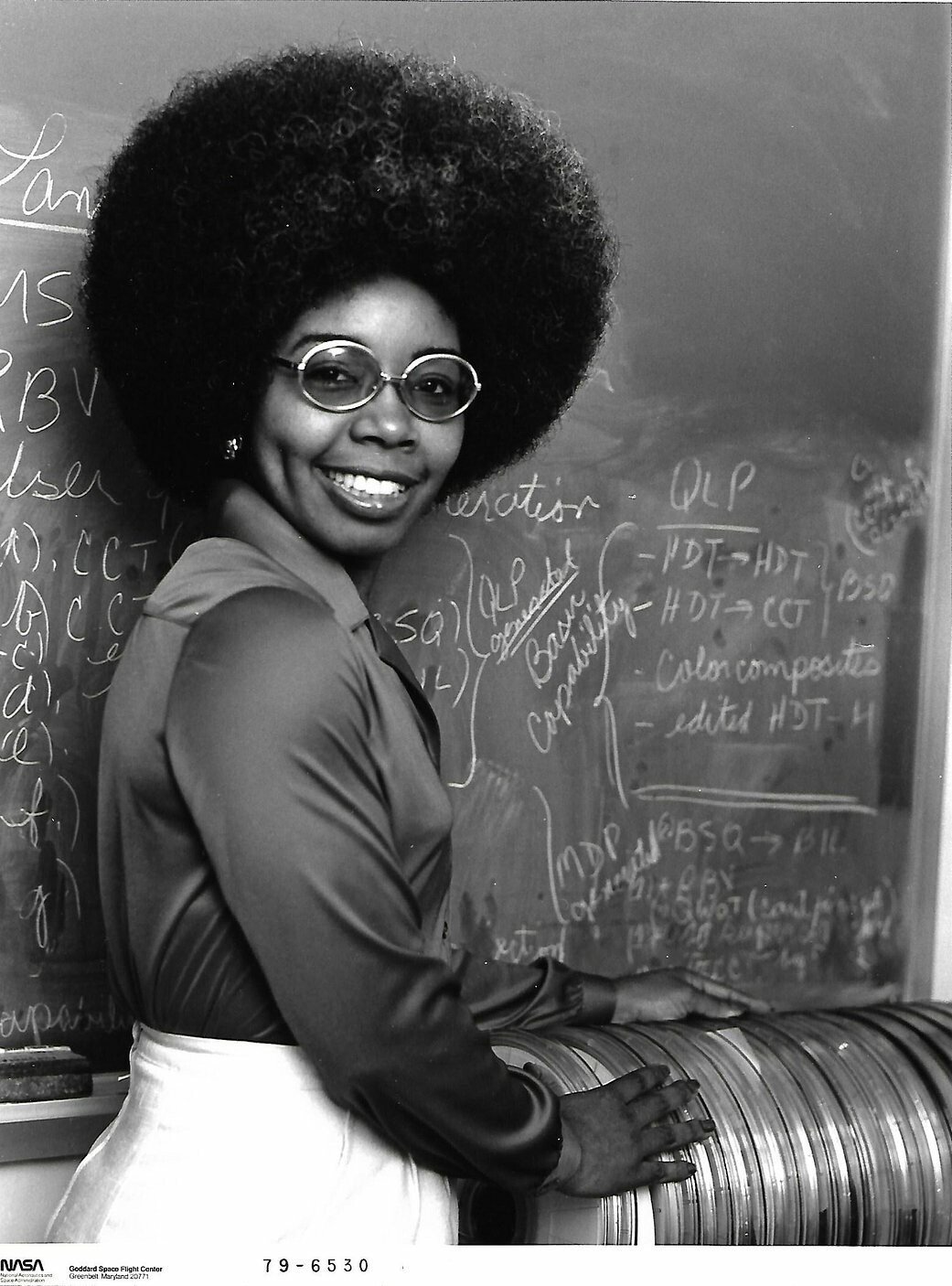
Meet the woman behind early @NASA_Landsat images: Dr. Valerie L. Thomas.
A self-taught programmer, she managed the development of Landsat image processing. Her work in the '70s helped show that satellite imagery could be used to support agriculture. https://go.nasa.gov/3EJMPgT #BHM
#NASA
sojournTime
boosted

HISTORY OF PHYSICS & MATHEMATICS
The problem of the Brachistochrone.
One of the topics considered by Galileo Galilei in his 1638 masterpiece, Dialogues Concerning Two New Sciences, is rates of descent along certain curves.
In Proposition V of “Naturally Accelerated Motion”, he proved that descent time of a body on an inclined plane is proportional to the length of the plane, and inversely proportional to the square root of its height.
1/
sojournTime
boosted

Adding an independent Gaussian variable is the same as doing a heat diffusion on the density. https://en.wikipedia.org/wiki/Convolution_of_probability_distributions
sojournTime
boosted

sojournTime
boosted

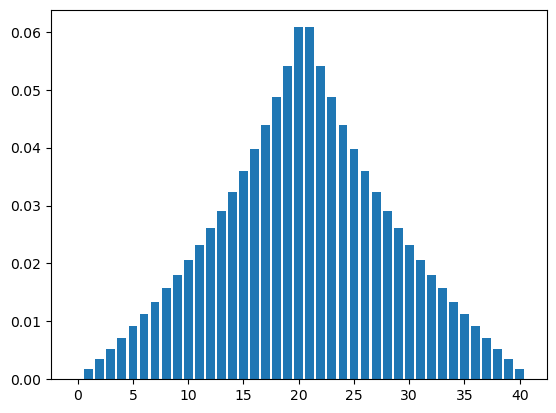
The 9yo nerdsniped me with a probability puzzle, which I have translated into maths below:
Suppose \(a\) is a random integer between 1 and 20 (inclusive) and \(b\) is a random integer between 21 and 40 (inclusive).
Now let \( c \) be a random integer between \( a \) and \( b \). What's the probability distribution of \(c\)?
Some partial solution:
@icecolbeveridge So this was a fun distraction! As several people figured out, the distribution is a double sum with very interesting limits:
\(p(X=x) = \frac{1}{400} \sum\limits_{y=\max(x, 21)}^{40}\sum\limits_{z=1}^{\min(x, 20)}\frac{1}{y - z + 1}\)
I uploaded a Jupyter notebook with my results and simulations:
https://github.com/dataNerd23/stochUnifBoundsProb
P.S.-I thought I could simplify the distribution with WolframAlpha, but alas, this is what it gave me:
sojournTime
boosted

Hello to everyone who is showing up because of my Runge phenomenon video! https://youtu.be/F_43oTnTXiw
sojournTime
boosted

How the Dunning-Kruger effect is just sugar for the ego (but mathematically wrong):
https://economicsfromthetopdown.com/2022/04/08/the-dunning-kruger-effect-is-autocorrelation/
sojournTime
boosted

@btcprox Let's think about this mathematically. Let \( x \) be the most overloaded symbol in maths and science-- oh wait.
sojournTime
boosted

"under the proposed popular vote system candidates would likely focus their campaigns on dense population centers, buying ads in larger media markets, and making promises to the benefit of the states that have those large cities."
Candidates would, reasonably, campaign where there are more voters.
It's not true that a candidate could concentrate in a few large cities and win. Even if a candidate got every single vote in the 100 largest cities, they'd only get 1/6 of the vote.
You may be concerned that they would OVERconcentrate in large population centers -- say, spending 75% of their time in the 10 largest cities. Handily, there's a nice way to empirically test this idea: within a state, where all votes are equal, Presidential campaigns spread out their events in proportion to the population. I found the evidence in this video very compelling:
https://www.youtube.com/watch?v=_gbwv5hf2Ps
"The way it is now, candidates need to visit the smaller states during a campaign, which provides more fairness."
Empirically, they don't visit all the states now. They only visit swing states:
Setting aside speculation about what would happen, I believe the fundamental principle of democracy is that every vote is counted equally. Under a popular vote, that happens by definition. Under the Electoral College, it doesn't -- any candidate would happily trade a California or Oklahoma vote for a Florida or Ohio vote. Some votes are worth more than others, and that's wrong.
sojournTime
boosted

@Pat
> Part of the problem is that people don’t realize that they aren’t voting for president, they never have
A bit pedantic, surely? Your ballot says it's for President, the names on it are those of the candidates... people realise as much as they need to get on with the business of voting. Maybe it's not precise enough for a detailed discussion of electoral mechanics like we're having here, but for casting one's ballot it's a perfectly sufficient mental model. I only made the distinction to try and explain the context to our curious friend :)
> A huge problem with a popular vote is that California and New York will essential pick the president because of their out-sized populations.
No. If we're going to be pedantic, under a popular vote system the states have nothing to do with picking the president; only the individual voters do. The fact that a sizable number of them live in this state or that is incidental, really.
sojournTime
boosted
@trinsec @sojournTime Short story (leaving out a few details):
Each state is worth a certain number of "electoral votes". The candidate who wins the most electoral votes becomes President.
Within each state, whoever gets the most votes gets ALL of the electoral votes. So, for example, if 51% of the people in Florida vote for you, you get all of Florida's electoral votes.
One consequence is that all of the political power goes to "swing states" that might go to either party in a given election. Everyone knows that California will go to the Democrats and Texas will go to the Republicans, so they get almost no campaign visits. Ohio, on the other hand, might go either way, so a LOT of campaigning happens there.
(An additional problem is that the number of electoral votes per state is not proportional to the state's population. This is a consequence of consolations made to slavers when the country was founded.)
The National Popular Vote Compact effectively ends this process and gives the Presidency to the candidate who gets the most votes.
sojournTime
boosted
@trinsec Alas, that's a different problem. Gerrymandering effects how legislators are elected; this is about electing the President.
Incidentally, I did a game jam game about gerrymandering. You can play it on the web here:
sojournTime
boosted
@trinsec
To offer a bit more background: the US Constitution was written in the late 1700s. It could take weeks to communicate down the length of the country, which presented challenges we don't see today - organising a single nationwide vote of the general public was logistically impractical. So the framers laid out a multi-step process:
1. The general public casts their votes for Electors
2. Electors meet at the state capital to cast their votes for President
3. Each state sends its Electors' totals to Congress, who adds them up and determines the winner.
Conventional campaigning is about convincing people to vote a certain way at step 1, a "faithless Elector" who votes for someone other than his pledged candidate would do so at step 2, and the events of 6 January a couple years ago were an attempt to influence Congress's determination of the winner in step 3.
Each state has a number of Electors equal to the total number of its Representatives (proportional to population) and Senators (two per state regardless of size), so the framers might have expected the states to use the existing ridings with a couple at-large statewide races for the two Electors corresponding to the Senators, but this isn't codified and the details are left to the states. Two small states still do things this way, but most now award the whole slate of Electors to the candidate with the plurality at the state level.
There's some disagreement as to why most states are winner-take-all. I take the view that it's self-interest: for swing states, this increases the payoff for winning and means candidates spend more effort and money to win its citizens' approval; for stronghold states it means the dominant party assures itself of that many more Electors on its side. But there are others who see this as a purposeful choice by the framers to avoid mob rule, and see this as an invention of great wisdom (or even Divine inspiration) on their part.
Now that we have the ability to conduct a single nationwide election, it would make a certain amount of sense to implement this - but amending the Constitution is really hard. There's a sizable cohort of Americans who revere the framers as religious prophets and consider any suggestion of modifying their writings akin to sacrilege. On top of that, the current system gives a small but durable advantage to less-populous states, who would actively oppose any attempt to weaken their position.
So instead the workaround is that if a group of states which collectively comprise more than half the Electoral College all sign onto this compact, they'll each award their slates to whichever candidate wins the *national* rather than statewide vote, guaranteeing him a majority. As @Pat points out, the legality of the plan to have Congress approve the compact after the states agree is unclear, and circumventing the normal amendment process this way is controversial.
@Pat @peterdrake @trinsec I don't want to get too into this, but the Wikipedia page does mention the legality of the compact referencing the compact clause:
https://en.m.wikipedia.org/wiki/National_Popular_Vote_Interstate_Compact#Legality
@trinsec @peterdrake the Wikipedia page is informative, though a little verbose:
https://en.wikipedia.org/wiki/National_Popular_Vote_Interstate_Compact?wprov=sfla1
@trinsec @peterdrake not quite. It's a legal agreement between states to work together to circumvent the electoral college to essentially implement a popular vote (see this video for more info: https://youtu.be/tUX-frlNBJY)
@peterdrake I prefer CGP Grey's contraction of the term as NaPoVoInterCo:
sojournTime
boosted
The National Popular Vote compact has passed house and senate committees in Minnesota!
https://www.nationalpopularvote.com/state/mn
If you live in Minnesota, please urge your legislators to pass the bill:
https://www.national-popular-vote.com/Campaign/MN/MN0
If Minnesota joins, we'll have 205/270 = 76% of the electoral votes required for the compact to take effect!
#uspol #minnesota #NationalPopularVote #EveryVoteEqual #democracy
- GitHub (Personal)
- https://github.com/dataNerd23
Data Science PhD Student
Likes math, stats, space, and board games (especially Dominion: https://dominion.games/).
⬛️⬛️⬛️⬛️⬛️✨⬛️⬛️⬛️⬛️⬛️⬛️
⬛️✨⬛️⬛️⬛️⬛️⬛️⬛️⬛️⬛️✨⬛️
⬛️⬛️⬛️⬛️🛰️⬛️⬛️⬛️✨⬛️⬛️⬛️
⬛️⬛️⬛️⬛️⬛️🌎⬛️⬛️⬛️⬛️⬛️⬛️
⬛️⬛️🌒⬛️⬛️⬛️⬛️⬛️⬛️✨⬛️⬛️
⬛️⬛️⬛️⬛️⬛️⬛️✨⬛️⬛️⬛️⬛️⬛️
Joined Apr 2022
