

sojournTime @sojournTime@social.cleverlibre.org
- GitHub (Personal)
- https://github.com/dataNerd23
Data Science PhD Student
Likes math, stats, space, and board games (especially Dominion: https://dominion.games/).
⬛️⬛️⬛️⬛️⬛️✨⬛️⬛️⬛️⬛️⬛️⬛️
⬛️✨⬛️⬛️⬛️⬛️⬛️⬛️⬛️⬛️✨⬛️
⬛️⬛️⬛️⬛️🛰️⬛️⬛️⬛️✨⬛️⬛️⬛️
⬛️⬛️⬛️⬛️⬛️🌎⬛️⬛️⬛️⬛️⬛️⬛️
⬛️⬛️🌒⬛️⬛️⬛️⬛️⬛️⬛️✨⬛️⬛️
⬛️⬛️⬛️⬛️⬛️⬛️✨⬛️⬛️⬛️⬛️⬛️
Joined Apr 2022
sojournTime
boosted

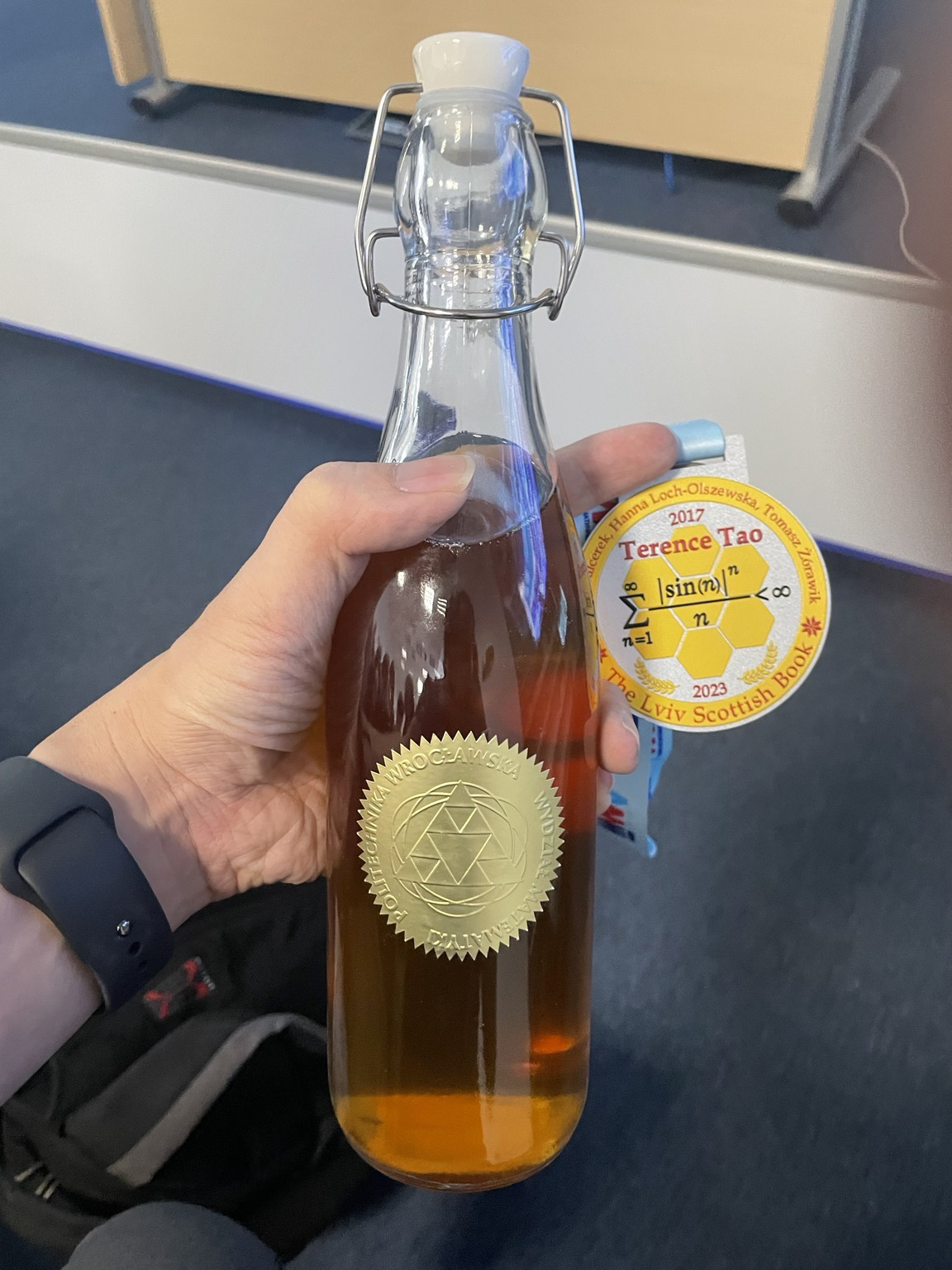
In 2017, I managed to solve a problem from the “Lviv Scottish book” in https://mathoverflow.net/a/282290/766 . The problem had a prize of “butelka miodu pitnego" (a bottle of honey mead). Today, while I was in Warsaw, some representatives from Lviv, Ukraine came (by train, as the Ukraine airspace is obviously closed) I was very touched and honored to unexpectedly receive the prize in person.
sojournTime
boosted

sojournTime
boosted

In a freakish bit of irony, my sabbatical replacement is going to Burning Man.
sojournTime
boosted
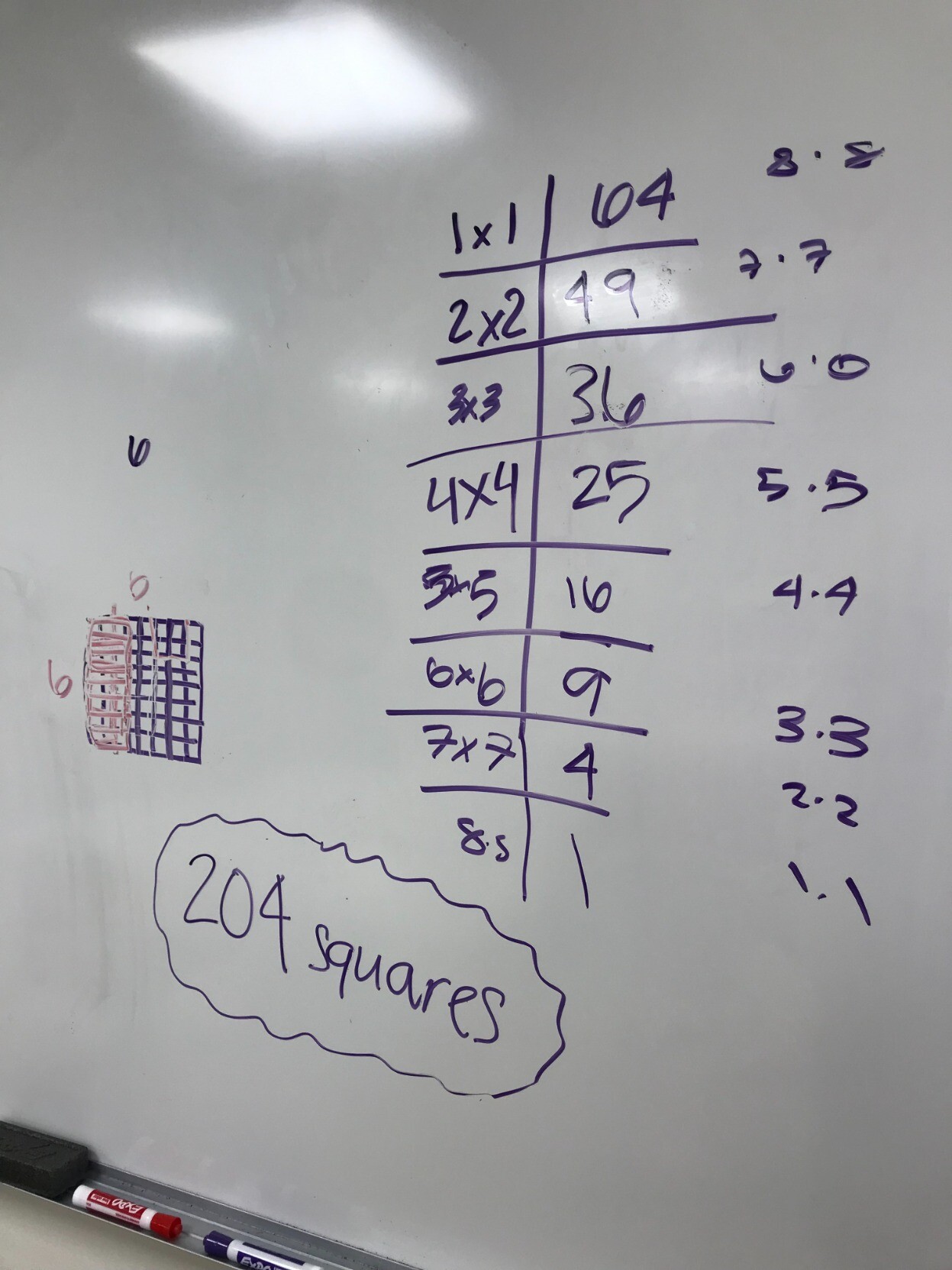
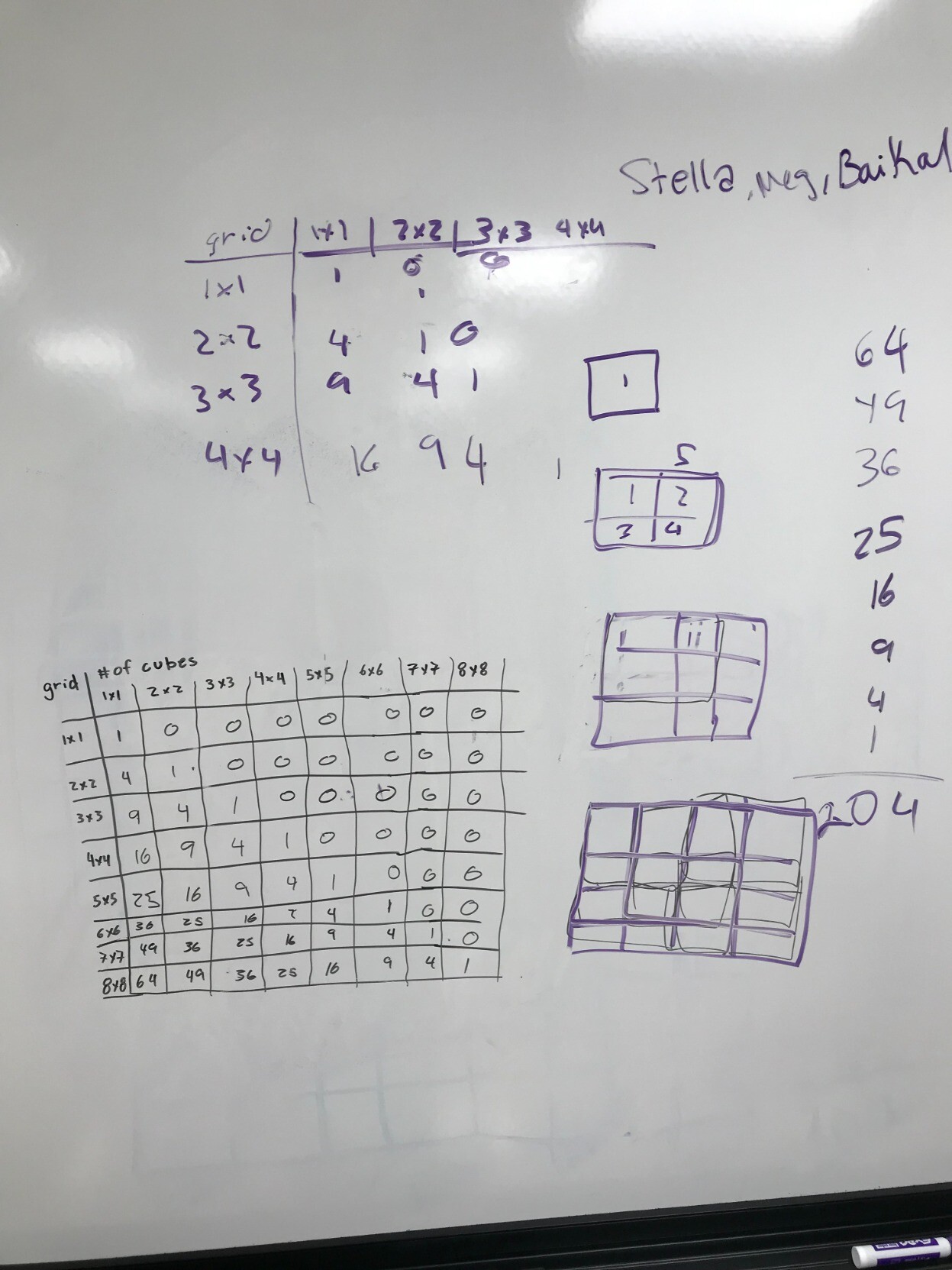
Day two in #Algebra2 went well. Did the checkerboard problem (Counting the number of squares in an 8x8 checkerboard, look for patterns, extend to an nxn board). Yesterday we experienced how using tables to organize our thinking could be useful and illuminate unforseen patterns, so I was happy to see many groups using tables today. I was especially giddy when two groups saw they had different numbers in their tables, but they added up to the same total, and then proceeded to spend some time trying to understand eachother's approach. All in all, a good day.
sojournTime
boosted

An illusion of predictability in scientific results: Even experts confuse inferential uncertainty and outcome variability
https://doi.org/10.1073/pnas.2302491120
Visualizing only inferential uncertainty can lead to significant overestimates of treatment effects, even among highly trained experts
Solution: when possible, plot individual data points alongside statistical estimates
sojournTime
boosted

@standupmaths "Skills and qualifications: knows π to at least 3 significant figures (more in some even-numbered years)"
sojournTime
boosted

@christianp I’m going to need a CV for the first time in a while.
sojournTime
boosted

Important sets:
ℂ the complex numbers
ℕ the natural numbers
ℚ the rational numbers
ℝ the real numbers
𝕏 the set of fascists wannabes
ℤ the integers
sojournTime
boosted

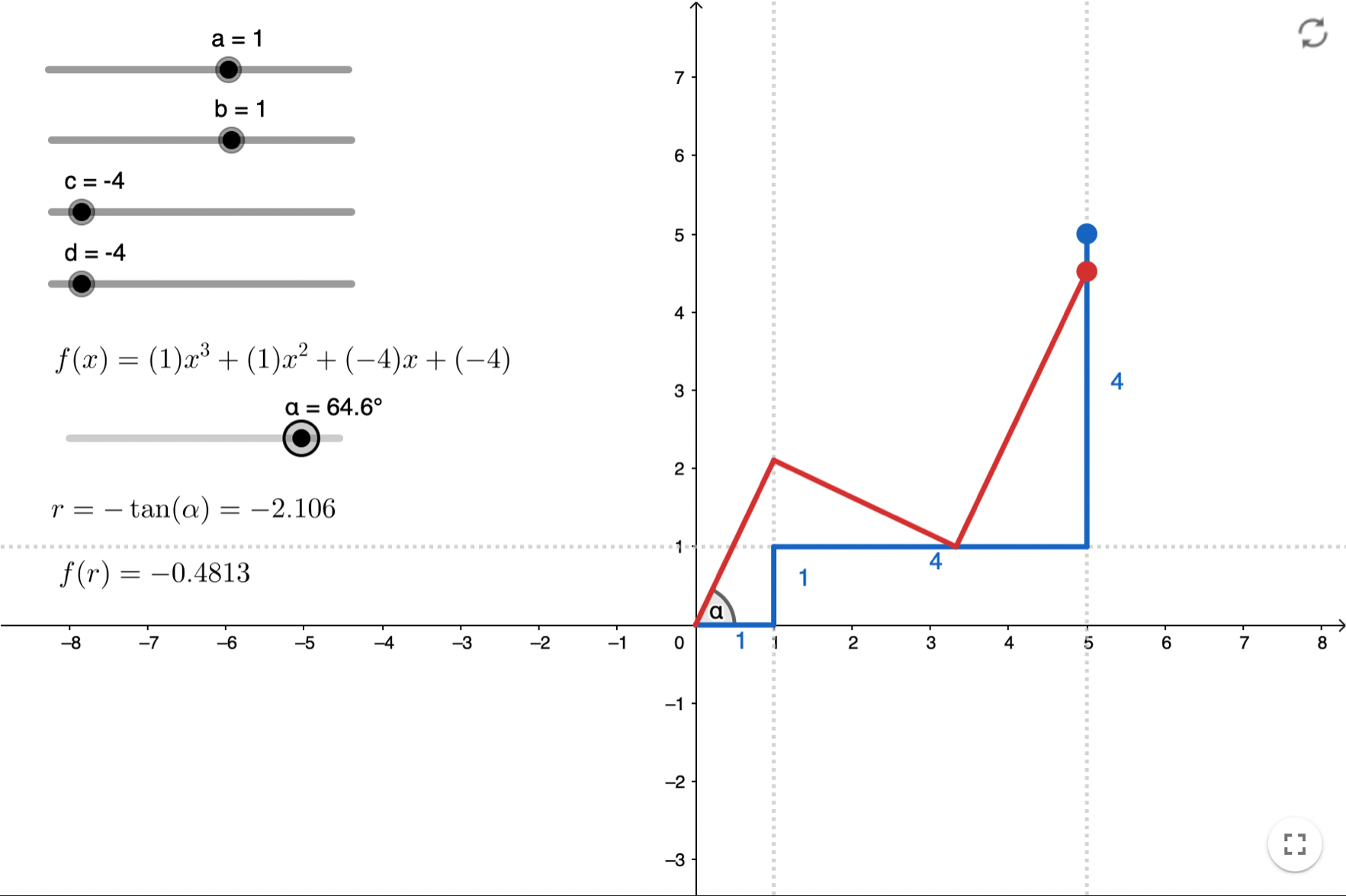
There’s a really cool and surprising way to find the real roots of polynomials that was discovered by Eduard Lill in 1867. I decided to make a Geogebra applet to show how it works (https://www.geogebra.org/m/cy3r7fw5), and I'll now describe the method.
Suppose the polynomial has the form
𝑓(𝑥)=𝑎ₙ𝑥ⁿ+…+𝑎₁𝑥+𝑎₀.
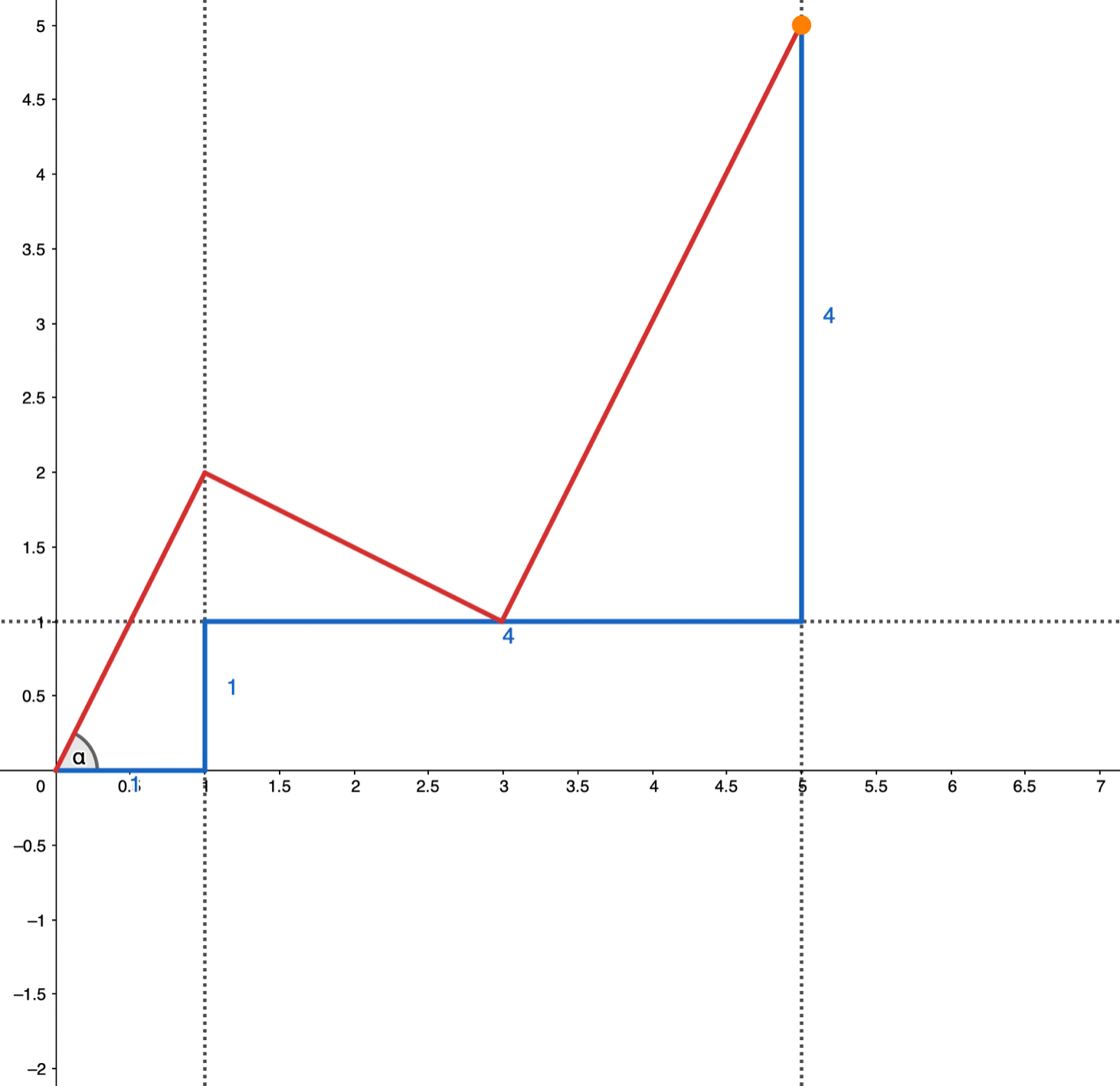
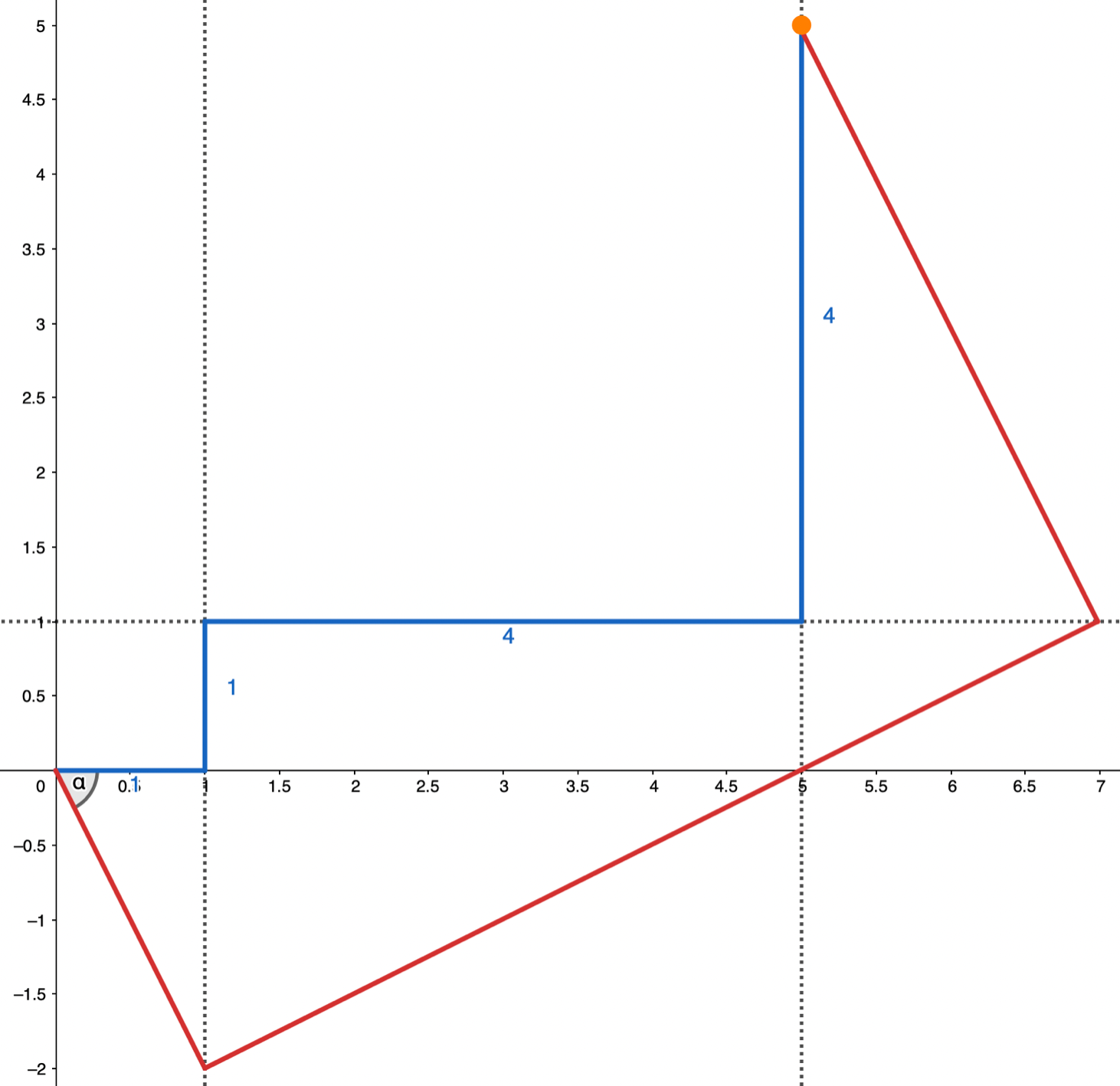
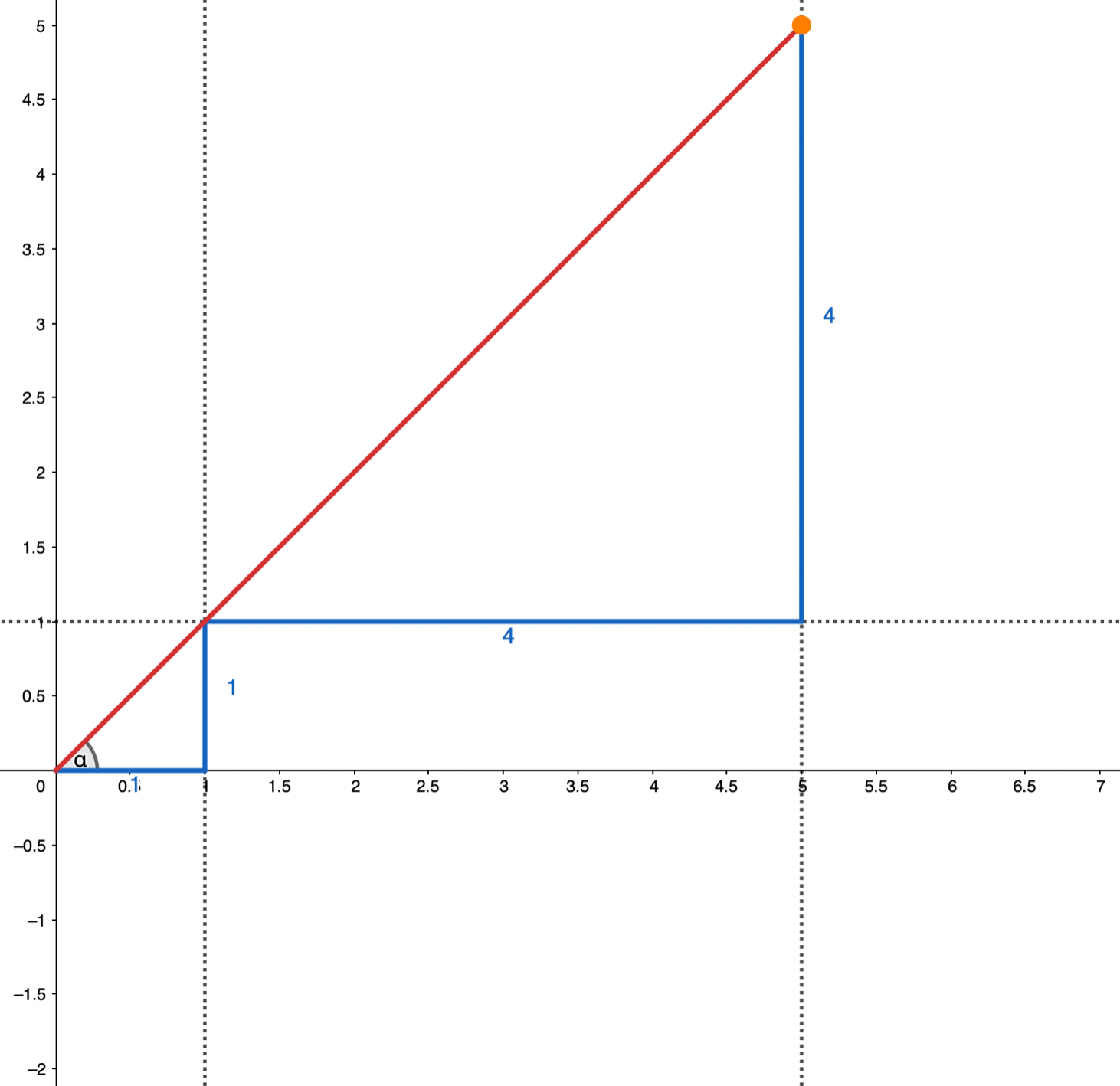
1) First, we'll draw a polygonal path starting at the origin. If all the coefficients are positive, go 𝑎ₙ units to the right, 𝑎ₙ₋₁ units up, 𝑎ₙ₋₂ units left, 𝑎ₙ₋₃ units down, and continue right, up, left, down, and so on. If any coefficient is negative, go in the opposite direction at that step. This path is blue in the applet.
2) Next, draw a line through the origin making an angle α with the x-axis. This path is red in the applet.
3) Find where this red line intersects the first vertical blue line of the path constructed in step 1 (extended, if necessary).
4) Construct a perpendicular (also red) line to this red path at the point of intersection.
5) Find where this line crosses the second (blue) horizontal line (extended, if necessary).
6) Repeat as many times as required to generate the full red path.
7) If the ends of the red path and the blue path coincide for a given starting angle α, then –tan(α) is a real root of the polynomial.
In the images below we see Lill's method finding the three real roots of 𝑓(𝑥)=𝑥⁴+𝑥³−4𝑥−4, which are (–1, –2, and 2).
As a cool added bonus, this procedure can be carried out with origami!
Wikipedia page: https://en.wikipedia.org/wiki/Lill%27s_method
sojournTime
boosted
sojournTime
boosted

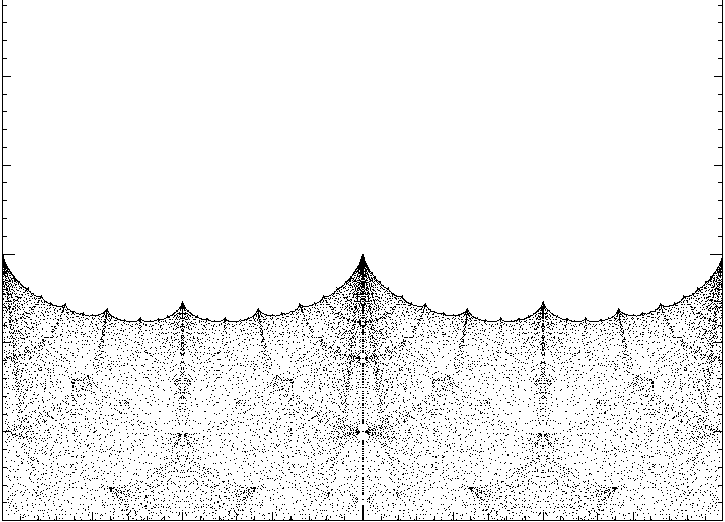
This is the first in a series of posts arising from the Fibonacci cusps of Kleinian double-cusp groups.
The attached static image is an illustration of the Maskit slice; if you draw a line along the topmost points in this plot, it cuts the plane into two regions: above it groups are discrete (and, among other things, are amenable to the ε-termination tool from last time), below it most groups are chaotic (plotted points being the exceptions).
Each point on the Maskit curve itself corresponds to a point on the real line between 0 and 1, inclusive; by convention we refer to those points that correspond to rational numbers "cusps"; they not only literally stand out from the curve, but also generate very appealing images made up entirely of tangent circles. But there are ofc infinitely more points that correspond to irrational numbers.
If you imagine perching on the top-right hand side spot at 2+2i, then jumping down and to the left to the next prominent cusp, then down and to the right, then left again, you'll visit:
1/1, 1/2, 2/3, 3/5, 5/8. 8/13 ...
These are the Fibonacci cusps, if you follow the path forever, it implies that you'll eventually converge on the point associated with 1/ϕ.
Art tax: Jorgensen and Maskit projections going through the first seven Fibonacci cusps and back.
[1] Mumford, D., Series, C., & Wright, D. (2002). Indra's Pearls: The Vision of Felix Klein. Cambridge: Cambridge University Press. doi:10.1017/CBO9781107050051
[2] https://people.math.harvard.edu/~ctm/gallery/teich/maskit.gif
[3] https://en.wikipedia.org/wiki/Bers_slice
#kleinianlimitset #kleiniangroup #fractals #mobius #mobiustransforms #mathematicalart #generative #generativeart #mathart #fibonacci #fibonaccicusps #perfectloops
sojournTime
boosted

Today, a group of scientists including @cees and Yours truly published a paper on A&A. We report about a fascinating finding: #satellite constellations can leak electromagnetic radiowaves, originating from onboard electronics, which we detected using the #LOFAR radio telescope. 1/
Image Credit: Daniëlle Futselaar
A&A Paper: https://www.aanda.org/component/article?access=doi&doi=10.1051/0004-6361/202346374
IAU/CPS Press Release:
https://cps.iau.org/news/new-radio-astronomical-observations-confirm-unintended-electromagnetic-radiation-emanating-from-large-satellite-constellations/
sojournTime
boosted

The Difference Between How Trump, Biden, Pence, and Clinton Mishandled Classified Information
I should first state where I’m coming from (because #IANAL). I served in the US intelligence community from 1996-2004, first as an enlisted Marine, and then as a federal employee at NSA and later CIA. I worked on watchfloors and did ops, but most of that career was spent managing and/or securing classified systems. I was trained at the Fort Washington¹ facility in qualifying SCIFs², had my classified courier card for years, and in my time saw a few classified mishandling cases up close.
Next is a bit of background on how classified information handling works. In the 99.99% case, classified docs are only ever handled in SCIFs (which have fence-lines and armed guards). Printed documents are marked with their classification level, and when not in use everything is locked in a properly rated safe, managed with access logs. Classified computer systems are rated to the maximum level of classified allowed, and also secured when not in use. Systems at different classification levels are air-gapped to prevent leakage (technically it’s more complicated, but accurate for this discussion).
The last bit of background is the legal framework for classified document handling. There actually is no law defining classified information or handling processes. Rather, there’s the 1917 Espionage Act³, plus 100 years of legal precedent and executive orders (most recently EO 13526⁴). The Espionage Act refers to a very broad category of “information respecting the national defense” and makes illegal the dissemination of this information through either “willful intent” or “gross negligence.”
The key point is that the law applies to a broad category of information, and the EOs build a framework for identifying such information and how to securely handle it. This is also the main basis that the courts use to delineate violations of the law, which is why classified mishandling is prosecuted under the Espionage Act.
With all of that out of the way, it’s time to look at each of these cases of classified mishandling. I’ll start with Clinton’s case first, because it’s the weirdest, in that it only barely involves classified data handling. That might seem confusing given all the press coverage in 2016, but the most accurate description of what Clinton did is that she forwarded emails from her official DoS (Department of State) email account to a personal account. The critical thing here is that because her DoS account was on a FOUO (For Official Use Only⁵) system, directly connected to the public Internet, those emails never should have contained any classified information. FOUO systems may contain sensitive information, but are explicitly not for handling classified information.
Accepting that, sometimes classified information leaks to a FOUO system. This tends to happen one of two ways, the first of which is usually in preparing briefings/reports for a lower classification level. It’s common to pull some of that information from classified documents, declassify as needed, and then transfer that to a lower classification system. Sometimes mistakes are made in this process and (now invalid) classification markings are left in the downgraded document. That explains the classification markings found in a few of Clinton’s emails⁶.
Classified information can also leak without being marked, if the substance of discussion simply includes information that would be considered classified. This is why it was reported that Clinton had 2,100 classified email threads⁷. Because, all of her emails were sent to the classification authorities at all of the intelligence agencies, and they reviewed everything, flagging anything they would have viewed as classified. FWIW, I doubt that any senior national security official’s FOUO inbox would make it through this process without coming away similarly flagged (but that's its own very long discussion).
With that context, here’s the first critical thing to understand about Clinton’s emails: The classified information leak was independent of her forwarding her official email to her personal email address. This is because any classified information she received was already leaked on the FOUO systems that the emails were coming from. So, the classified mishandling situation is the same regardless of whether Clinton’s email had remained on the FOUO DoS server or on a machine in Clinton’s basement. Neither are authorized for handling classified information.
So, then what was wrong with Clinton forwarding her FOUO emails to a personal address? Mainly it comes down to the government’s obligations regarding records retention and the mandatory security baseline for the systems they manage. Those are both extremely good reasons for why Clinton shouldn’t have forwarded her emails, but they don’t really have anything to do with classified information handling.
And to be fair to Clinton, since she was using a FOUO system, she had a reasonable expectation that she wasn’t receiving any emails containing classified information. So, unless she personally introduced the classified information into the discussions that got retroactively flagged, it’s entirely possible that she never even mishandled classified herself. Rather, she may have simply had additional copies of emails that had already leaked to FOUO systems. (FWIW, I don’t expect to ever find out the answer to this.)
This gets to the legal repercussions of what Clinton did. Once again, IANAL, but I did see cases of similar infractions. And as long as the offending party cooperated, there was very little in the way of repercussions. About the worst case would be junior enlisted getting slapped with non-judicial punishment⁸ because their commander wanted to make an example of them. But outside of that, pretty much anyone else in the same situation would just be told to stop, or at worst get a minor slap on the wrist.
Either way, I cannot imagine what grounds someone could even be prosecuted over if they're simply forwarding emails from a FOUO account, to their personal account, for the purposes of accessing their email from another device. Moreover, the scope and depth of the Clinton investigation would normally have been reserved for someone stealing actual marked classified information or otherwise bridging classification levels between systems. Clinton genuinely received more scrutiny and greater repercussions than pretty much anyone else in her situation would have. None of this is to say that what Clinton did was a good thing, but it genuinely was far less than it's usually made out to be.
Now, on to Biden and Pence, which are nearly identical cases of classified mishandling. Remember several paragraphs back about the 99.99% case? Well, that’s not the White House, because that place is just weird. It has a mess of spaces cleared for handling classified, and uncleared people endlessly circulating about—some of whom literally live there! The whole thing is a security nightmare, and they should ban printed classified just as a precautionary measure.
That’s why I’m not surprised that Biden and Pence wound up with marked classified papers mixed in with their other documents. TBH I’m surprised it doesn’t happen more often. But that sort of thing is also why the statute sets the bar at “willfully” or “negligent.” Both Biden and Pence did exactly the right thing in notifying the appropriate custodian of the mistake, turning over everything, and complying fully with investigations. It was all by the book, and no one would ever be charged for something like this.
Finally, we get to Trump. His case is highly unusual, but not at all complicated. The indictment⁹ provides mounds of evidence that he “willfully” took large quantities of classified material with him when he left the White House. After NARA (National Archives and Records Administration) contacted him about returning the missing classified material, he chose to lie, evade, and then turn over only some of the stolen documents. Eventually the FBI had to raid Mar-a-Lago to recover 300+ additional classified documents, and it’s still unclear whether everything has been recovered.
The whole point here is that the Trump case is genuinely unprecedented in just how crazy it is. The volume and scope of the theft puts it in league with espionage cases that land people in prison for decades. Even worse, the whole crime is documented with recordings, corroborating witnesses, and pretty much everything a prosecutor could dream of.
While I'm at it I should also quickly knock out some of the more common attempts I’ve seen to dismiss the criminality of Trump’s situation, so here goes:
Are the classified documents in fact Trump’s property? No. The Presidential Records Act is entirely clear on this¹⁰.
Could Trump have declassified these documents already as president? No. EO 13526 sets out the classification process, and if he wanted to expand it to include psychic declassification he had to write a superseding EO laying out such a process.
Does it matter that Trump doesn’t appear to be an agent of a foreign power? No. Just ask Petraeus¹¹ or Schulte¹²; you break the law when you willfully take the information and risk dissemination to those not cleared for access.
Does it matter that Trump stored the information in a locked room? Accepting that a resort with random people ambling about is laughably unsafe, the fact is that there are clear regulations for storage and transport of classified material, and Trump was so far outside the bounds of those that the tiny measures he took are immaterial.
TL;DR: Literally anyone else who did what Trump did would already be sitting in federal prison for at least a decade. Trump is getting an unheard of level of special treatment—entirely to his own benefit! There’s simply no comparison to what Clinton, Biden, or Pence did. The most appropriate comparisons for Trump’s case all involve people currently serving long federal prison sentences… or people who already died in prison.
_
¹ https://en.wikipedia.org/wiki/Interagency_Training_Center
² https://en.wikipedia.org/wiki/Sensitive_compartmented_information_facility
³ https://en.wikipedia.org/wiki/Espionage_Act_of_1917
⁴ https://en.wikipedia.org/wiki/Executive_Order_13526
⁵ https://en.wikipedia.org/wiki/For_Official_Use_Only
⁶ https://www.politico.com/blogs/under-the-radar/2016/07/hillary-clinton-classified-emails-error-225194
⁷ https://www.usnews.com/news/politics/articles/2016-02-29/state-dept-wins-dispute-over-clinton-email-on-north-korea
⁸ https://en.wikipedia.org/wiki/Non-judicial_punishment
⁹ https://www.justice.gov/storage/US_v_Trump-Nauta_23-80101.pdf
¹⁰ https://en.wikipedia.org/wiki/Presidential_Records_Act
¹¹ https://en.wikipedia.org/wiki/David_Petraeus#Criminal_charges_and_probation
¹² https://en.wikipedia.org/wiki/Joshua_Schulte
sojournTime
boosted

Different types of usefulness of a field of mathematics:
- One can use the field to construct an empirically adequate model in some scientific discipline (calculus in classical mechanics)
- One can reduce a class of problems from one field to another (commutative algebra in number theory, linear algebra in differential topology)
- The field is 𝑔𝑒𝑛𝑒𝑟𝑎𝑡𝑖𝑣𝑒 to a whole new class of questions or mode of thinking (topos theory in Grothendieck's algebraic geometry, the formalization of real analysis in the 19th century)
- The field unifies previously disparate ideas allowing us to use insights from one domain in another (set theory/category theory)
- One can gain a brand new perspective more amenable with your mode of thinking or different from a previously dominant view (Galois theory to study polynomial equations, combinatorial species, the use of cohomology for matroids/graphs etc.)
sojournTime
boosted
Siobhan Roberts from the #NewYorkTimes attended the #IPAM workshop on #MachineAssistedProof earlier this year. Based on her experiences and interviews there and elsewhere, she has now written an article about #AI and #math : https://www.nytimes.com/2023/07/02/science/ai-mathematics-machine-learning.html
sojournTime
boosted

and then he serialized himself using python pickle
funniest shit I've ever seen
funniest shit I've ever seen
sojournTime
boosted




sojournTime
boosted
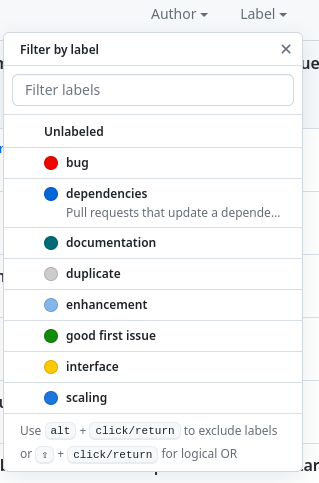
GitHub seem to have removed the colours from issue labels.
You're not supposed to convey information solely by colour, but it's quite a thing to resolve this by not conveying the information at all.
sojournTime
boosted
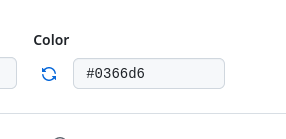
whaaatttttt!
Labels still have a colour associated with them, which you can edit, but the form doesn't show you the colour
sojournTime
boosted
- GitHub (Personal)
- https://github.com/dataNerd23
Data Science PhD Student
Likes math, stats, space, and board games (especially Dominion: https://dominion.games/).
⬛️⬛️⬛️⬛️⬛️✨⬛️⬛️⬛️⬛️⬛️⬛️
⬛️✨⬛️⬛️⬛️⬛️⬛️⬛️⬛️⬛️✨⬛️
⬛️⬛️⬛️⬛️🛰️⬛️⬛️⬛️✨⬛️⬛️⬛️
⬛️⬛️⬛️⬛️⬛️🌎⬛️⬛️⬛️⬛️⬛️⬛️
⬛️⬛️🌒⬛️⬛️⬛️⬛️⬛️⬛️✨⬛️⬛️
⬛️⬛️⬛️⬛️⬛️⬛️✨⬛️⬛️⬛️⬛️⬛️
Joined Apr 2022
