

Tavo @tavoglc@social.cleverlibre.org
- Medium
- https://tavoglc.medium.com/
- Substack
- https://tavoglc.substack.com/
- Github
- https://github.com/TavoGLC
- linktree
- https://linktr.ee/tavoglc
I like to know stuff
Joined Nov 2022
Tavo
boosted

"To describe the prevalence of #longCOVID in #children infected for the first time (n=332) or reinfected (n=243) with #Omicron variant SARS-CoV-2, compared with test-negative children (n=311). 12-16% infected with Omicron met the research definition of long COVID at 3 and 6 months after infection, with no evidence of difference between cases of first-positive and #reinfection (pchi-square=0.17)."
#longCovidKids #Covid19 #science
https://www.jpeds.com/article/S0022-3476(23)00311-6/fulltext
Tavo
boosted


#IDMastodon @JExpMed Unvaccinated patients who X-linked recessive deficiency of TLR7, a MyD88- and IRAK-4–dependent endosomal ssRNA sensor, impairs #SarsCoV2 recognition and type I IFN production in plasmacytoid dendritic cells (pDCs), thereby underlying #hypoxemic #COVID19 with high penetrance.
https://rupress.org/jem/article/220/5/e20220170/213920/Humans-with-inherited-MyD88-and-IRAK-4
I'm trying, but I think I'm not really good at it 😿
Tavo
boosted

In computer science it's *impossible* to publish your work in many prestigious venues unless you travel to a present that work at conference!
Here's the famous computer scientist Moshe Vardi on how that needs to change:
"As I argued in January 2020, in view of the worsening climate crisis, our discipline's practice that every publication requires travel, often trans-oceanic, is inconsistent with the public good. A report released in March 2023 by the Intergovernmental Panel on Climate Change paints an even bleaker picture of the worsening climate crisis. The world is on brink of catastrophic warming, the report warned. A dangerous climate threshold is near, but "it does not mean we are doomed" if swift action is taken, the scientists said."
"Going back to the pre-pandemic conference-travel culture is simply not morally acceptable, I believe. Yet many conferences have gone back to a full in-person model, and authors are required to present in person. This requirement is drawing criticism. A recent article by Theoretical Computer Scientists for Future (TCS4F) concluded, 'Coupling formal publications with an in-person gathering no longer makes sense for everyone.'"
https://cacm.acm.org/magazines/2023/5/272297-acm-for-the-public-good/fulltext
Tavo
boosted

#COVID tests are still free with insurance, but only until May 11th. Don't miss out on this opportunity to protect yourself and those around you. #CovidIsNotOver #COVIDTests
https://www.pbs.org/newshour/health/experts-worry-about-costs-as-free-covid-testing-comes-to-end-in-may
Tavo
boosted

@yaneerbaryam @whn DEMAND not ask! We deserve to be safe when we go to a doctor, we deserve to be safe when we go anywhere we have no choice but to go. DEMAND THEY WEAR A MASK in any government office that requires your presence as well. Show them the CDC guidelines for indoor mask usage. Explain that you are an at risk person. Fuck it even if you aren’t, especially if you aren’t. The more voices raised the better. They need to fucking hear us. #Covid #CovidIsNotOver
@bicmay and follow solar activity
Tavo
boosted

As the COVID public health emergency phase winds down, the NYT reviews lessons learned:
▶️ Get the messaging right 📲
▶️ Make it easy to share data 💻
▶️ Think carefully about school closures 🏫
▶️ Stockpile vital supplies 💊
▶️ Invest in vaccines early 💉
▶️ Quickly set up large randomized trials 🧪
▶️ But don’t rely only on vaccines 😷
@luckytran from 3 to 10 years after that I think it will be pretty much gone.
Tavo
boosted

Why don't researchers share their data?
One reason is fear of errors being exposed.
Yet, a new paper adds to increasing evidence that authors who share their data are just as likely to make errors in their manuscripts as those that don't.
So, perhaps this fear is unfounded...or their errors can only be uncovered using the data itself. Or maybe this error fear isn't why researchers don't share their data.
via https://doi.org/10.1371/journal.pone.0284243
#OpenScience #AcademicChatter @academicchatter
h/t @oatp
Follow the sun and you will find the pandemics.
Cambios en el tamaño del genoma por duración promedio del día y localización geográfica. #COVID19
Tavo
boosted


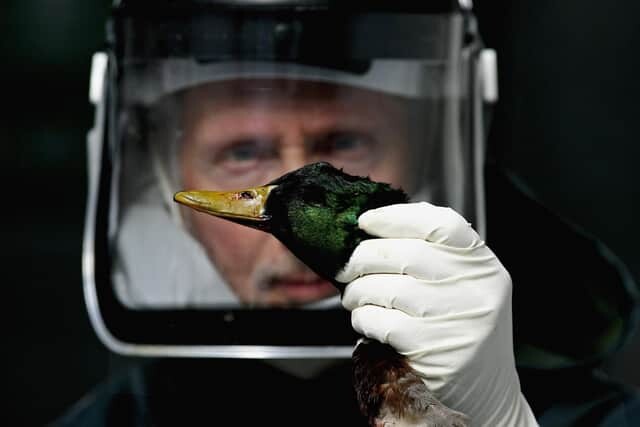
H5N1 bird flu outbreak continues to affect mammals across the US 🇺🇸. A striped skunk, three pumas and two red foxes are the latest to test positive for the virus.
@Pat es una animación que realice utilizando los datos del NCBI https://www.ncbi.nlm.nih.gov/sars-cov-2/
Aunque el conjunto de datos con los datos de latitud y longitud lo encuentras aquí.
https://www.kaggle.com/datasets/tavoglc/covid19-metadata
Adaptations to solar radiation can also be found inside the SARS Cov2 genome. The genome changes its size over time, reaching a minimum at a season with large sunshine duration and large UV radiation. #COV1D #covidisnotover #COVID

Low levels of UV radiation could increase the overall virus concentrations in the environment. As UV radiation is used to kill/inactivate viruses. #COV1D #covidisnotover #COVID
https://www.ncbi.nlm.nih.gov/pmc/articles/PMC9221687/
There could be many reasons for such a correlation. One possibility is that low solar radiation also implies low UV radiation. #COV1D #covidisnotover #COVID
https://www.kaggle.com/code/tavoglc/solar-radiation-patterns
Looking at other cycles with different duration points towards the bubonic plague and other prominent outbreaks. #COV1D #covidisnotover #COVID

Regardless of the means used to make those predictions, there's a key metric that correlates with the emergence of large outbreaks. Stationary points in the Schwabe or solar cycle cluster many of the different large outbreaks. #COV1D #covidisnotover #COVID
https://www.sciencedirect.com/science/article/pii/S2319417023000033#bib15

- Medium
- https://tavoglc.medium.com/
- Substack
- https://tavoglc.substack.com/
- Github
- https://github.com/TavoGLC
- linktree
- https://linktr.ee/tavoglc
I like to know stuff
Joined Nov 2022
