

tripu @tripu@social.cleverlibre.org
Technologist, Spaniard, male, 42
Joined May 2020
You are joking, right?
In my thought experiment I painted what is literally the most justifiable case for compulsory #wealthredistribution — one where the decrease in wealth and well-being for a person being “taxed” is indistinguishable from zero, while the benefit to an utterly helpless recipient is enormous (the difference between life and death, no less). Even you “believe in that moral obligation to a point”.
…and yet you worry that admitting so much, and defending a system where that absolute minimum of redistribution is somehow “imposed” on people, could easily lead to what is (again, literally) the most extreme case the world has ever seen of forced redistribution (ie, #socialism, #communism).
> _“It's a short step from stealing just a dollar to feed the poor to the massive taxes we have today.”_
No, it's not. It's a huge leap.
@monika@mastodont.cat https://masto.nogafam.es/@aperalesf/106566689384732122
To me, #feminism is primarily about “equality of the sexes”, and (only after that) “especially” about “women's rights”. That's [the original meaning from the very end of the 19th century](https://plato.stanford.edu/entries/feminist-philosophy/#FemiBeliFemiMove), and also the _current_ meaning according to [Britannica](https://www.britannica.com/topic/feminism), [Merriam-Webster](https://www.merriam-webster.com/dictionary/feminism) and [Wikipedia](https://en.wikipedia.org/wiki/Feminism).
With that in mind, this is good news about the end of an outrageous inequality before the law between the sexes that still exists:
https://www.econlib.org/whats-wrong-with-registering-women-for-the-draft/
Totally!

¿Soy yo o las respuestas no tienen mucho que ver con las preguntas? 🤔 RT @technology@twitter.com Spanish Prime Minister Pedro Sanchez is visiting ...
One more point where I think you're wrong:
You are right in that forcing an _action_ upon others is in principle morally wrong (eg, nobody should force you, in principle, to donate money to the poor). But forcing an _inaction_ is equally wrong in principle. This is how I think your reasoning actually imposes _inaction_ upon others:
Imagine three people:
* **A** is the most privileged person imaginable (say, Jeff Bezos),
* **Z** is the most miserable and helpless human being, and
* **Y** is someone who is slightly above Z, but still basically destitute and resourceless.
The three people stumble upon each other. **A** sees without a doubt that **Z** is in agony and on the brink of a horrific death, but **A** is utterly selfish and decides to give **Z** nothing, not even a glass of water from his Olympic pool. **Y** contemplates the scene, and feels the moral obligation to steal a dollar, or a banana, or a paper clip (since **Y** doesn't even have that to spare) from **A** (exerting no violence upon him) and to give it to **Z** to somehow remedy their plight, or even save their life, at least temporarily.
I bet you that the vast majority of human beings (including the sub-groups of ethicist and political philosophers) would agree with **Y** and defend his “altruistic theft”.
Your absolutist #Libertarianism, on the other hand, would _impose inaction_ on **Y** and condemn/prosecute/ban that behaviour.
**2.** Even the most staunch sceptic/relativist/rigorous critic would agree to an absolute minimum for that threshold, don't you think? If you think my assessment (whatever it is) is too generous, divide it by ten. Can we agree on that, at least?
Imagine a person who is ill and malnourished to the point where any doctor would predict their death in a matter of hours if they don't receive assistance. Or a person with chronic pain who lives in constant agony but doesn't have the resources to afford painkillers, anaesthesia nor euthanasia.
Do you believe in the moral obligation of society, or of the Sate, or of _you personally_ (Fidel Ramos) to somehow help that complete stranger who is staring you in the eye?
If your answer is “yes”, you agree with me in that there's at least a minuscule baseline for human dignity that imposes moral obligations in others to help. There's the hole in your Libertarian absolutism.
If you answer “no”, then there's a much wider gulf between our philosophies than I thought.
**1.** Many other moral rules that I (and I think most human beings) hold true do not have clear, objective cut-off measures or thresholds — but that does not utterly invalidate them.
I (and most people) believe that interrupting procreation by force one minute after intercourse is OK, but that doing so one day before the due date of the child is wrong. There might not be an instant in time where the act switches from morally acceptable to morally wrong. So what.
I (and most people) believe that an adult having sex with a newborn is wrong, but that sex with some who is 30 or older is OK. There might not be an age where the act switches from monstrous to normal. So what.
etc.
The impossibility of _“objectively [demonstrating] the ‘universal threshold for human well-being’”_ does not destroy my reasoning, I think.
Two arguments:
tripu
boosted

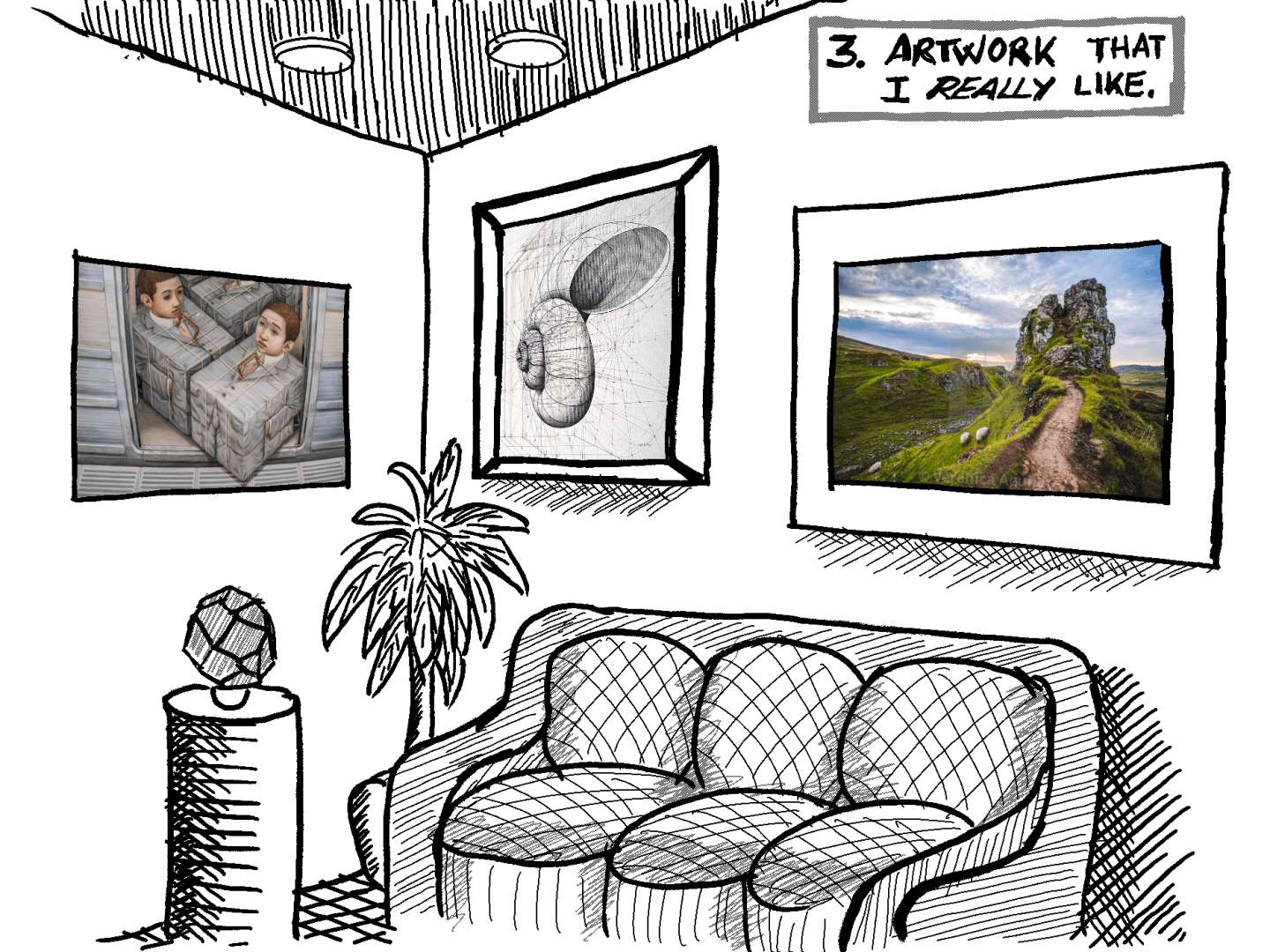
Things I want in my #house (if/when I have one), #3: #artwork that I really like.
#sketch #cartoon #drawing #reMarkable #reMarkable2 #homeSweetHome
• Tetsuya Ishida: “Self-Portrait of Other” https://brooklynrail.org/2019/11/artseen/Tetsuya-Ishida-Self-Portrait-of-Other
• Rafael Araujo: “Semi-flat Shell” https://www.rafael-araujo.com/product-page/semi-flat-shell
• Verónica Aguilar: “Fairy Glen, Isle of Skye” https://veronicaaguilarphotography.picfair.com/pics/013236649-fairy-glen-isle-of-skye
#sketch #cartoon #drawing #reMarkable #reMarkable2 #homeSweetHome
• Tetsuya Ishida: “Self-Portrait of Other” https://brooklynrail.org/2019/11/artseen/Tetsuya-Ishida-Self-Portrait-of-Other
• Rafael Araujo: “Semi-flat Shell” https://www.rafael-araujo.com/product-page/semi-flat-shell
• Verónica Aguilar: “Fairy Glen, Isle of Skye” https://veronicaaguilarphotography.picfair.com/pics/013236649-fairy-glen-isle-of-skye
tripu
boosted


 🌿
🌿  :ignucius:

Addendum (lest I should be accused of utopian over-simplification):
Yes, **chance** plays a huge role in life outcomes. Yes, **the past**, which we can't control (heritage, inheritance, the womb, childhood) is decisive, too. Yes, even conscious life decisions are strongly constrained by circumstances and by the information available at the time.
Yes, **free will** might be but an illusion.
I just want to stress that all the above holds true in our current welfare systems, too.
I realise many cases won't be easy to adjudicate. But that's a problem with our current welfare laws, too.
It shouldn't be too difficult for the State to collate all the relevant data they hold for each person and feed it to an algorithm which in many cases would produce a fairly confident result. Think work history, tax returns, residency, health indicators, race, education, reports from social workers, property owned, investments, criminal record, etc. A good chunk of the population are clearly “privileged” or “dispossessed” by looking at these metrics.
Expressed this way, it sounds eerie and inhumane. I'm just describing the logic of it here. Of course, there still would be judges, social workers, recourse, and exceptions involved — just as in the current system. But I feel this general guidance would deliver as well if not better than the current system, while decreasing rent-seeking and public expenditure (taxes).
Thoughts?
🧵 5/5
**A single parent who finds themselves struggling to raise their offspring while at the same time enjoying themselves the small luxuries of modern life** (tourism, Netflix, eating out, a new car, a gym membership). If they are a single parent because their spouse died or left, leaving them with precarious income, they should get some benefits to help them make ends meet. If, on the other hand, they decided to raise kids without a partner in the first place, they are not morally entitled to anyone else's money.
**A new retiree who suddenly can't afford more than the basics and has to lead a monastic life until death**. If that person had miserable jobs all their life and still managed to be frugal and save a bit for retirement, society owes them a chunk now, since their misfortune was not their fault and they made responsible use of the bad cards they were dealt. If, on the other hand, that person used to be well-off and had the resources to invest on their own retirement plan, but was reckless enough to live hand to mouth instead, then a monastic life is all they get, in all fairness (no assistance from the rest of society).
**Someone who is unemployed.** If they are unemployed because they are handicapped, belong to a marginalised group, suffered an important workplace accident, have a very low IQ, etc, then society should fund a reasonable life for them (ie, above the minimum threshold). If, on the other hand, that person is lazy or unconscientious, or too picky when offered a job, then food, clothing and shelter is all they are entitled to get from the rest of society.
🧵 4/5
What about **needs up and beyond that basic threshold**? To give a few examples: predictable, regular cash flows from retirement until death (public pensions); subsidies for IVF or child care; public study grants; tokens for public transport; subsidised campsites or holidays; everything having to do with “culture” or sports (coupons for book shops, concerts, museums, sport centres, sport clubs).
For those, I draw a line between situations of necessity that are **caused by events mostly outside the control of the person**, and those **for which the person is much to “blame”**. I am all for taxes to fund the former, and zero for the latter.
So: individual responsibility, and the predictability of the (bad) outcome, are my deciding criteria.
Here go a few examples:
🧵 3/5
First of all, I establish
* a **universal, absolute threshold for human well-being** (enough food, reasonable shelter, basic medical treatment, physical safety), and
* the moral obligation of society as a whole to help those who find themselves below that threshold, _for whatever reason_,
* for as many people as necessary, for as long as necessary, and regardless of the cost in taxes.
It doesn't matter whether you are a long-time beneficiary of social benefits already, a former billionaire who recklessly burned all their cash, a chronic tax-evader, or an unrepentant serial killer: if you are starving, have no roof, or suffer from illness or violence — and you do _not_ have the resources to remedy your situation — and you have _not_ unequivocally rejected the assistance of society — then it is not only moral but _mandatory_ that our taxes be directed towards lifting you out of that dire state and back into human dignity.
That's the unconditioned baseline for welfare benefits.
🧵 2/5
More about me slowly coming to (always temporary) conclusions in #politics:
#welfare, social #safetynet
For a long time, I failed to define a clear line between **fair, necessary, humane benefits** on the one hand, and **greedy, opportunistic, unjustified rent-seeking** on the other.
More recently I settled on a heuristic that I find just, and that is fairly simple to apply:
🧵 1/5
This is the kind of #cityscapes that I dig 🏙️
https://www.reddit.com/r/CityPorn/comments/onbxp5/shanghai_at_night_china/
#urban #punk #dystopia #BladeRunner
@shironeko
I consider quite a few more variables: licence, source code, protocol, jurisdiction, governance, discoverability, feature set, usability…
/cc @eff
@shironeko
Fair enough. We enter the territory of trade-offs and individual preferences.
/cc @eff
Technologist, Spaniard, male, 42
Joined May 2020
