
Twitter have decided to deal with the Taylor Swift deepfake problem on their platform by blocking all searches for Taylor Swift, to stop people highlighting it.


@csstrowbridge Lol, that's not how 230 works. It makes no requirements that an interactive computer service be, in any way, a "neutral". It does the opposite.
@csstrowbridge It would be nice for them to act in good faith, sure, but they're under no legal obligation to.
"In good faith" is actually in the text of the law. If they don't, then they are considered a publisher and publishers are liable for what they publish.
That's the whole point of section 230. Social media platforms are not liable for what their users say on their platforms, as long as they regulate what's there "in good faith".
@csstrowbridge That is a common misconception, but it is incorrect.
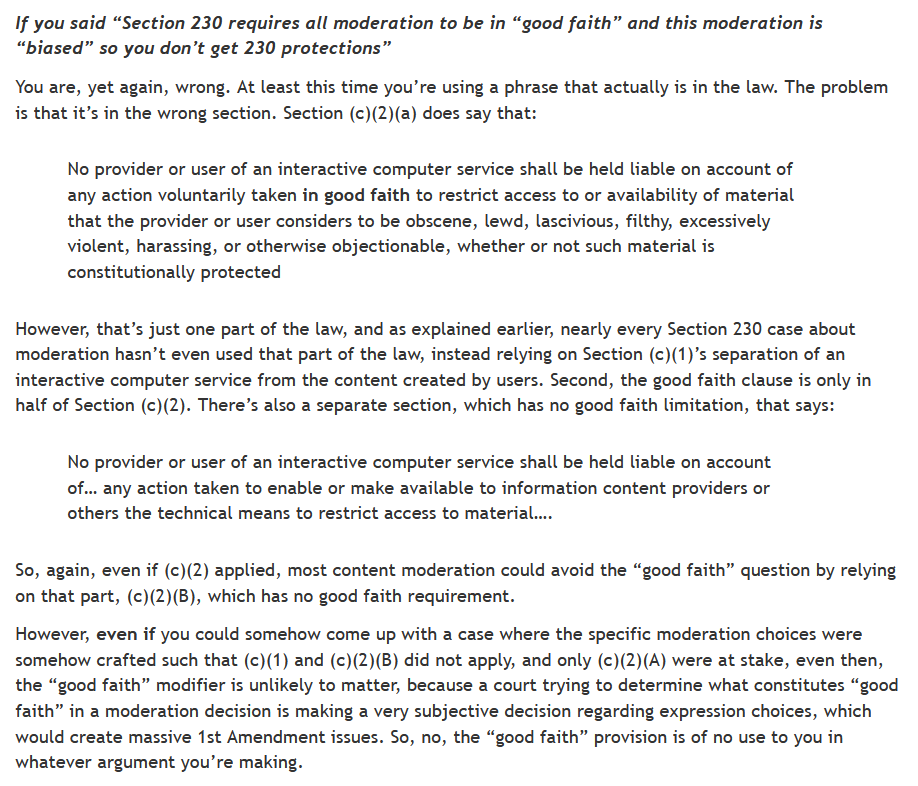
... The guy that wrote that has an MBA in business. He's not a lawyer.
There's are protections granted to social media platforms that publishers don't have. It cost Fox News almost $800 million to learn that.
@csstrowbridge The only distinction or requirement the law makes is that it covers "interactive computer services". Fox News isn't an interactive computer service, it's a television station.
If you need more proof, here's a lawyer who is a preeminent expert on 1A: https://popehat.substack.com/p/section-230-is-the-subject-of-the
Here's another one: https://reason.com/volokh/2020/05/28/47-u-s-c-%C2%A7-230-and-the-publisher-distributor-platform-distinction/?utm_source=dlvr.it&utm_medium=twitter
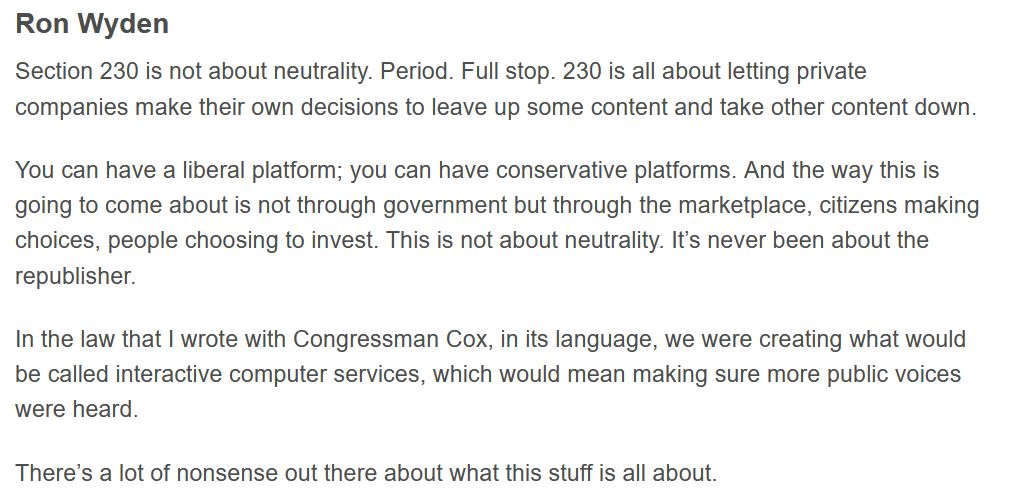
And here's Ron Wyden, one of the two *authors of the bill* (quoted in the screenshot below): https://www.vox.com/recode/2019/5/16/18626779/ron-wyden-section-230-facebook-regulations-neutrality
And Chris Cox (R):
@csstrowbridge Also, Fox News wouldn't have been protected by 230 anyway, because 230 protects against 3rd-party speech only and Dominion sued Fox for 1st-party speech.
“You can have a liberal platform. You can have conservative platforms.”
Neutrality isn't a matter of liberal vs. conservative.
HOWEVER, there is a difference between being a interactive computer service and a publisher. Interactive computer services can moderate their content without becoming a publisher, AS LONG AS THEY DO IT IN GOOD FAITH.
If an interactive computer service decides some people are allowed to break the rules, then they are publishing that content.
@csstrowbridge That may be how you want it to work, but it's simply not how the law works.
Everyone I see talking about this are talking about a pre-Musk Twitter. They are making these statements based on what was happening at that time.
At some point, an interactive computer service becomes a publisher, because it acts like one.
@csstrowbridge No, the owners of interactive computer services are already publishers... of their own content. Just as users are publishers of their own content.
There is no magical "switchover" condition like you're describing that suddenly makes one responsible for the content published by another.
Just like there's no magical "switchover" for porn. That doesn't stop the government for having rules about porn.
@csstrowbridge At this point I have to assume you're trolling me. Nobody is really this obtuse in the face of overwhelming evidence. Goodbye.
@LouisIngenthron@qoto.org
Last year, the Supreme court had two cases dealing with section 230 protection. In the first case, they decided the anti-terrorism law wasn't applicable and ended the suit. They specifically said the weren't dealing with 230. In the second case, they said the first case was precedent and punted back to the lower case. If you cross a line, you can lose 230 protection. No one wants to set were that line is.

@LouisIngenthron
Twitter has to act, quote, "in good faith".
As soon as they stop doing that, by, for example, covering up TOS abuses instead of acting on them, then they can no longer pretend they are acting in good faith.
Likewise, if these lapses always seem to benefit one side, they are also not acting in good faith.