
Twitter have decided to deal with the Taylor Swift deepfake problem on their platform by blocking all searches for Taylor Swift, to stop people highlighting it.

She needs to sue and argue they shouldn't have 230 protection, because they are clearly not enforcing their TOS evenly, so they can't pretend to be a neutral publisher.


@csstrowbridge Lol, that's not how 230 works. It makes no requirements that an interactive computer service be, in any way, a "neutral". It does the opposite.
Twitter has to act, quote, "in good faith".
As soon as they stop doing that, by, for example, covering up TOS abuses instead of acting on them, then they can no longer pretend they are acting in good faith.
Likewise, if these lapses always seem to benefit one side, they are also not acting in good faith.
@csstrowbridge It would be nice for them to act in good faith, sure, but they're under no legal obligation to.
"In good faith" is actually in the text of the law. If they don't, then they are considered a publisher and publishers are liable for what they publish.
That's the whole point of section 230. Social media platforms are not liable for what their users say on their platforms, as long as they regulate what's there "in good faith".
@csstrowbridge That is a common misconception, but it is incorrect.
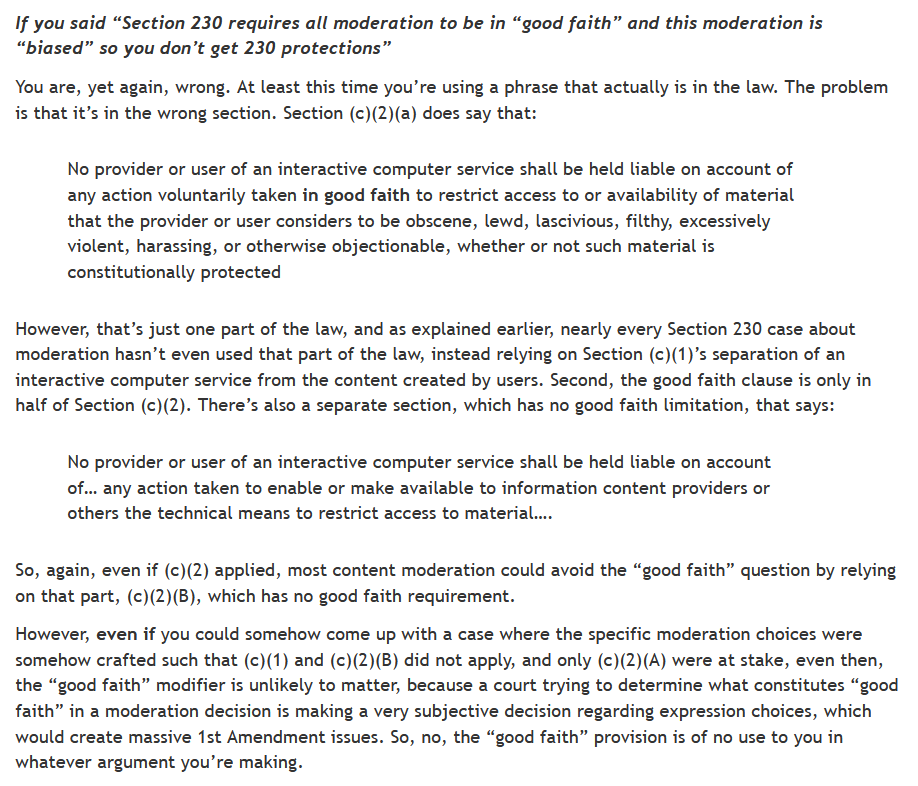
... The guy that wrote that has an MBA in business. He's not a lawyer.
There's are protections granted to social media platforms that publishers don't have. It cost Fox News almost $800 million to learn that.
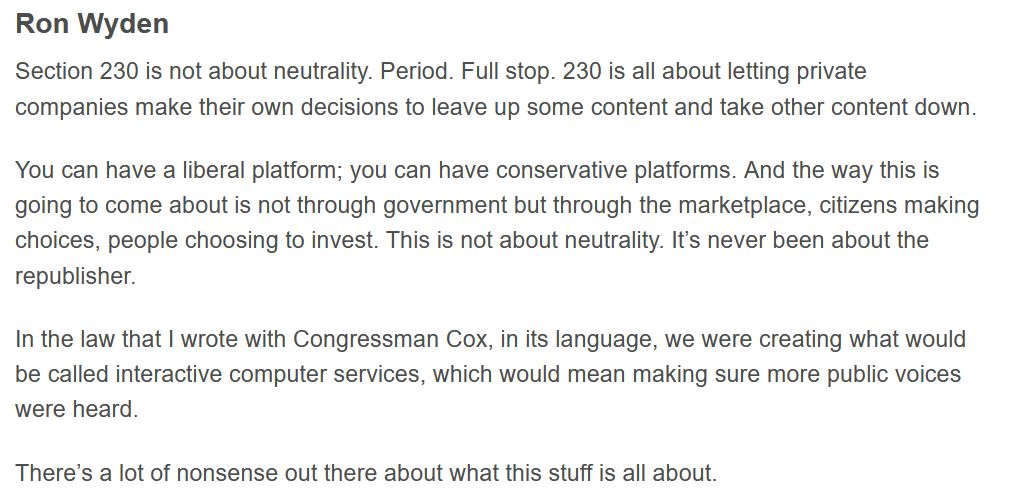
@csstrowbridge Also, Fox News wouldn't have been protected by 230 anyway, because 230 protects against 3rd-party speech only and Dominion sued Fox for 1st-party speech.
