I don’t have a copy of the book, but the Principa Mathematica includes the proof of 1 (
https://en.m.wikipedia.org/wiki/Principia_Mathematica)
It’s also been augued in several courts that software, binaries included aren’t a mathematical constant, but a set of machine instructions, however encoded, and that the processes the software uses to produce a result are works of copyright, regardless whether the products themselves can be copyrighted. This legal argument has been the cornerstone of both the IBM v Compaq and Google v Oracle cases, as well as others like SCO v Novell.
Since copyright and trademark law are protected internationally via several treatises, these decisions hold wide merit.
And nice, bringing politics into a factual discussion, because you have no real arguments.


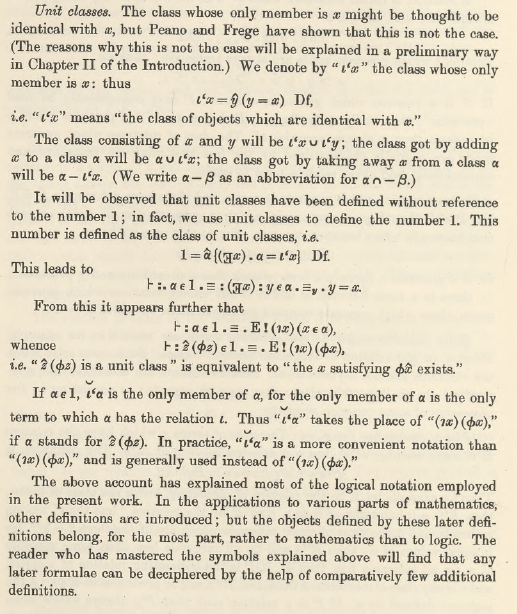

They are using x=1 to solve for a, since it would make x=a. The entire book is almost 200 pages to prove 1+1=2 and 1>0 and 1 != i
In order to do that, the author needs to prove out that variables scale with the inputs of an equation, and that the lowest real value is 1.