
Science... or not science.
"They found that, at 7.2 degrees F (4 degrees C) above pre-industrial global temperatures, 34%of all Antarctic ice shelves (including 67%of the ice shelf area on the Antarctic Peninsula)"
Apparently science doesn't require full sentences, just wild premises that sound scary. Presumable they wanted to say "will melt" or will disappear, or something. But, when they can't even proof read before posting an "article" it comes off like social media noise. That paragraph just... wow, fire the editor.
And, where the F do they have evidence of a 4°C temperature rise?
What's your take on this kind of article?
https://www.space.com/antarctic-ice-shelf-collapse-as-earth-warms

 🇳🇱
Yes, I did. That's kinda the point. I've been reading about how temperatures will climb in the coming decade... for, literally decades. I believed them over 20 years ago. Now, it's the boy who cried wolf, and Bill Gates wants to block out the sun when Vit-D deficiency is (*cough*cough*) killing people.
Yes, it's not a journal, it's not a paper, it's "news" article. And my point is, it's as suspect as ever of being bullshit. The deeper you dig, the more complex the atmosphere control factors get, and the more we realize that what we THING will bring about change has a natural buffering system we haven't calculated yet, and/or that there are much greater natural dangers to humanity than man made (like, why the fuck aren't we funding NEO research more?).
My point was (although now mute) to find out what Gene thought about such "stories" and the context he'd put them in, because, I'm curious about Gene, and honestly would love to interview him and learn what he knows, and how he thinks.
Wasn't intended to be a pro/anti global warming debate, nor a demonstration of scientific reporting. Anyway... So much for that.
Boy who cried wolf? Huh? 1) the temperatures did increase 2) they increased proportional to the CO2 we released very close to predictions.
Now what did happen, thankfully, is we slowed down our rate of dumping CO2 and other green house gases into the air. So the predictions based on "if we keep doing what we are doing" didnt come to pass, but that is exactly as expected. But the CO2 model has been spot on this whole time.
Its very easy to predict the amount the temperature will increase as a result of green house gas if we assume green house gas production remains unchanged.
The what we cant predict however is 1) how much we will reduce green house gases and avert the disaster 2) the average temperature for a specific year... but we dont need to in order to measure how much danger we are in.
"Its very easy to predict the amount the temperature will increase as a result of green house gas"
Disagree. Nothing is that easy...
"if we assume green house gas production remains unchanged."
Still, even with one condition set static, which could never actually be acomplished, there are still to many variables for anyone to claim the levels of certainty they (journalist) try to claim.
> Disagree. Nothing is that easy...
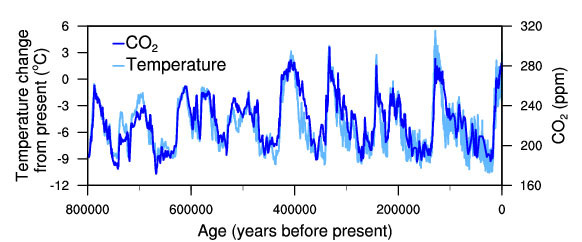
We have so much data showing the level of correlation (millions of years) and the two correlate so closely that yes, its quite easy to predict.
> Still, even with one condition set static, which could never actually be acomplished, there are still to many variables for anyone to claim the levels of certainty they (journalist) try to claim.
The point is journalists arent claiming what the future temperature will be. They are claiming what it would be if current patterns remain the same and only "on average".. this number comes from the science not from them and the science has shown to be right. We can and have easily measured the CO2 change over time and the temperature has changed to the extent predicted given the change in CO2. So all the evidence shows these predictions of how CO2 and other green house gases effect temperature is very accurately with fairly low error.
See the images attached to see just how tightly correlated CO2 and temperature is... there really isnt much doubt here.
lets be clear what we have zero doubt about...
1) We have zero doubt that the CO2 levels in the atmosphere is higher than they have been in the last million years at least.
2) We have zero doubt that the rate at which we are dumping CO2 into the atmosphere is many thousand times faster than has ever occured over any significant period of time in all of history.
3) We have zero doubt that CO2 in the atmosphere will significantly increase overall temperatures and that contribution is predictable.
#3 can be shown not just by looking at historic correlation but you can literally just test it in lab.. fill a jar with CO2 and one with air, stick them under a heat lamp and the one with CO2 will get much much hotter. We know and can calculate how much hotter it will get and can apply that to the atmosphere and get results that agree with the historically measured correlation as well.
There is no doubt of these 3 points to anyone with half a clue.
1 and 2, ok. 3, not so much.
"CO2 in the atmosphere will significantly increase overall temperatures and that contribution is predictable."
First half, yes, will influence.
Second half, "is predictable." That's where I part ways, because the predictions of the past failed to memorialize and were explained away without sufficient .. Anyway.. .I disagree. (to be clear, I disagree about the certainty aspect, not the trends).
And, I guess we could just end there. Because, you can't prove the future based on isolated variables in a jar in a lab. Ecosystem is pretty complex. It's likely to affect central areas of continents, I believe that. But I'm just not seeing 321,003,271 cubic miles of something with a specific heat of 1kcal/(kg K) rise 7 degrees in my lifetime due to CO2 just yet... Possible, yes. Probable, maybe. Zero doubt, not even close.
Again bullshit... We predicted what the average global temperature rise would be given a rise in CO2 and the actual abserved temperatures not just were in the range of the predictions, they were smack dab in the middle of the prediction almost perfectly.
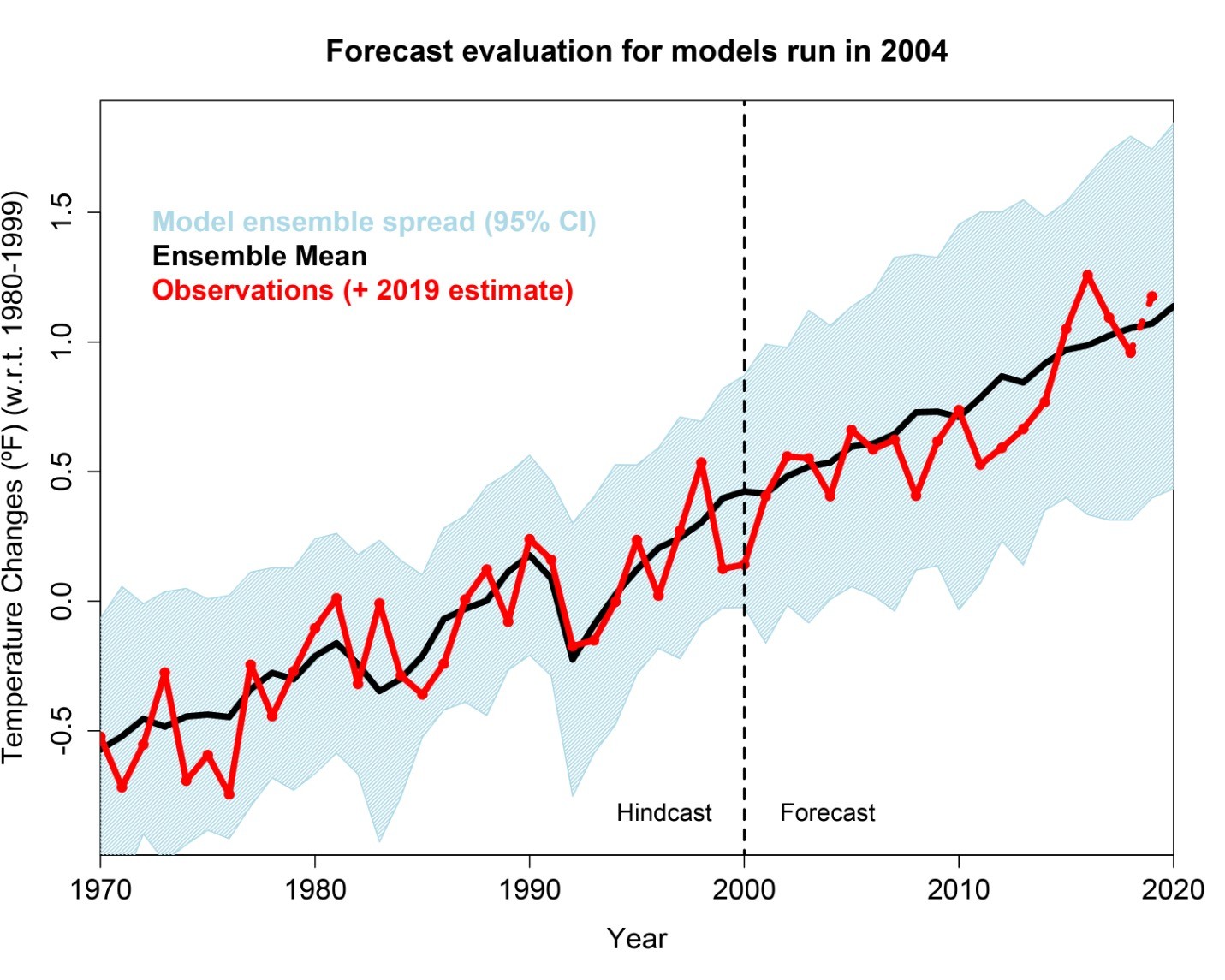
Attached is an image of the temperature rise and CO2 predictions made in 2000 predicting to 2020 and then the actual observed values. They were spot on.
You found one prediction. I've been watching them since the 70s. Your always bound to find one model that fits.
That was not the predictions of the 1960-1990s, nor the doom and gloom of today where we are saying 7 degrees, that started this whole thing.
If anything, that shows that the nonsense in the first article is super exaggerated, because how is that going to make a sharp vertical turn now, based on it's own model.
Half a degree in 20 years, that's what you are showing. 7 degrees in 80 years is what that original journalist artical stated (that's almost 1 degree ever 10 years). Sure, acceleration, but I don't see that kind of curve here.
Scientific journals of note, peer review, all the accreditation in the world, doesn't make these models match. You have just disproved the original "news story" premise to declare victory? WTF?
Yes, looked to quickly. 1.5 over 20. So, x5 is 7. Hmm. so, we are all going to die. You win. I stand corrected. (actually, you are right on this one, I have like 8 things going on, that model does fit the story).
Bring on Cambrian.
BTW, YOU are not the kind of person I'm here for, and I am not a source of truth. My primary function (only reason to be on fedi) is to troll.
But, anyway, yes.. Looks like we all might burn up in a fire ball, I guess. I'm in no position to dispute it (nor do I think I can find proof even if I had access to data). But I still find all the journalistic attempts to cover and explain the issues somewhat pathetic, raising far more questions than providing answers.
Things arent looking great, but we are only doomed if we do nothing to stop green house gases. Huge strides have been made so prediction into the future arent so bleak, it bought us some time thankfully. But if we keep converting over to a greener world, and we are already making huge strides on that, any disaster may very well be averted.
By the way here is some background on the image I posted if you care to read it. The model is from the IPPC 4th assessment report in early 2000
Yea, but history is good at showing us, one unexpected thing changes everything. It's going to be something like a stream of ocean water shot into space to thermal vent, or a big fucking icecube (Futurama joke), not CO2 caps. Crazy shit, just as long as it's not "block out the sun" bullshit, fuck Gates.
the earth is big, so any solution is going to have to be at a global scale and setup long before we are at 0 hour. So sure you might solve the solution by creating some sort of crazy high tech bacteria powered tree that scrub CO2 or whatever scifi solution. But youll still need millions of them (or any solution) around the globe. And frankly, isnt it easier to just plant some trees and use some nuclear/solar/wind/tidal energy and call it a day? Why rely on a hail mary when we already have the means to solve the problem.
For that matter, why hold on to the old polluting ways of doing things at all.. coal is so inefficient, you gotta mine the stuff, and use it in massive quantities.. switch to nuclear or solar or whatever and your talking about 1/100th the effort for the same power.. even if it wasn't cleaner there is no reason not to really.
Also lets not forget fusion is getting really close to being a thing. We are about to bring our first fusion reactor online that will produce usable energy in a year and over the course of the following decade ramp it up to full power as we tweak it. Fusion power is likely only a few decades away from being the norm. While that shouldnt stop us from going green now (as it is viable) that may very well take it to the next level.

 it's always been just about to happen and they never deliver

Depends who you ask.. seems to me their timeline since the first operating tokamaks were build has been relatively predictable and on schedule. A bit of variance as science wasnt even sure if it would work at first, but were at the point where we have pretty good confidence it will and the reactor that can do it is already built and the big bugs proven out. but for almost a decade now its progression has been pretty much on schedule.

Give it a decade and you might just have a chance to use some fusion power.
Solar is already viable.. its just not great at high power, too many panels for too little energy. That wont ever change. But its perfectly viable for lower to medium energy needs.
Solar hasn't explored a lot of tech, honestly. It's like TVs, we had them for decades before we made on flat and lower power. The pn junction efficiency of panels can only be pushed so far (there's a bit more to squeek out, not much). It's going to take a leap, and another technology.
"Solar" as in the panels and converters you know, can be optimized even further, by rooftop. If each roof was covered, it helps (because of transmission losses, it's way better than the stupid "solar farms.") Basically, THAT, "won't ever change." It'll never see like over 40% efficiency or something...
But, that's not the end of the story. That's just one box they label "solar" because of it's wide deployment.
It's a definition of terms issue. And "solar" (as in energy from the sun) is a very viable energy source still, that we haven't even begun to fully harness. So, don't discount the thought that there might be a more efficient technology, possibly within our lifetime. At maybe 25% efficency (they claim, not really even that high), we have a lot of room for improvement. Just, probably not with pn junction stuff... Well, at least not with the commonly used inorganic materials, but bio/organics haven't even been "fully" explored yet for higher efficiency (which could up it, maybe? 10-20% more? Maybe). It'll probably be something totally different (mirrors/heat stuff has been explored, it is in the same ballpark of efficiency, not a quantum leap forward).
until then they're just toys that makes you feel better. (i live in a complex that has solar panels; they don't produce enough.)
@freemo @Genen
Yes no doubt there is some room for improvement. Only so much we might see 2x - 4x theoretical improvement on efficiency, maybe a little more.. Which nice.. but it will never be what fusion can be, and even without that it is still viable now.
"Solar is already viable.. its just not great at high power,"
Or, human consumption of power is grossly inefficient. That is a huge factor. I don't need to be texting from a 16 core dual Xenon 2013 Mac Pro drawing a shit ton of power right now... When an M1 would be fine, if I could afford it, and didn't hate binary blobs so much. I mean, it's all relative to something else. Everything is meaningless if there isn't a 3rd point of view to put it in perspective. I believe in the golden rule of 3, if you don't have 3, you can't really see. Pick 2 of the three if you want to optimize, one will always have to suffer in quality, that's nature. You need 3 for 1 to really become "above average" at anything. Even points of view. Think in Fermi levels, what does this all mean if we just jump the microscope back by a factor of 10, is it still significant? What part is? Even Fermi levels need 3 for perspective, one above, one of higher magnification to a key issue.
This is certainly true. We do a horrible job at making power efficient. However an interesting note, if you use electric heat then in the winter the inefficiency of everything in your home is no longer working against you.
Everything is nearly 100% efficient at producing heat. So when you have inefficient devices in your home in winter it really just means your heater works less and overall you consume the same electricity as you would if everything was 100% efficient.
"the earth is big, so any solution is going to have to be at a global scale and setup long before we are at 0 hour. "
No, we are small, and we need to think smaller and find the key that opens the damn door. We need to think about the little things we do, like use less power to acomplish more useful goals.
(now I'm going to contiune to cook for 5, feel like we are about to get the door kicked in for to many people in the hosue, and try to keep reading the rest of all this shit, I'm way behind in this thread at this point).
its not about finding a model that just happens to fit.. I showed you the **prevailing** model.. these models arent complex by any means, they are realtively simple and easy to compute, and there is very strong agreement among scientists. This was **the** model of the 2000s and it turned out to be right.
You are grasping at straws. In the 70s there also wasnt consensus yet on a model.



One having zero doubt is not a measure of the certainty of the reality of the situation, it's merely a measure of one's lack of imagination about the situation.
To some extent I agree. But there are certain things with so much overwhelming evidence zero doubt is perfectly fine. I have zero doubt the earth is not flat, I have zero doubt the sun is far away, I have zero doubt the stars are even farther away, and I have zero doubt over the 3 points I mentioned regarding climate change.
Some things are so overwhelmingly obvious given the body of evidence that having zero doubt is perfectly ok.
Just one possible counter example: there's a tiny but non-zero chance we're in a simulated universe, so the distance to the stars, and everything else in your list could possibly all be an illusion 🤷♀️
You're of course free to believe whatever you want, but we men of science should be clear-eyed about what is fact and what is faith.
"The first rule is to not fool yourself, and you are the easiest person to fool." - Richard Feynman
Actually there is a pretty decent chance of a simulated universe. But even if we are in one, doesn't change the fact that in this simulation the sun is far away and the stars are farther.
Now of course when i say things like "zero doubt" that doesnt mean that i can never under any circumstances change my mind. But you would need rather extraordinary evidence to convince me the world is flat, so it isnt something I doubt, but it is something that you are more than welcome to prove if you have such evidence.

"we have objective ways over measuring correlation and we know the order of scale to expect the noise at."
We do not have an objective measure capable of even knowing the typical noise in the system. Completely disagree.
The statistics do favor the existence of these theories. Yes. They do not provide "zero doubt" that we have fully modeled the system accurately to predict what is coming. And, thus far, a number of "predictions" have failed (albeit, because they predictions were journalistic hype, that over state the statistical significance of the data).
I do not disagree with the position that overall, it points to CO2 being a huge issue.
I disagree it's as statistically sound as "no doubt." It's more than likely, but it's at best, still around that 80% fit (just like that graph), even when you dig way, way, way deeper into that data.