
 🇳🇱
No, since everyone sits on their money economies stagnate as far less of the money is being used to build new wealth and over time the people loose wealth even if the value of an individual dollar gains. In the failing economy you wont be able to keep your money in savings for long as youll quickly find your spending it to feed yourself as food becomes more scarce as fewer people are investing in the farms and infrastructure for food. So the money itself may gain value while you loose wealth as it does.

@freemo Coercing people into investing when they otherwise wouldn't is immoral. Instead, we should be educating them to invest voluntarily after due diligence. Do you have proof that the economy would screech to a halt if inflation zeroed out? With wealth as concentrated as it is, there are plenty of investors who will continue building their wealth regardless of price fluctuation.
@melovida Its not about coercion. Not matter what we do we are "coercing" people to do something. If we create systems that dont have healthy inflation then we are encouraging people to hoard and not invest, if we create a system with healthy inflation we are coercing them not to hoard and to invest.
The best proof we have is early economic systems that tried to fix the wealth/value behind a unit of fiat. These caused devestating poverty and economic depression which is largely why we moved away from it to the current model.

 福神龍
All the alternatives to fiat money seem to work out much much worse for various reasons. Unless you are using an unusual definition of fiat, or even just one different than my own.
Fiat money is money with no reserve basis whose value is derived by the credit of the government that issued it.
Paper money backed by gold; reserve notes issued by a government, are far superior. The majority of large scale depressions have occurred under the banner of fiat and fractional reserve banking.
Finance capitalism is a pyramid scheme, plain and simple.
I mean, the gold standard was a huge factor that created the great depression, the worst depression in history. We literally moved off the gold-standard in part due to the depressions it caused.
While we have been off the gold standard for a long time, and thus have a good number of depressions under our belt. None of them have come close to being as bad as the great depression.
So would seem the data and history would disagree with you.
Incorrect. The great depression was caused by massive margin calls that caused a run on the banks due to a media induced panic.
Just so happened to be the ammunition for Wall Street to get us off the gold standard and secure their ability to print money.
Wall Street literally engineered a depression which would ultimately benefit them. No one disputes this now.
You're wrong. The gold standard is far superior to the kike-owned money printing machine of today.
Incorrect and completely ignorant of history.
What happened was due to WWI the governments spending was more than 3x over what its income due to taxes happened to be in an attempt to recover from the war effort. In addition our loans to foreign countries went into default since Britain and other countries couldnt pay us back. This put the US government in significant debt.
Because the supply of money was fixed to the supply of physical gold, and since the government was poor in government terms and in debt our supply of gold was particularly low at the time. As a result the number of physical fiat in existance was also at a all time low (they would have to destroy fiat if they wanted to spend gold).
Banks stay in business by loaning out money. The amount of money they can loan out is limited by what they have on hand, what they have on hand is limited by how much money is in existance. So most banks had far fewer physical bills in their vaults than usual even though the amount of their deposits remained the same. Plus the banks continued to loan out money to afford their rent, so there was very little cash.
As a result of this between the media reporting on the situation, and banks going out of business (at this point in low numbers) due to being unable to generate enough income off the small reserves it had people started to panic. They knew there wasnt enough money to go around and many people lost hteir life savings as a few banks already went bankrupt. People started to withdraw their money, convert it to gold, and began hoarding gold instead.
The hoarding of gold caused gold prices to go up, making it harder for the US govt to obtain new gold needed to print new dollars, combine this with the run on banks and now banks were going out of business left and right. Some people got their money, many went from rich to debt overnight.
As a result of the insolvency of many and the fact that brokers were loosing access to their own money resrves they did a mass margin call, no one could meet the margin and the stock market collapsed as well.
Now witht he banks and stock markets in full collapse the great depression is a reality..
In short, yes it was due to gold standard.
Homie, WWI ended in 1918, the great depression occurred in 1929 and was caused by overextended bets on margin.
This is well documented.
Fiat money is backed by gov. You claim governments spending during wartime fucked the economy and so the solution was to switch to a currency backed by the temperance of government. You've literally made the case for why gold standard is superior.
Federal Reserve Act passed in 1913 and is what allowed government to leverage itself beyond its ability to repay. An Act written by banks which established banks as the lender of last resort and printers of money for the US.
Later, the roaring-20s was fueled by banks lending on margin for equities which led to massive losses (like a GMEx20).
You're in full on dunning kruger. The gold standard limits corruption and abuse by banks and governments because it puts an absolute value to devaluing currency through expansion of the money supply. The removal of the gold standard was always the goal, because printing money at that time allowed for the US to reach global monetary hegemony, which was far more important than an efficient accountable one.
Yes WW1 ended about a decade earlier. You do realize that doesnt matter.. As I said our spending skyrocked to 3x our tax income in WW1 in an attempt to fix our debt, this lasted for a decade because, since we couldnt raise money through printing money, it was slow an ineffective. By 1929 a decade later we had not even reduced the debt we incurred in WW1 by 1/3 and the decade long spending depleted our gold reserves in the process.
See the attached chart showing how the debt incurred in WW1 was only 1/3 reduced by the time the great depression hit.
Funny, its almost like events in the past effect the present. Who woulda thunk.
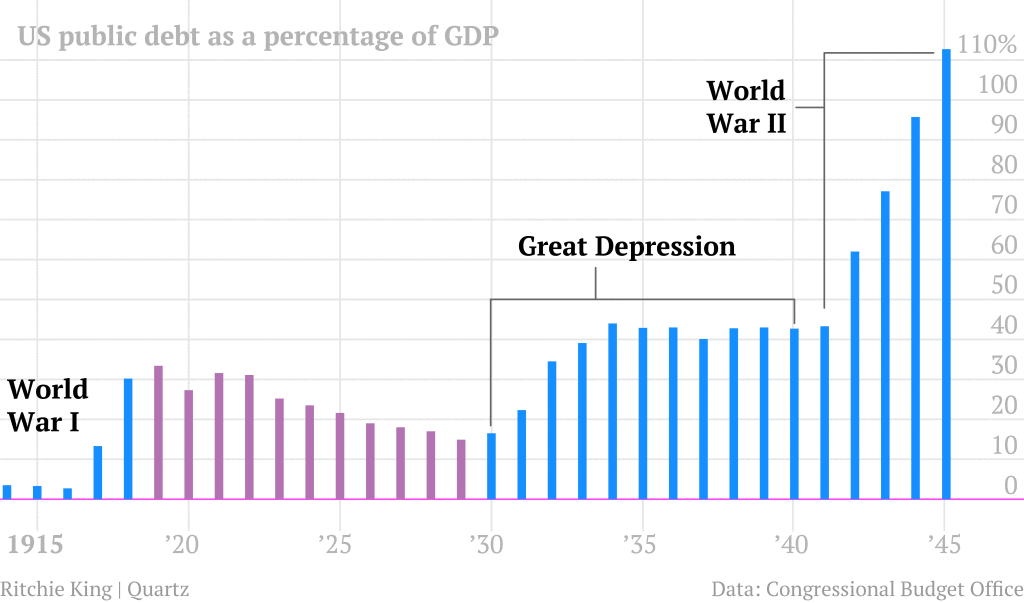
Oh you're not wrong about the national debt. But, what you're saying about the past is akin to saying the 2008 financial crisis was because we were $10 Trillion in debt as a country while completely ignoring the mortgage crisis created by Wall Street.
You are incorrect. That doesn't mean everything you say is wrong, it's just not the reason.
There was no crisis on wall street until banks started failing, no one could cover their debts, and the margin call kicked in.
All of which was the direct result of the gold standard.
It is quite clear how and why the gold standard caused us to collapse under any appreciable debt. Its also clear why **not** having a gold standard meant that despite having more debt in 2008 than during the great depression the financial crisis that ensued wasnt even close to the levels of the great depression. So yes you might say the debt in 2008 played a factor then too but it is literal proof of why moving off the gold standard saved our asses despite that.
Your cause and effect is wrong. Margin calls were made, people couldn't pay, banks were left holding the bag and called in loans. People saw there money evaporate and as word spread runs began to collapse banks.
The gold standard without a Federal Reserve would have prevented the entirety of the financial maleficence to begin with. Your assertion that our ability to put off short-term failures to the long-term is a boon, is not only myopic but also the reason the system fails the ones it's supposed to help. Because, it isn't designed to create positive stewardship for society, only short-term gains for holders of capital.
Incorrect, history clearly records the timeline of events the month before black thursday (the day of the stock market crash and official start of the great depression).
The previous month before the crash the first move that sealed the fate of the great depression was in august when **banks** rose the discount rate in an attempt to defend the gold standard and make up for the shortage in physical fiat. Effectively a bailout for the already crashing banks.
It wasnt until a few weeks later when the actions of the banks bailout which failed did the stock market begin to crash with an 11% fall on black thursday which eventually led to margin calls.
No. The first move was in the early 1920s when the Federal Reserve expanded the money supply to deal with their mistakes from WWI; this mean rates were incredibly low and people could borrow money cheaply. Which led to people borrowing money to buy stock and overextending themselves.
The Federal Reserves response before and after the 1929 crash coupled with the real economic losses from it, were the reason the Great Depression lasted so long.
The Federal Reserve is a backbone of a fiat currency. Fiat currency must be managed and it's mismanagement time and again has caused depressions.
The gold standard requires far less managing as it's based on actual reserves; not the market for loanable funds and short-term rates.
No wrong again. The money supply actually **decreased** from 1920 to 1921 significantly from 7.3 billion to less than 6 billion. This was a direct result of the debt I had already mentioned.
they did try to respond to that by increasing the money supply back to nominal levels but because it was backed by gold that had to be locked away and couldnt be spent, and because the government was already in debt this is exactly what I said earlier where it caused extreme debt and economic stress in an attempt to do this due to the gold standard. As a result the money supply did increase slightly from 1921 to 1925 but at great economic cost (huge spending with marginal effects on debt) that lead to the very crash I mentioned, all thanks to the gold standard. It should be noted that the expansion of money supply from 1922 to 1925 only increased the supply by about 0.8 billion leaving it at 6.8 billion which was still half a billion less than it was in 1920.
So your comment is not just flat out wrong but the exact opposite happened, the money supply decreased significantly and the government was desperately trying to keep it from doing so (and failing due to the gold standard).
LOL
you: "in the early 1020s the fed expanded the money supply"
me: "You mean the money supply plummeted and they tried to restore it and couldnt"
you: "your trying so hard to be right, you are twisting the fact"
It literally went down by 1.3 bil in the early 1920s then back up by 0.8 bil.. I am not twisting the facts by pointing out the money supply went down, not up... what your doing is called projection, you are literally twisting the facts.
Dude you are just so far off base and ignoring fundementals.. the whole point of the gold standard is there is no such thing as "cheap money", money's value is fixed by gold. What you are really doing is trying to twist the fact that the gold standard was crippling into something that ignores the gold standard.
What you mean to say is that bank loans were cheaper (lower interest rate) which was done because the banks were struggling to stay in business so slashed prices in a desperate attempt to try to sell more loans, stimulate economy, and get out of debt caused by a deleted gold reserve that directly effected monetary supply.

In the early 1920s the Fed was dealing with a mini-depression, from 1920-1921, which is when they started expanding the money supply, and this lasted until 1928; which made for cheap money easily borrowed which people used to buy stocks on margin and when the markets dipped the calls came in and a domino effect occurred. Albeit the response from the Fed was also poor after the crash and exacerbated the depression.
The crux of the discussion is whether a Fiat currency is to blame for crashes or the gold standard. It is clear that the gold standard is superior as you've just helped me show it was Fiat monetary policy which caused the great depression and every one thereafter. Whether you're able to accept that or not isn't the issue.