
 🇳🇱
@realcaseyrollins How would you measure a "booming economy" in the context of a communism anyway? Usually we rate the health of an economy by how much disposable income someone has. The whole point of a communism is that there is no distinction between disposable income since there is no code income needed for necessities, those are (supposedly) provided.
Cumulative wealth divided by the population and compared to median wealth? GDP? Growth of businesses?
I don't think disposable income should be the best indicator of a good economy, but rather the economy's ability to perform, grow and expand.
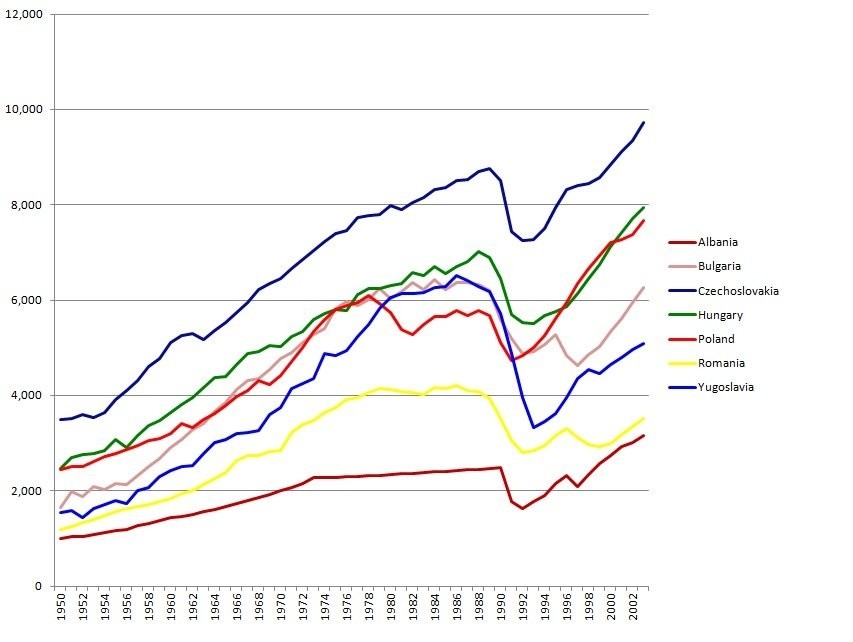
In that case here you go, a graph of previously communist countries showing GDP per capita. You can clearly see how the growth of GDP changed pre and post communism here as well as the cost of the transition itself.
@realcaseyrollins Perhaps, this is largely why I asked you what the indicators should be and then provided whatever that was.
Healthcare in tiny socialist countries can be impressive though, from what I've heard
@realcaseyrollins I am of the opinion that communism generally fails both economically and in terms of personal freedoms.
In the charts I provided you can clearly see that the rate of increase int he GDP is significantly higher post-communism than pre-communism for most of those countries.
@realcaseyrollins You are looking at the GDP, thats the wrong thing, you need to look at the rate of change of the GDP, the slow of the lines not their position.

 @realcaseyrollins@counter.fedi.live
@realcaseyrollins on second look perhaps its less obvious than I first thought. One would have to calculate the actual slopws here to really say I suppose. It also isnt the best graph considering it is cut off a bit too early anyway.
