


 🇳🇱
@realcaseyrollins How would you measure a "booming economy" in the context of a communism anyway? Usually we rate the health of an economy by how much disposable income someone has. The whole point of a communism is that there is no distinction between disposable income since there is no code income needed for necessities, those are (supposedly) provided.
Cumulative wealth divided by the population and compared to median wealth? GDP? Growth of businesses?
I don't think disposable income should be the best indicator of a good economy, but rather the economy's ability to perform, grow and expand.
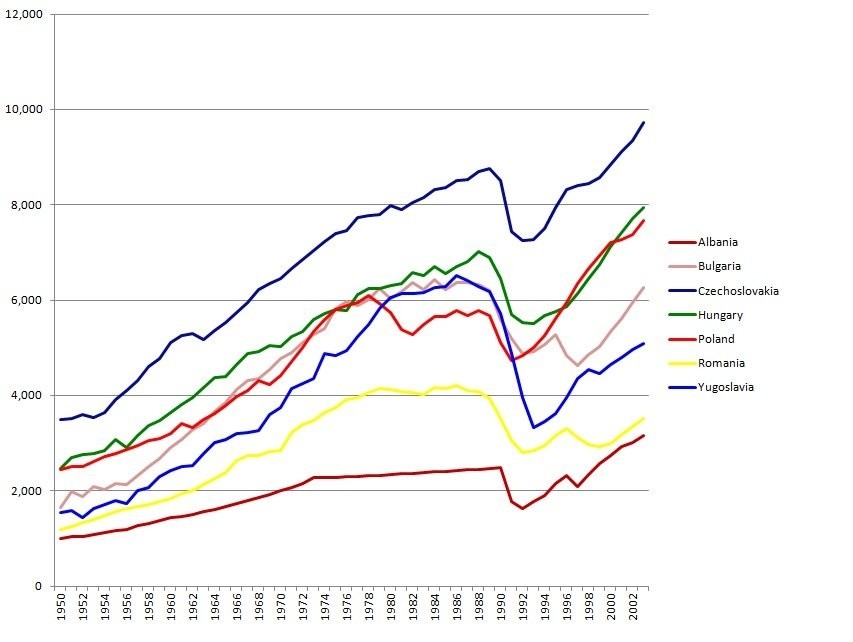
In that case here you go, a graph of previously communist countries showing GDP per capita. You can clearly see how the growth of GDP changed pre and post communism here as well as the cost of the transition itself.
@realcaseyrollins Perhaps, this is largely why I asked you what the indicators should be and then provided whatever that was.
Healthcare in tiny socialist countries can be impressive though, from what I've heard
@realcaseyrollins I am of the opinion that communism generally fails both economically and in terms of personal freedoms.
In the charts I provided you can clearly see that the rate of increase int he GDP is significantly higher post-communism than pre-communism for most of those countries.

@freemo @realcaseyrollins there are as many flavors of Communism as there are flavors of Liberalism.
Libertarian Communists for example have little trust in the State and seek to maximize civic liberties, all that while only allowing economic systems with a republican form.
While it is certainly true there are many fgorms of communism, but definition being a communism ensures you have a very specific set of properties, and you **must** have this to qualify as a communism.
Therefore it is perfectly reasonable to say, and in my opinion correct, that any of the many flavors, if they happen to have the properties needed to qualify as communist, then that quality will ultimately lead to a much worse economy and quality of life than if that communistic property were not present.
@freemo @realcaseyrollins which is why you will very rarely see Marxist-Leninists, Trade-Unionists and Market Anarchists parade together ; their moral compass is far too different to hope for some sorta leftist unity.
Indeed. But their moral compass is less of a concern for me than the fact that the shared property of communism is a harmful factor (in my opinion) to the quality of their proposed governments.
depends how you define "shared property" -> we never witnessed Republics in which the only acceptable legal structures were worker cooperatives and citizen associations. Hell you could still have your (somewhat) free market mechanisms. and I dont see how workers (the real wealth creators) enjoying workplace democracy would be a harmful factor for wealth creation.
there are been a few attempts but they were short-lived, mostly due to external factors, such as wars.
"shared property" is not the definition of communism. Communism is most commonly defined as a system of government where the means of production **and** the means of consumption is controlled.
Contrast this with socialism where only the means of production is controlled.
The definition of "shared property" isnt particularly necessary given the formal definitions.
@freemo @realcaseyrollins my final point is ; its counterproductive to say communism is harmful when we only tried only one of its flavor.
its like saying democracy is harmful as a whole because some of them decayed into fascist states
We have in fact tried quite a few flavors of communism. There are atleast 12 or 13 countries I can think of off hand which were non-marxist communisms.
Consider the over 100 different communist countries we have tried over the years, and in many different "flavors" and forms, all of which effectively failing, I think its pretty safe to say its a deadend.
Now if you want to try a non-communist country that you think should be considering communist but isnt because it doesnt meet the definition, then I might be more forgiving in my opinion of that. We would have to discuss the details. But I would never consider those communist myself.
@freemo @realcaseyrollins may I know which non-marxist-leninist communist republics are you referring to? 
cause legit all the ones that came to my mind have been mostly victim of external factors such as fascism and foreign-backed coups d'état.
La Commune de Paris -> defeated by loyalist forces
Spanish Libsoc Republics -> crushed by fascists
Rojava Confederacy -> getting wrecked as we speak by islamist-fascists and turkish nationalists 
The following is the list generally accepted by experts on the topic as historical and present day non-lenist-marxist communisms:
Algeria People's Democratic Republic of Algeria (since 1962)
Bangladesh People's Republic of Bangladesh (since 1971)
North Korea Democratic People's Republic of Korea (since 1948)
Belarusian People's Republic (1918–1919; unrecognized)
Autonomous Republic of Crimea Crimean People's Republic (1917–1918; unrecognized)
Hungarian People's Republic (1918–1919; unrecognized)
Korean Empire People's Republic of Korea (1945–1946)
Kuban People's Republic Kuban People's Republic (1918–1920; unrecognized)
Libya Great Socialist People's Libyan Arab Jamahiriya (1977–2011)
Ukrainian People's Republic (1917–1921; succeeded by the Ukrainian Soviet Socialist Republic)
West Ukrainian People's Republic (1918–1919; joined the Ukrainian People's Republic)
Zanzibar People's Republic of Zanzibar (1963–1964)
Not always recognized as states:
Donetsk People's Republic (since 2014)
Luhansk People's Republic (since 2014)
The existance of cooperatives is not considered communism. WE can and do have cooperatives in the USA and we dont remotely resemble a communism. Nor would a country that makes "lucrative property" illegal necceseraly be a communism.
There are ways you could implement those that might be communistic of course, but on their own they are not things that make something a communism.
By the way the prohibition of lucrative property has absolutely been experimented with in certain countries and remains the case today. We have governments that have even went so far as to ban the ownership of property by individuals all together.
