
Denial in a crisis.
It's a maladaptive response trying to reimpose order on a world that to the person has lost sense.
I keep saying we need psychologists to weigh in.
This is why you see it out of people who are ... odd.
And their followers as well. You will see the followers ssying thank you for the good news.
They are not looking for accurate facts.
They are looking to be soothed.
For any raft they can find in this storm.
I rather suspect the GIVER of "good" (fake) news feels good about giving it and reassuring the RECIPIENT.
And lo and behold we see that happen.
The two adults have self-soothed.
This is why my opposition to idiots in public health "soothing" the public. It is a myth that the public panics. These are just weak people in charge.
Took me 10 s to find a Foreign Policy piece referring to this _disaster sci expert_ saying it's a myth.
And here is the Foreign Policy piece itself.
https://foreignpolicy.com/2020/09/16/trump-woodward-elite-panic-coronavirus-pandemic/
But just to close out, I cannot see that infectious disease doctors (for ex) take a single disaster management course in their training.
Further, public health requires (in Ontario) one year of ID, and to be a doctor.
As I said from the start, these people are not trained for this.
Which is why, and this is just my opinion, we might see so much "be kind" messaging out of them.
It might be as much about being kind to THEM (i.e. not criticizing) as to each other. (Or it's straight career PR. Some are very good at that.)
To be frank, considering what people are going through, most people have continued to be pretty kind to each other
Why did countries in Asia do better than we did? No, IMO, it was not simply they threw on a surgical mask.
They have effective DISASTER RESPONSE systems.
Again, one minute of searching found this Korean article. Korea dealt with MERS.
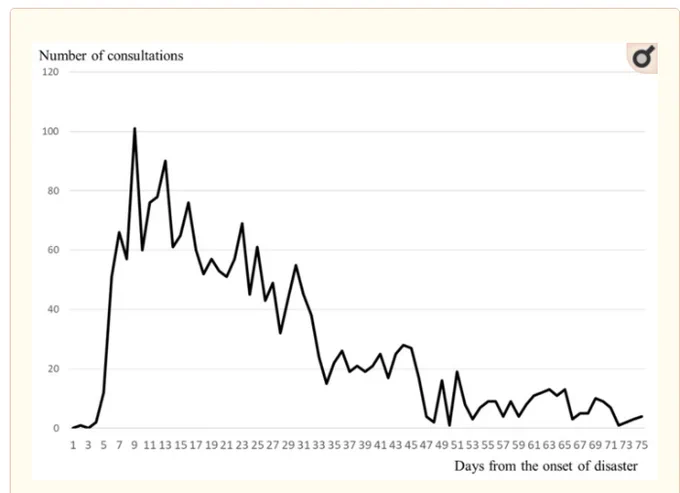
And in 15 more seconds found this Japanese article discussing mental health consults in times of crisis.
https://www.ncbi.nlm.nih.gov/pmc/articles/PMC7084937/
Within WEEKS the consults are down to a low level.
Not zero. We shouldn't expect them to be zero.
But the myth that people panic and the world goes to pieces is exactly that:
a myth.
Reminder to follow the disaster science expert, above!
(Sure, I may read up before I open my mouth, but I am no expert.)
P.S. This is why people stating risks get called "fear mongerers"
It's a tactic to try to stop messaging that contradicts the worldview of the person trying to self-soothe.
Same with anti-mask sentiment.
Mask is necessarily a signal of risk. Incompatible with "no big deal", the fantasy they desperately want to believe in.
(It should go without saying, but I'd better say it: yes, there are of course people who stoke fear for personal gain, and this is not what I am referring to here.)
For reference, to leave here, an example summary of what infectious diseases is, from one school of this field.
I don't know why I didn't think to search Wikipedia until now but there we go.
Article about how CDC had a messaging plan and it went out the window during this pandemic.
Link to PDF about disaster myth. Hosted at CDC, ha.
https://www.atsdr.cdc.gov/emergency_response/common_misconceptions.pdf
Department of Homeland Security has a link to 2002 guidelines for communication in a crisis.
CDC emergency manuals etc.
Short article about panic myth
https://journals.sagepub.com/doi/pdf/10.1525/ctx.2002.1.3.21
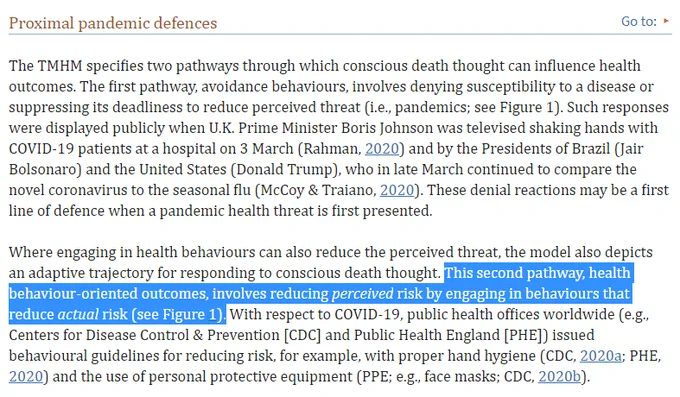
Here are the two streams of response:
1. Denial, which avoids the cognitive dissonance and worry about death by simply suggesting to ones' self the danger does not exist. We see this in animal accounts on the bird site.
2. Actually changing behaviour to reduce risk.
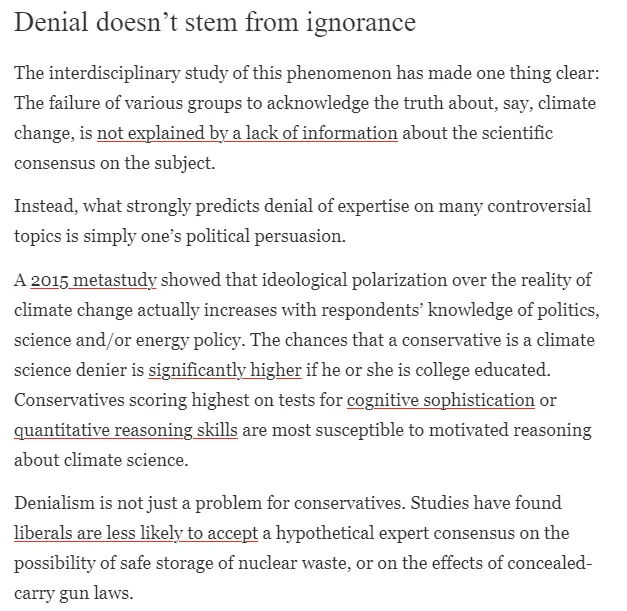
Also, denial does not flow from ignorance.
It is a desire to reject beliefs that do not accord with our existing knowledge or beliefs.
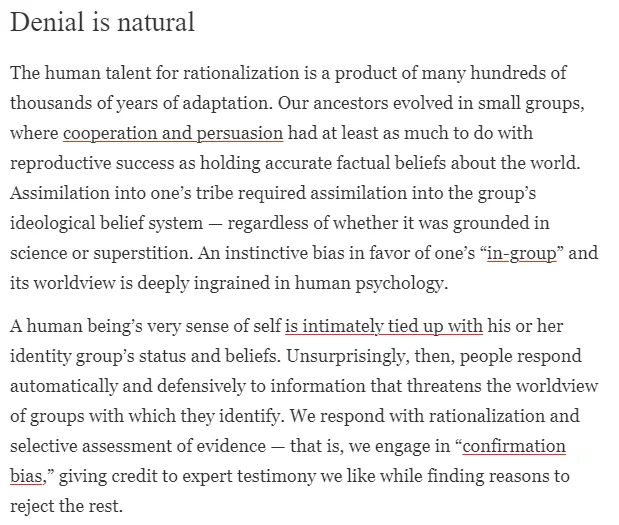
Origins? We used to hang out and caveman & chill in small groups.
Things that didn't fit, got thrown out.
Including Bob, if he suggested we sleep by the lake and not in the cave everyone else wanted to sleep in.
And another about panic myth
You may revisit all the lies as institutional failure, in not being trained to respond to a crisis, and attempting to sooth a supposedly panicked public.
It's rather hilarious when you look back on it.
Except for the dead and disabled people.
Then it is not so hilarious.
Consider whether when you read articles about other well-known viruses they smack of desperation and denial.
Denial is a helluva drug.
---
Ah we do everything again, and again, and again.
This from 1948.
"It's not as bad a whopping cough, stop freaking out"

 🇳🇱


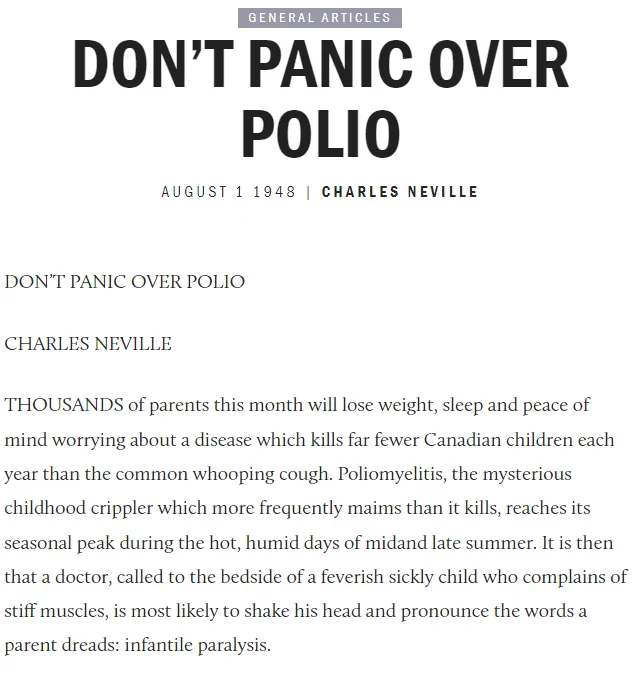
@jmcrookston Does anyone know if this is factually true? It seems to be claiming in 1948 the claim was made polio was rare in winter and only common in summer... Is that true? I am having trouble finding seasonal numbers on this.
Ok did some checking, the post here actually is accurate and factual for its time.
Polio is a **highly** seasonal disease and, as the article suggests, it is not a significant issue in the winter and it is during the summer that parents (at the time) should worry, winters were fairly safe.
Source:
"Temporal pattern... Peaks in the summer in temperate climates"
@jmcrookston Sure, yes i assumed it was a reproduction of a real article.

@freemo
Yeah, just looking at it now i thought it might have been a little confusing generally, because the font is modern.
I can't find the link now but MacLean's had reproduced it on their site somewhere. If I could find the link I'll edit it in so people can read the whole article.