
Another note to my earlier self:
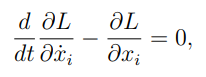
When we first studied Hamilton's principle we were faced with expressions that looked like L(x,x') where x is the position of a particle and x' is dx/dt. We were then asked to work with expressions like ∂L/∂x'. This sent my head spinning. WTF does it mean to differentiate with respect to a derivative? I'm used to the "denominator" z in an expression like ∂f/∂z being the name of a variable. x' isn't the name of a variable. Or another interpretation might be to go back to the definition of partial derivatives and ask how L(x,x') varies if you hold x constant and vary x'. But that's weird.
I was overthinking it. L is just a function of two variables. ∂L/∂x' is just ∂L(u,v)/∂v evaluated at u=x and v=x'. That's it.
I'm not sure anyone else ever found this confusing. Even an elementary intro like Neuenschwander's "Emmy's Wonderful Theorem" makes no attempt to clarify things so it must be obvious. The thing that clarified this for me was learning functional programming as it forced me to be more explicit about what is a function of what. (Embarrassed to say I haven't read Sussman's SICM.)
I still think ∂L/∂x' is weird notation that's deserving of an explanation the first time you see it.

@dpiponi wrote: "I'm not sure anyone else ever found this confusing"
Every mathematician I know finds this intensely confusing! That's why there are books on classical mechanics for mathematicians, like Abraham and Marsden's, or mine, which explain in *mathematical* notation what the physicists are talking about.
Physicists seem blissfully immune to this confusion, perhaps because they just pick up rules for computing with expressions, keep the physical meaning in mind to guide them, and don't expect these rules to fit together in some globally consistent system.
@johncarlosbaez I find this example peculiar though. I don't recall any of the ("applied mathematics") books I've ever looked at making any note about this notation at all. They all just use it as if it's something we've been doing all our lives.
Other places where physicists or non-rigorous mathematicians do weird stuff they may warn you. They'll say things like "we'll treat Dirac delta like an ordinary function even though it's not", etc. I'm very tolerant of (and even enjoy) weird notation or lack of rigour as long as the author gives you a heads up.
@dpiponi - Yes, it's peculiar. I teach courses on classical mechanics in the math department at UC Riverside, and also run around explaining physics to mathematicians online. So I know LOTS of mathematician find this notation upsetting. The ambiguity: 𝑥̇ᵢ is often used to mean
a component of the time derivative of a curve 𝑥(t) in space
but also, here,
a coordinate function on the tangent bundle of space
The latter function applied to the tangent vector 𝑥̇(t) of the curve 𝑥(t) gives the former quantity. Physicists seem to think it's hopelessly pedantic to distinguish them! Maybe it's because they already use x to mean both
the position of a particle at time t
and
a coordinate function on space
and that doesn't seem to cause them much trouble.

@johncarlosbaez @dpiponi The epitome of this different use of notations is thermodynamics, where physicists use the same name of the function although the indendent variables and hence functional „form“ is totally different. For example: S(E, V) and S(T, p). However, I always found this less confusing…

@__joerg__ @johncarlosbaez @dpiponi In a similar vein, I remember being confused by expressions in quantum optics where a quantity involves partial derivatives by z as well as its complex conjugate.
@johncarlosbaez @internic @__joerg__ Oh yeah, that's a good one. After studying that stuff for years I was really surprised decades later to come across the term "Wirtinger derivative" for the corresponding derivative operations.

@dpiponi @johncarlosbaez @internic @__joerg__ This is too representative of my complex analysis education too 😆 My favorite definition is to write \(a=\partial f/\partial z\) and \(b=\partial f/\partial\overline{z}\) whenever \[\lim_{h\to 0}(f(z+h)-f(z)-ah-b\overline{h})/h=0\]
(this is just the same definition as for the Jacobian matrix). I think this is a much better way to look at things than in Ahlfors' complex analysis book, which says "these quantities have no formal definition as limits, but we can nevertheless introduce them as symbolic derivatives" -- but "just symbolic" is too far, it's as good of a definition and totally equivalent to the Jacobian!
But I imagine I'm preaching to the choir. On a related note, I've recently done some integrals \(\int f dz\wedge d\overline{z}\) which required a bit of mind bending. https://math.stackexchange.com/q/1456403/607269
@davidphys1 @johncarlosbaez @internic @__joerg__ I still have the book where I learnt the formal machinery for dealing with complex 1-forms in a rigorous way showing that you can write differential forms as the sum of a dz and a dz-bar part. Here it's sort of an algebraic move.
(Gunning, lectures on Riemann surfaces.)
@davidphys1 @dpiponi @internic @__joerg__ - Ahlfors takes a hand-wavy, somewhat nineteenth-century approach to many topics, and we shouldn't be using his book anymore.

@johncarlosbaez @internic @__joerg__ @dpiponi I was taught that \(f\) is analytic if and only if \(\frac{\partial f}{\partial{\bar z}}=0\)

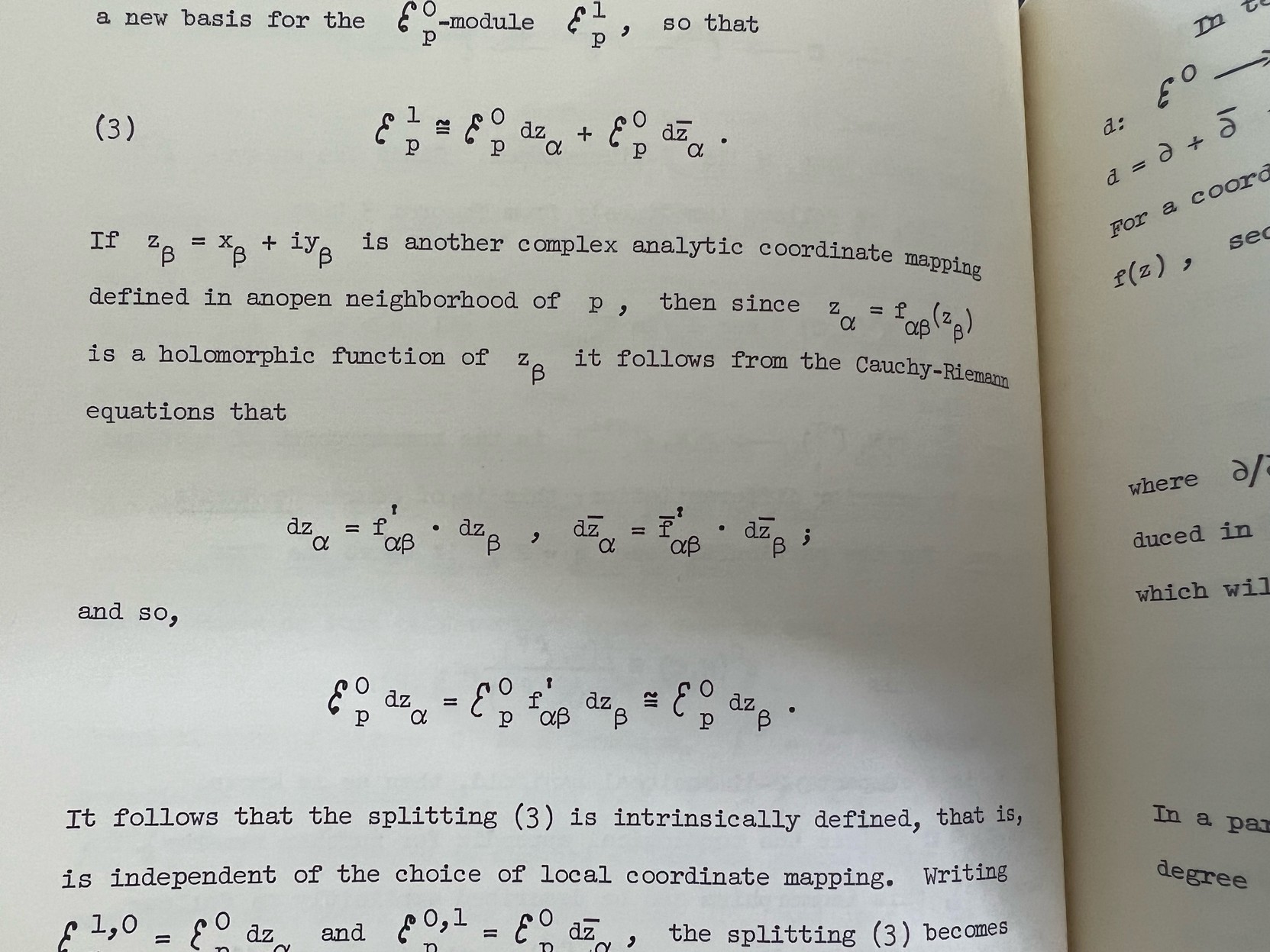
@BartoszMilewski Indeed. From the PDE & complex geometry perspectives, it is more convenient to work with z & its conjugate, especially when the complex dimension is greater than 1.

@internic @__joerg__ @dpiponi - yes, in complex analysis you need to know the sense in which 𝑧 and \(\overline{z}\) are independent complex coordinates on the plane! That confused the hell out of me until I worked at it.