Physicist John Archibald Wheeler was born #OTD in 1911.
A titan of 20th century science, Wheeler introduced the S-Matrix; developed the first general theory of fission with Neils Bohr; coined many terms (”worm hole” and “it from bit”) and popularized others (“black hole”); and trained Feynman, Everett, Thorne, and a host of others.
Wheeler received his doctorate from Johns Hopkins at the young age of 22, and went to work with Niels Bohr in Copenhagen.
As a junior professor at Princeton Wheeler introduced the quantum field theory “S-Matrix,” which relates the states of a system before and after scattering. When you want to make predictions about decay rates or scattering cross sections in QFT, you calculate S-Matrix elements.
During WWII, he contributed to the Manhattan Project, working at the Hanford site in Washington.
Even after the war, Wheeler – who was famously hawkish on national security - continued to work for the government on the development of the H-bomb. This is, imo, a shameful aspect of his legacy.
After WWII Wheeler returned to Princeton and took up ✨gravity✨. During this period he worked on gravitational collapse, including nuclear processes in collapsing stars.
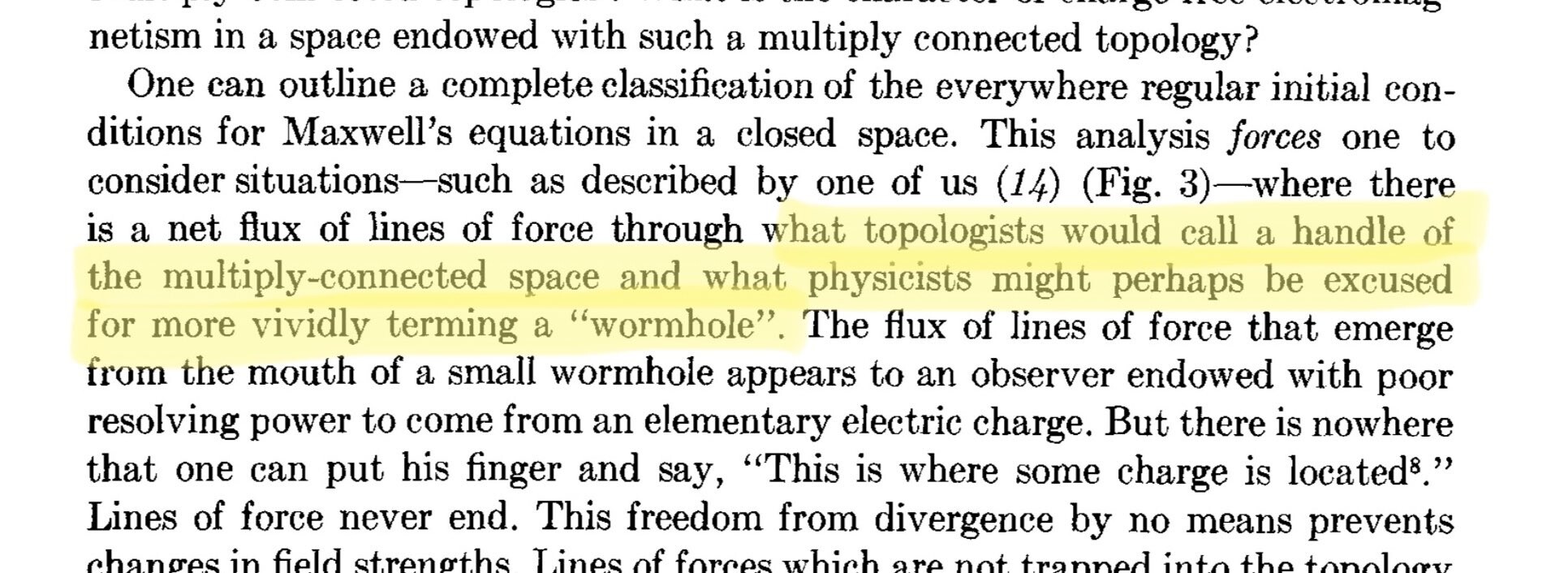
In a paper with Charles Misner (“Classical Physics as Geometry: Gravitation, Electromagnetism, Unquantized Charge, and Mass as Properties of Curved Empty Space”) he introduced the term “wormhole” for speculative tunnel-like solutions of general relativity.
https://www.sciencedirect.com/science/article/abs/pii/0003491657900490
The work of Wheeler (along with a few others) in the 1950s-70s is often credited with bringing general relativity fully into the physics mainstream.
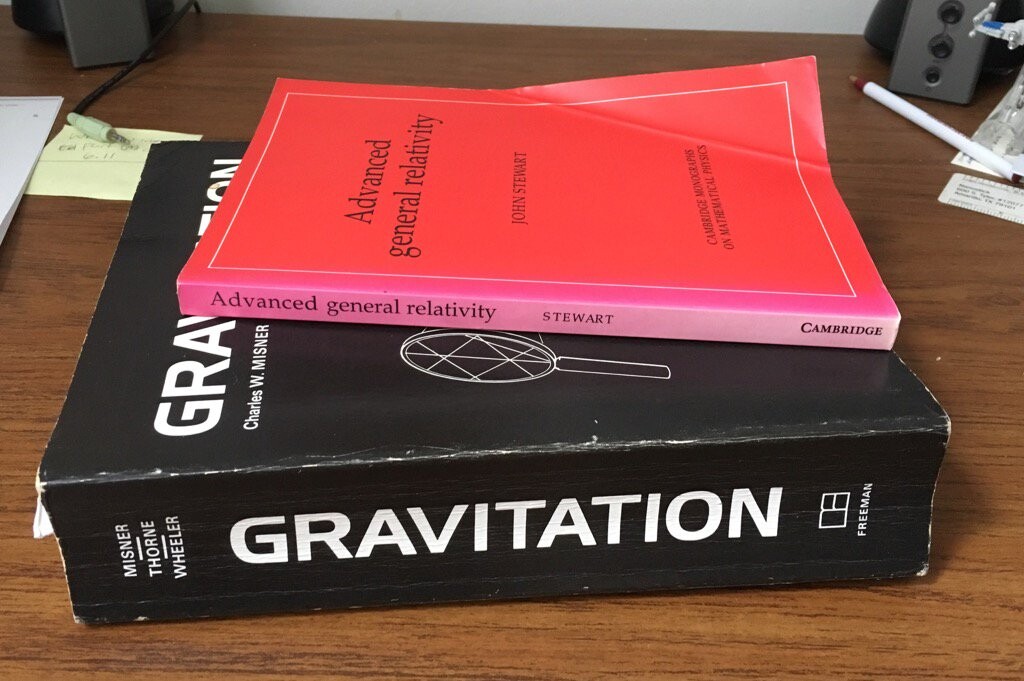
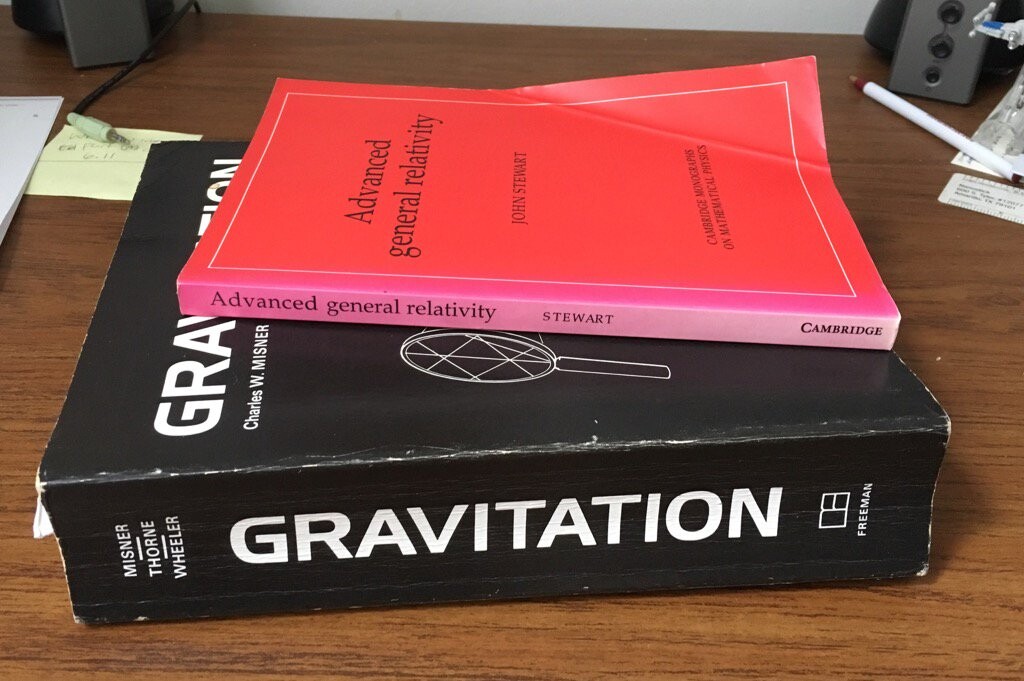
He also wrote a pretty well-known textbook on the subject with his students Charles Misner and Kip Thorne.
This absolute unit of a book enabled the “don't speak to me or my son ever again" meme pictured below, and is responsible for back problems in a generation of physicists.
Besides Thorne and Misner, the list of Wheeler’s students includes Feynman, Everett, Bekenstein, Christodoulou, Brill, Geroch, Unruh, Wald, Wightman, and many others.
That is a long list of very well known physicists, but they are all men. Besides Katharine Way, I’m not aware of any women who were trained by Wheeler. He had a lot of students, though, so there may be others I don’t know about.
Aside: Katherine Way is an interesting figure in her own right, and I’ll do a thread on her at some point. She was Wheeler's first PhD student (UNC) then took a teaching position at UT Knoxville before joining the Manhattan Project. She worked closely with Alvin Weinberg (a close friend of my family), spent time at Hanford and Los Alamos, then moved to Oak Ridge. After relocating to Washington DC in 1949, she established the Nuclear Data Project. Eventually she settled down at Duke University.
Wheeler eventually became interested in all aspects of quantum gravity.
His work with Bryce DeWitt led to the Wheeler-DeWitt equation for the “wave function of the Universe.” There’s a bit more to it than this, but you could get away with writing it in shorthand as:
H Ψ[𝛾] = 0
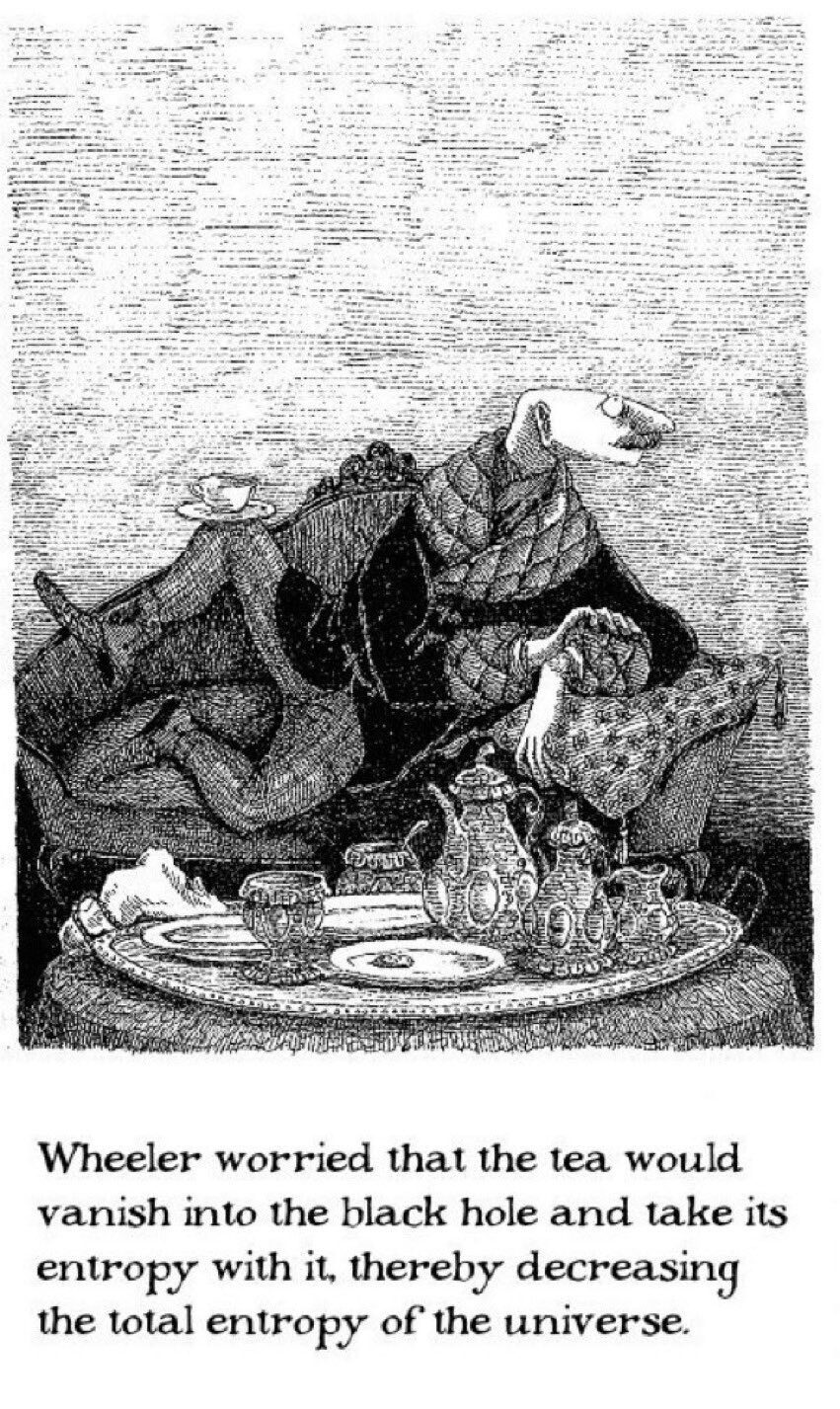
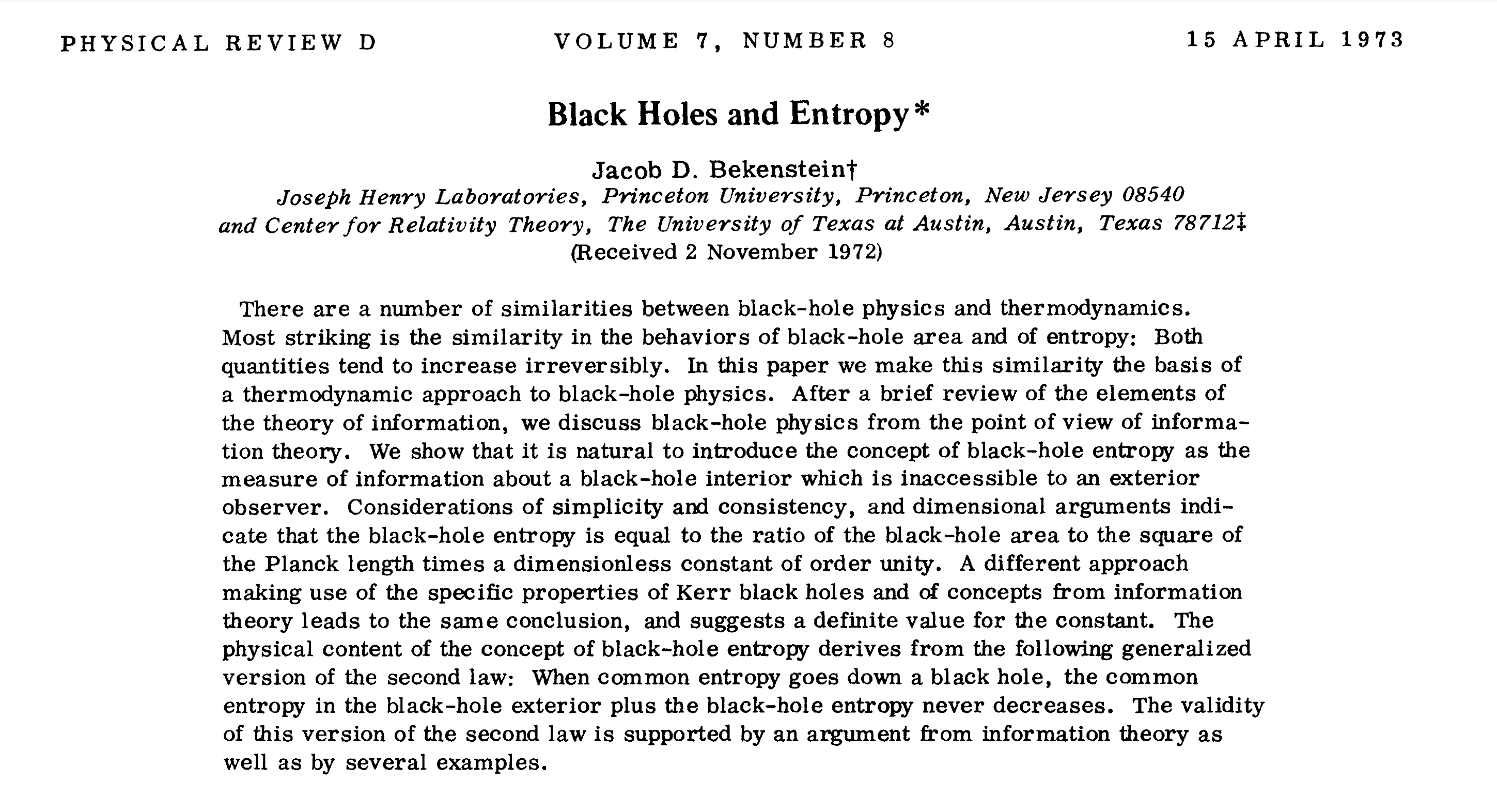
His 1972 discussions with student Jakob Bekenstein led to Bekenstein’s famous result for the entropy of black holes. Wheeler was worried about what would happen to the entropy of a hot cup of tea poured into a black hole. Would it vanish like everything else?
This would violate the 2nd Law of Thermodynamics! As Eddington wrote in 1915 “If your theory is found to be against the second law of thermodynamics I can give you no hope; there is nothing for it but to collapse in deepest humiliation.”
Bekenstein’s famous resolution of this problem was to propose that black holes must be (colossally) entropic objects. The total entropy of matter, radiation, and black holes is always increasing, preserving the 2nd Law.
There’s no way to do justice to the breadth of Wheeler’s contributions in a thread. But you can get an idea from some of the terms and phrases he coined:
* S-Matrix
* Wormhole
* It from Bit
* Wave function of the Universe
* Black Holes have no hair
* Everything is Information
And of course, this skims right over his work on nuclear fission and essential insights into quantum foundations (the “delayed choice” experiment).
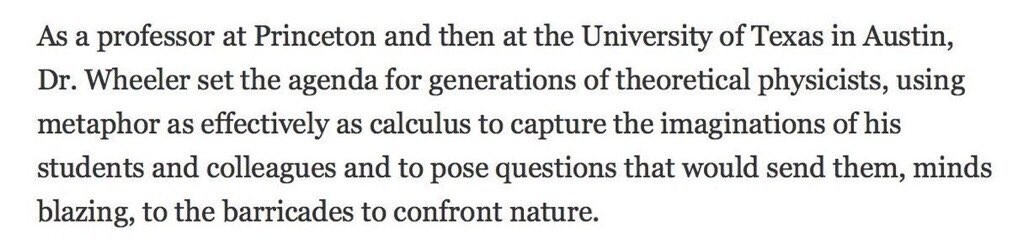
A passage from his NYT obituary does a good job of capturing his impact on 20th century physics.
However, there’s an important mistake in the lede of that NYT obituary!
The term “black hole” is often credited to Wheeler, but he did not come up with it — he only popularized it.
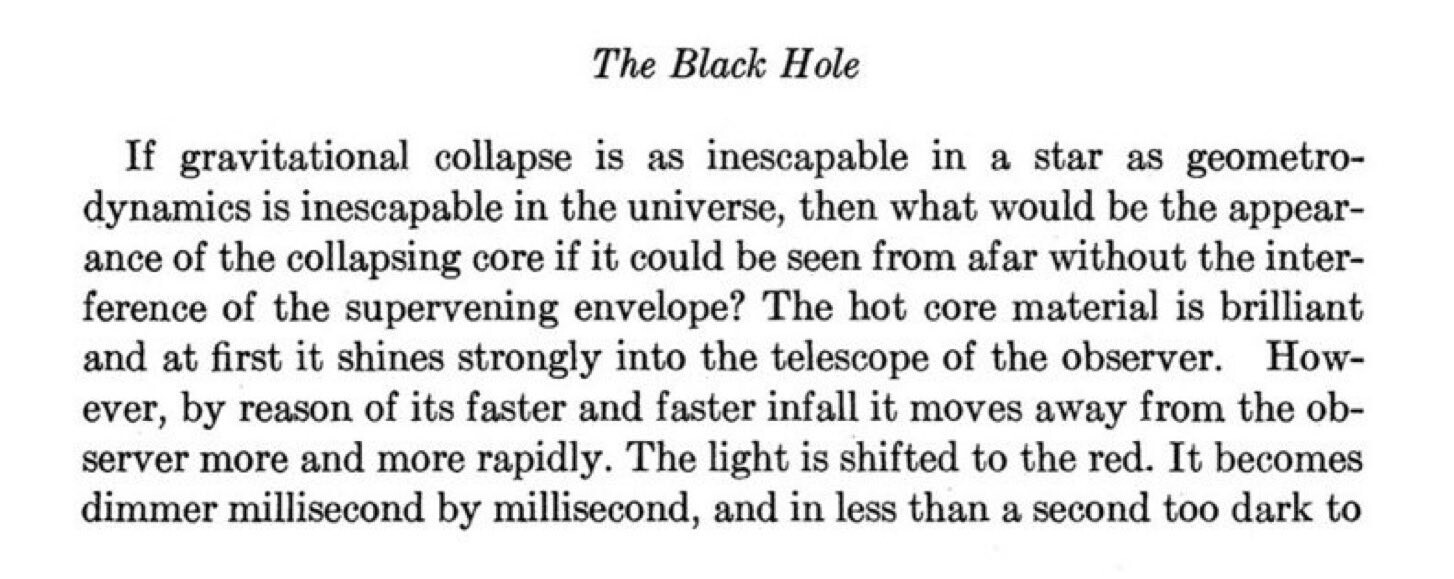
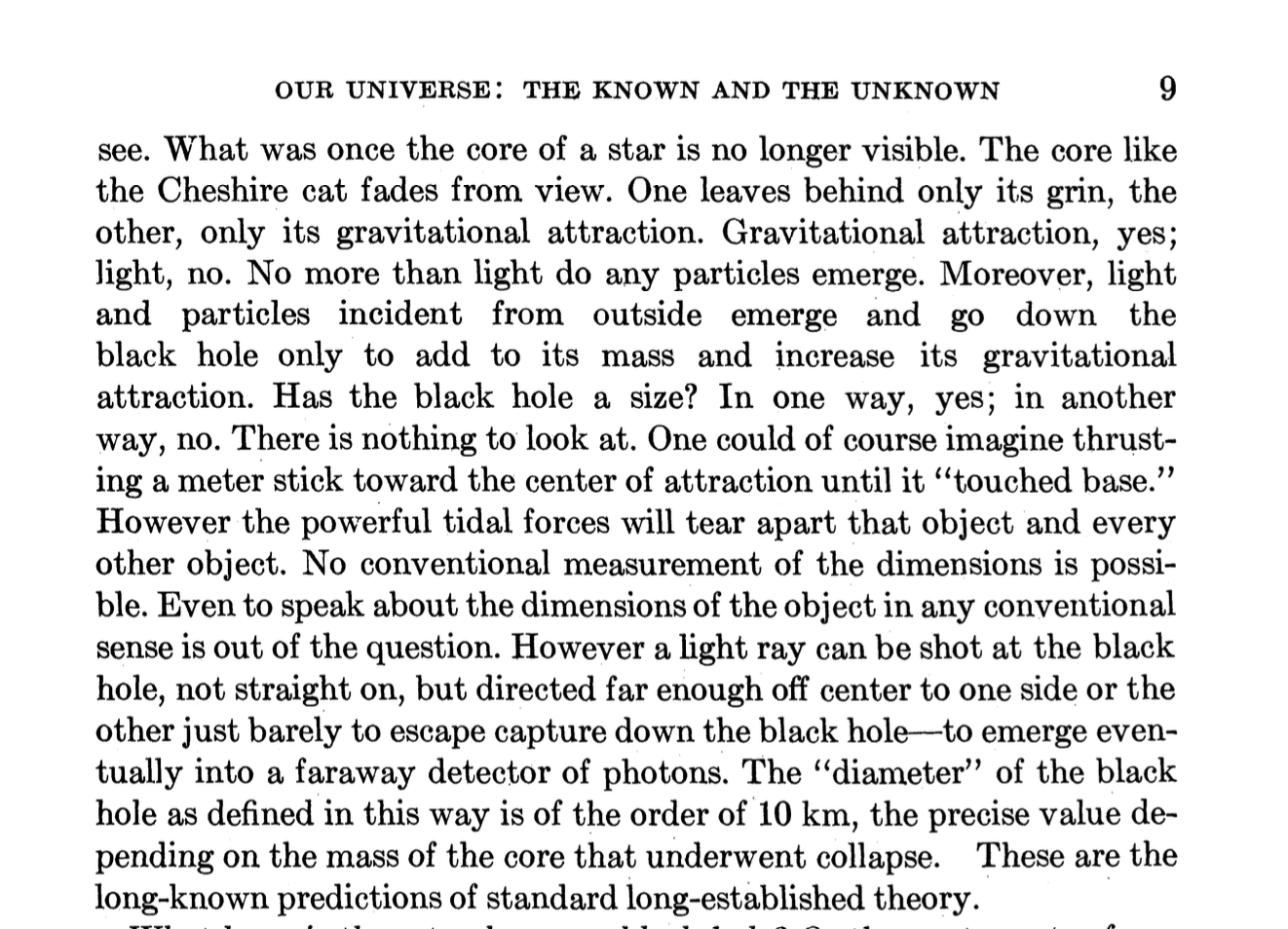
As far as I can tell, he began using it in print in "Our Universe: The Known and the Unknown," a written version of his 1967 AAAS lecture.
https://www.jstor.org/stable/27827972?seq=1#page_scan_tab_contents
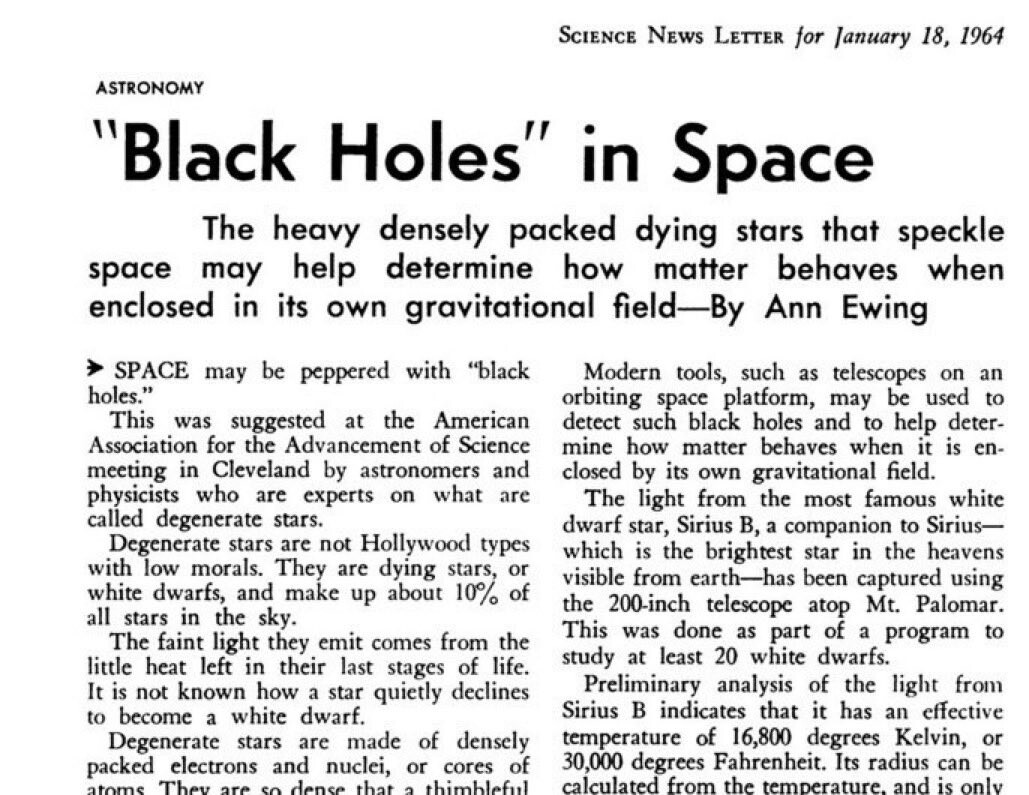
However, the term “black hole" appeared in print well before that.
Journalist and science writer Ann E. Ewing reported on "Black Holes in Space" in January of 1964, after attending an AAAS meeting in Cleveland. She did not attribute the term to anyone in particular.
Physicist Hong-Yee Chiu claimed that Robert Dicke used the term “black hole” as early as 1960 or 1961. But as far as documented use in print, Ann Ewing in 1964 is the earliest example I know of.
Ref: https://www.jstor.org/stable/3947428?origin=crossref&seq=1#page_scan_tab_contents