
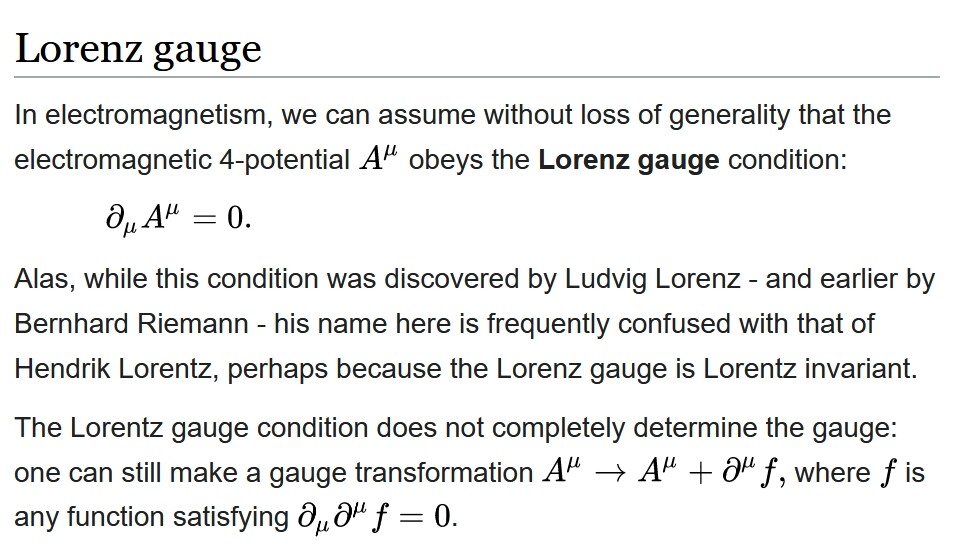
Lorenz and Lorentz - two different physicists who did important work on similar subjects. It's easy to mix them up. Lots of textbooks call the Lorenz gauge the 'Lorentz gauge'. Let's stop doing that!
But what is the Lorenz gauge?
It's very efficient to describe the electromagnetic field using the 4-potential \(A^\mu\), which is a 1-form on spacetime. But you can change the 4-potential without changing anything observable! This is called 'gauge symmetry'.
Gauge symmetry is important, but sometimes it's a bit of a nuisance. Sometimes it's nice to eliminate, or partially eliminate, this gauge symmetry by requiring that the 4-potential obeys various extra equations. These are called 'gauge conditions'.
Maxwell used a gauge condition now called 'Coulomb gauge'. To write this condition you need to choose a reference frame, so it goes against the spirit of special relativity - though it only affects unobservable quantities.
When Lorenz introduced his alternative gauge condition, Maxwell didn't like it - because he thought it would violate conservation of energy! But it's fine if we include the energy of the electromagnetic field, as we should. And it has the advantage of not requiring you to choose a reference frame, i.e. a notion of rest.
So yeah: the Lorenz gauge is Lorentz invariant.

@johncarlosbaez Wow, I can't believe I never realized this!

CleverLibre Social is an inclusive social instance for open discussion, learning, and community.
All cultures welcome.
Hate speech and harassment strictly forbidden.