

@futurebird I went to an elementary school that heavily emphasized arts and crafts, which was torture for me because I have always struggled to do tasks with my hands where precision matters.
I was so happy to largely leave arts and crafts behind after that, and I think incorporating it into math class probably would have been enough to turn me off the subject.
I do think that physical models can be really illuminating, that much more when they're interactive, but constructing such models can be really difficult/frustrating for some students (not sure what proportion).

@lipow @internic @futurebird
There are also tools to make it easier to construct well. It's critical to take that even more time (but worth it) to *build the connection* between the concrete (or if it's Geogebra or its ilk, the visual) and the abstract. So many of these activities ... only the instructor and a few folks enjoy and marvel at the math part, and sometimes assume others do to, whilst the others get that idea that "you get this, you think it's amazing, but normal people don't!"
I had a grad school course in manipulatives and secondary math; it was awesome.
But what if encountering arts and craft in a mathematical context instead helped you to understand art?
When we make things in my class it's not like making something in an art class, how it looks, the skill isn't as important as the meaning and process.
When we study proportions we work with perspective and projections. One student who hated drawing decided to make her drawings using turtle in python.

@futurebird @internic i've seen the act of making overwhelm the participant to such a degree that no learning can take place.

@mensrea @futurebird @internic Its true, people are different. But the model right now is to throw away every student who doesn’t possess an inbuilt talent for purely abstract math represented in ways that happen to be convenient to print.
@JoshuaACNewman @futurebird @internic I mean, we know the solution: train the teachers well, pay the teachers well, and keep class sizes to 15 kids max
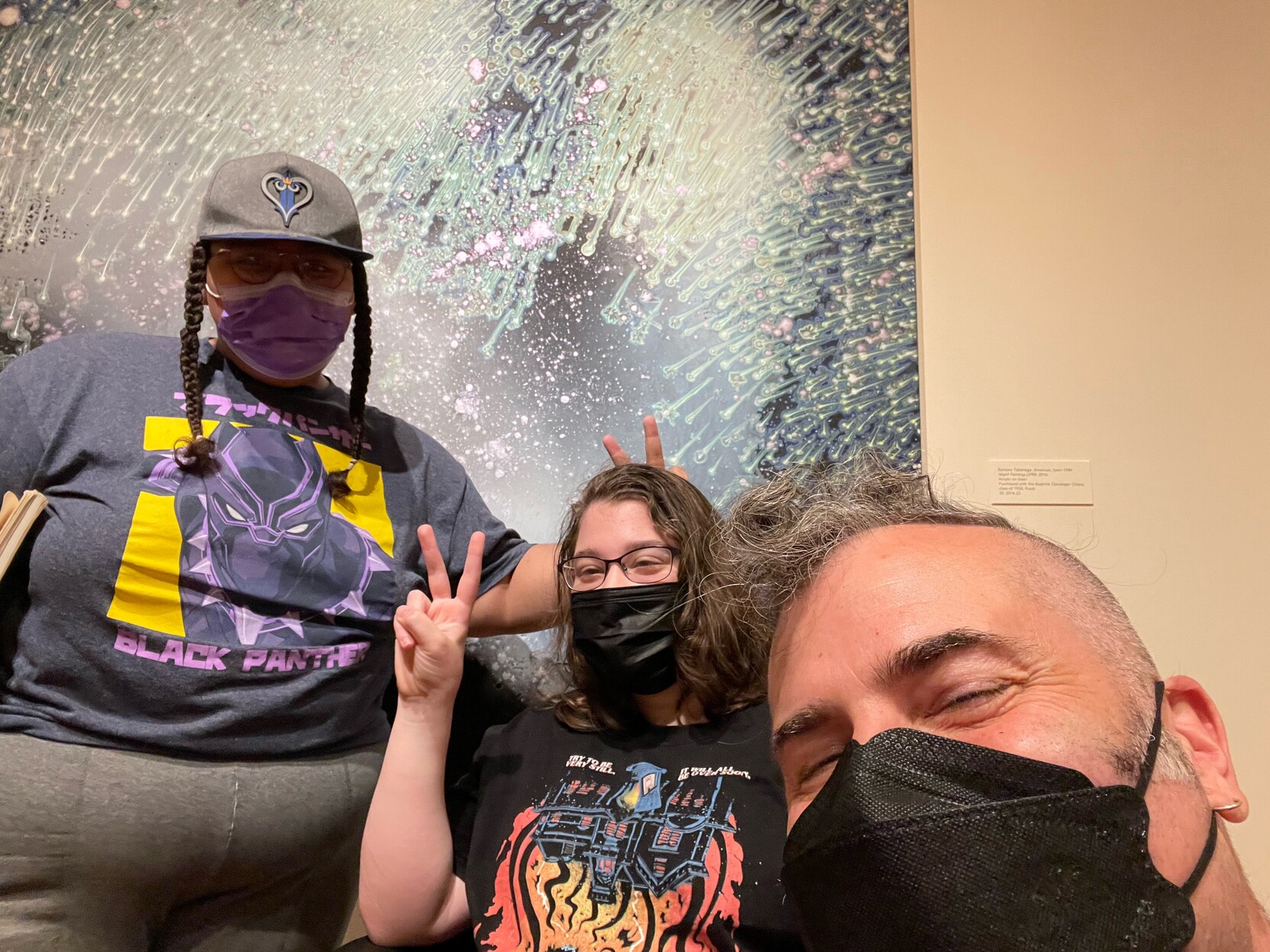
@mensrea @futurebird @internic Me, earlier today with two of my Makerspace students at an art museum.
We live in a stupid, grim future and I want them to have one that they can treat with the humor and joy they will need to thrive in it.
I make $11k/yr and crowdfund the rest to approach a living. If you wanna help, you can! https://Patreon.com/PunkPedagogy !
@futurebird Well, as far as I can tell, in my specific case (which may be quite unusual for all I know) it's less a question of understanding than the ability to physically execute on that understanding.
I think if the utility of the things you're making depends on the precision with which you make them, that's where someone like me would struggle. But as you said, using software is always an option, as is constructing things from modular pieces, where no free-hand precision is required.
As an example of the latter, when learning non-Euclidean geometry, I think that polyhedra can be a good stepping stone to thinking about smooth surfaces (e.g. Euler number), and having physical models could be really helpful. You could imagine, for example, cutting out paper polygons and building polyhedra, but someone like me would struggle to cut straight sides and the proper angles (which then messes things up when you try to get the polyhedron to close on itself properly). However, a colleague had a set of magnetic building pieces (magnetic cylinders and ferromagnetic ball bearings) that could be naturally pieced together to form polygons, so with that I was able to build every platonic solid in no time. It worked fine for me because it didn't depend on the fine accuracy of placement. So even for people like me, it is possible.
I only commented because I know for many people arts and crafts are a happy carefree space, and they may forget that there are also people who view them with as much fear and loathing as some people have for math.

@internic @futurebird I learned geometry mostly by dropping out of middle school and “playing” on the computer writing little programs that drew shapes - I had to geometry to make things line up right
I learned early that there are “good students” and “good teachers”, but when I started teaching it was very quickly apparent that that’s not how it works; learning effectively depends on matching, not on “good”ness
The idea that one way would work for all never made sense

@internic @futurebird I believe that in general, the people who are now most likely to become elementary school teachers tend to be by and large people who are not strong, or feel themselves to be strong, in numerical and abstract reasoning skills.Thus "connected math" can tend to turn into extended art and storytime in a manner that doesn't really enhance development of future math, science or engineering skills. Too often it is the teachers themselves who convey math anxiety. This mode of presentation doesn't help math and abstract reasoning development of any of the students and is especially frustrating to those who are already ready and eager for actual math and science.

@internic @futurebird when i teach i try lots of modalities and let each student thrive in the one they are best at. when they need to or WANT to, they can work hard enough to master other modalities.

@internic @futurebird I think this illustrates how important it is to always have options - and it should be possible to get the advantage of the hands-on approach even by just watching how it is done and perhaps being able to touch the results, even if you can't do the actual act of creating ...