

Jeff Yoshimi @jyoshimi@social.cleverlibre.org
Philosopher, phenomenologist, and cognitive scientist at UCMerced. Visualization builder. Work on Simbrain (http://simbrain.net) in my free time.

The epitrochoid and peritrochoid construction methods taken together also resemble a kind of mechanical differential where one of the rolling wheels drives the other through the linkage made up of the two arms. As with hypotrochoids the turning ratio for an epitrochoid or peritrochoid is the number of times the rolling wheel revolves around the center of the fixed circle to the number of times the rolling disks spins around its center.
In this example once the tracing point has completed tracing over the entire curve the smaller rolling disk has revolved 3 times around the center of the fixed circle and spun 8 times around its own center. So its turning ratio is 3/8. At the same time the larger rolling disk has revolved 8 times around the center of the fixed circle and spun 3 times around its own center. So its turning ratio is 8/3. As with hypotrochoids the arm ratios and turning ratios for the two construction methods are reciprocals.
This video shows the two construction methods together. Again the two construction methods together resemble a kind of mechanical differential where one of the rolling wheels drives the other through the linkage made up of the two arms. The turning ratios are the same as before. Once the tracing point has completed tracing over the entire hypotrochoid the smaller rolling disk has revolved 3 times around the center of the hypotrochoid and spun 4 times around its center. So its turning ratio is 3/4. At the same time the larger rolling disk has revolved 4 times around the center of the hypotrochoid and spun 3 times around its center. So its turning ratio is 4/3.
Here is an example of a hypotrochoid to illustrate Bernoulli's double generation theorem. It shows how the same hypotrochoid can be generated in two different ways.
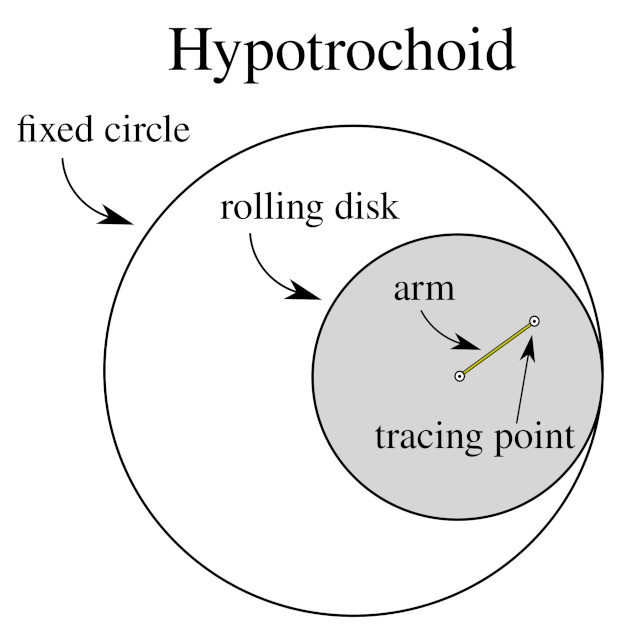
A hypotrochoid can be constructed by rolling a disk along the inside of a larger circle as shown in the attached picture and in the first video. The rolling disk is shown in gray. The gold colored line segment inside of the rolling disk is called the arm. We think of the arm as being attached to the rolling disk. One of its end points is positioned at the center of the rolling disk. It traces out a circle called the deferent (not shown). As the disk rolls the other end point of the arm traces out the hypotrochoid shown in sea green.
There are two numbers that are often used to characterize a hypotrochoid. They are the wheel ratio and the arm ratio. The wheel ratio is the ratio of the radius of the rolling disk to the radius of the fixed circle. The arm ratio is the ratio of the arm's length to the rolling disk's radius. Two hypotrochoids with the same wheel ratio and arm ratio are geometrically similar.
Hypotrochoids are often divided into three classes based on their arm ratios. If the arm ratio is less than 1 then the tracing point is in the interior of the rolling disk. If the arm ratio is 1 then the tracing point is on the circumference of the rolling disk. If the arm ratio is greater than 1 then the tracing point is outside of the rolling disk. A hypotrochoid with an arm ratio less than 1 is called a curtate hypotrochoid. A hypotrochoid with an arm ratio equal to 1 is called a hypocycloid. A hypotrochoid with an arm ratio greater than 1 is called a prolate hypotrochoid.
I set the enrollment cap for my phenomenology course a bit high in Spring, and now I need to fill those seats, so I made this poster....

Wow, PLoS' first logo, from the year 2000!
In 2005, I joined the advisory board PLOS ONE and it started publishing in 2006. #scientificPublishing #openaccess
I've given https://husserl.net/ a site I created 20 years ago to facilitate bibliometric studies of Husserl's corpus, a much-needed makeover. Go from keywords, to texts ordered by occurrence, to page references, to the text itself (courtesy of https://ophen.org/), in just a few clicks. Get a feel for when different ideas were prominent for Husserl. Lots of other custom features I'll post about later!
Ok I’m new to this I thought I was liking when I was reposting but that’s ok they were worthy of reposting :)

2022 was a tough year. Sorrows from the war, other painful losses, a broken wrist that never healed. But let me celebrate some successes. Somehow several publications came out and I am especially proud of them. The main one is this volume

Please bear with me as I learn basic #mastodon #etiquette 😆 I welcome tips on how to settle into this new (to me) community and help make it a nice place 🙂
if you're a public funder, or just love some hardworking scholar, wouldn't you feel wonderful giving the gift of prestige this Christmas?
It's not too late to get for Christmas a publication in Nature Communications for the low price of $5890! (On 1 January 2023, the APC will increase to $6290 / £4590 / €5190) https://www.nature.com/ncomms/open-access#apc
RT @StevenXGe
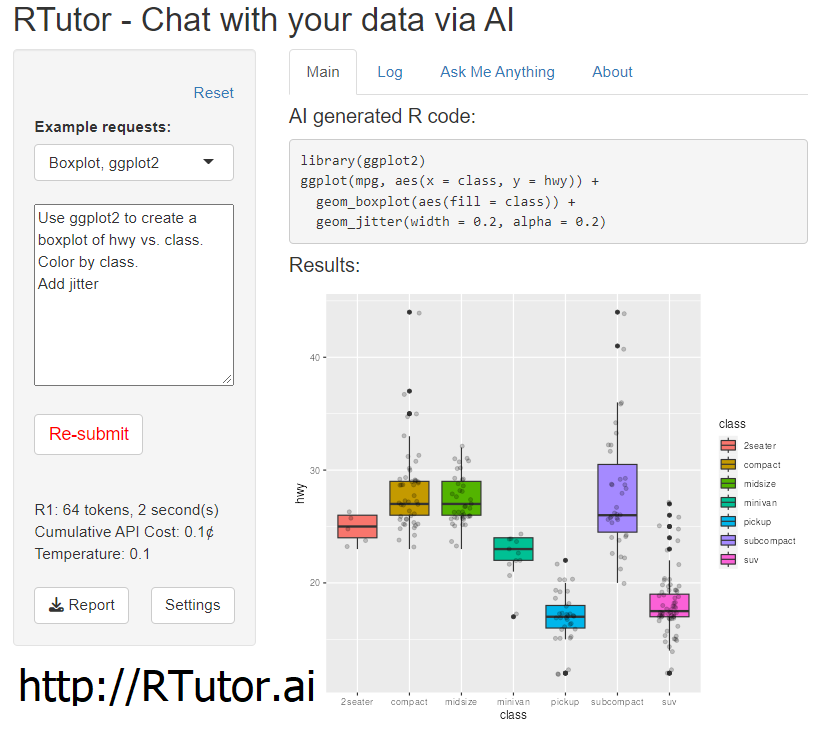
Happy holidays! Introducing http://RTutor.ai, an AI-powered app that lets you chat with your data in English! RTutor uses Davinci (#ChatGPT’s sibling) to turn requests into R code, which is executed & results are shown instantly, available as a HTML report in seconds. 1/8

Hello fediverse! We are a nonprofit organization that protects, defends, and empowers public-interest journalism in the 21st century.
Our work includes:
- Advocating for press freedom rights:
https://freedom.press/news/
- The US Press Freedom Tracker:
https://pressfreedomtracker.us/
- Digital security trainings and guides:
https://freedom.press/training/
- @securedrop, to empower journalists and whistleblowers
- @dangerzone, to help journalists (and others) handle electronic documents safely





We’ve published a new issue!
Does Mastodon search require an exact match? "David Barack" returns nothing, but "David L Barack" does.
Hi everyone (or anyone?). Just got here and still not sure how it works. Looking forward to chatting!
Philosopher, phenomenologist, and cognitive scientist at UCMerced. Visualization builder. Work on Simbrain (http://simbrain.net) in my free time.
