
Sadly, @arstechnica is embarrassing themselves with their innumeracy here.
The average time-to-failure of HHDs (hybrid hard drivers) is not less than three years, and the study in question does not claim that they do.
So what went wrong....?
https://fediscience.org/@arstechnica@mastodon.social/110310597119922958 h/t @waldok
It's a form of selection bias.
The study in question looks at the failure times not of all hard drives, but *of the drives that failed*.
Of those drives, the average failure time was 2.5 years.
This does not mean that your drive will fail at 2.5 years on average.
In fact, something closer to the data we need are buried deeper in the article: the annualized failure rate data. The average annualized failure rate is 1.4%.
We don't know the distribution of failure times, but for comparison, if the risk of failure was constant over time and thus the lifetime of a hard drive was exponentially distributed, this would correspond to an average lifetime of 70 years.
@waldok l
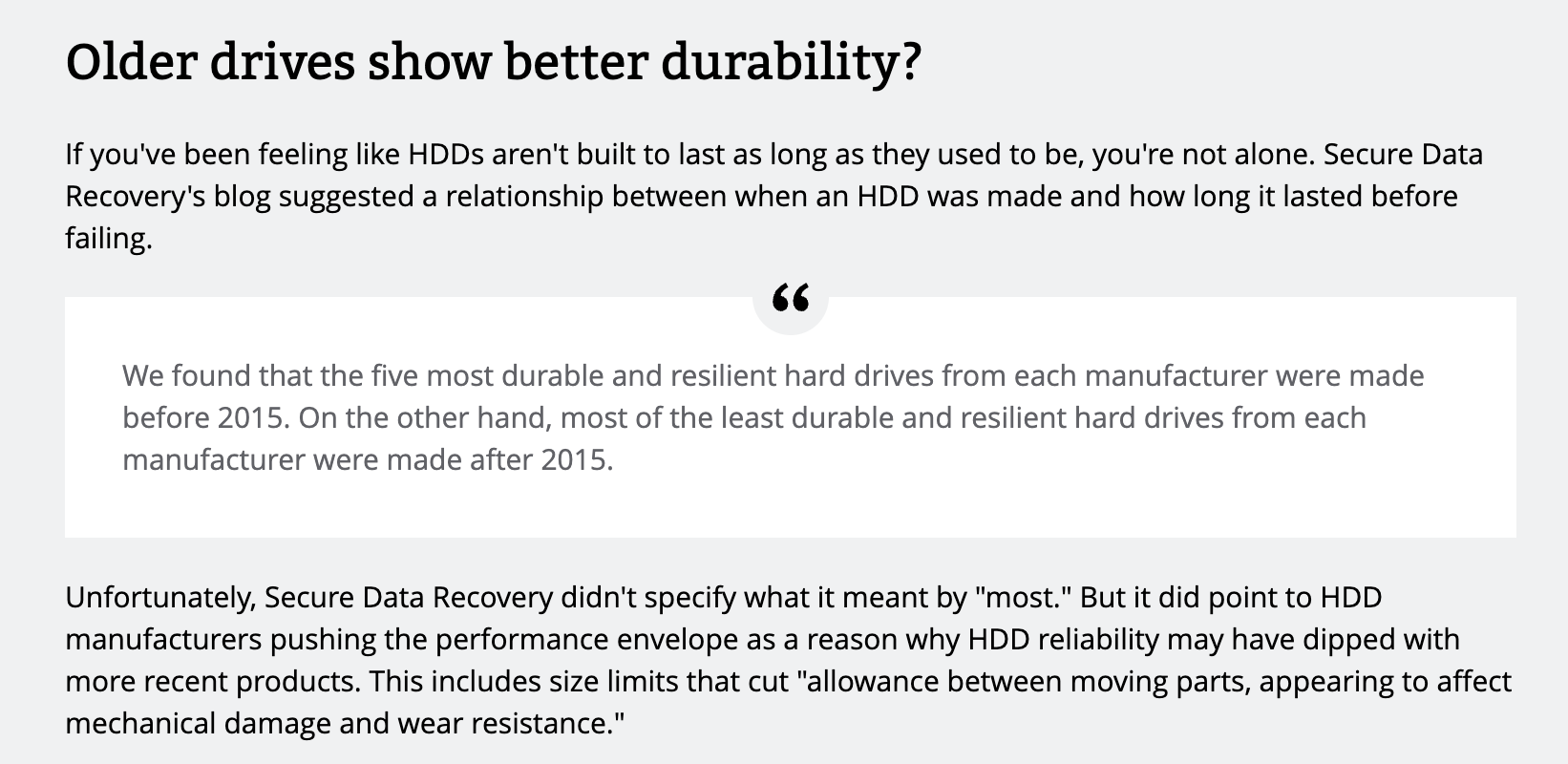
This story follows a previous @arstechnica story that somehow managed not to notice that hard drives sent to a data recovery company are not a good sample from which to estimate hard drive failure rates and instead blames SMR (shingled magnetic recording) technology.
It even notes that the previous study sounded too bad to be true, but then takes the Backblaze results as evidence to the contrary.


@ct_bergstrom @waldok @arstechnica I'm just crying now. Putting the arse in Ars Technica
