

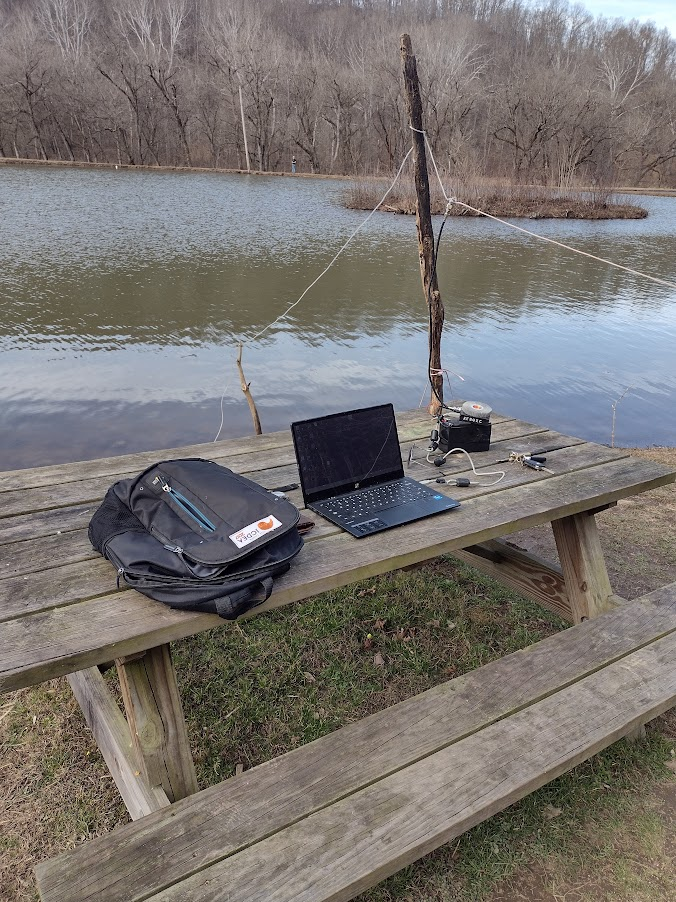
@tomcuchta Yup, janky. All your signal is going straight up. Maybe a little is leaking out sideways on 10 meters. Lmao.
@shuttersparks yep i got about 5 contacts over an hour on ft8 lol
it was 20m, but I don't think that makes much a difference! a dipole is a dipole
@tomcuchta To bring the radiation pattern down closer to the horizon, horizontally polarized antennas want to be about 1/2 wave up. So 20 meter wavelength, half is 10 meters or about 30 feet. It's not critical.
With makeshift setups you usually can't get perfection. Just get as much of that antenna as high off the ground as possible, especially the highest current portion, which for a dipole is usually the center, the feedpoint where the coax connects.
You can do a good job with a single support by setting the dipole up as an inverted-vee. If you have a 30 foot support like a squid pole or painter's pole get the feedpoint up at the top of the pole and let the two ends angle down towards the ground.
The far ends of a dipole are the low current, high impedance part, which radiates little. Being close to the ground doesn't hurt much. Most of the radiation somes from the center of a dipole which is up nice and high at the top of the pole.
@shuttersparks yep I usually have trees around and things go much smoother!
I have a couple fiberglass masts, but I never needed them for POTA when I was doing it 100W.
Matters much more when QRP; I'll come out the other end a better operator for it.
@tomcuchta Oh yeah. QRP works fine.
Antenna efficiency always matters but QRP makes you more *aware* of efficiency. This is good.
The thing is that efficiency works both ways, sending and receiving. It's always important regardless of your transmit power level because if you can't hear 'em you can't work 'em. Legal limit power doesn't help you hear any better!
If you look at a monster contesting setup like Frank's (W3LPL) you'll see 200 and 300 foot towers, each with stacked monobanders. Whoo hoo! The first thought is wow, legal limit into that and I'm gonna BE LOUD.
Yes, you will be. But the secret is that those high-gain antennas and hardline feeds that cost a fortune, everything possible done to maximize efficiency is not about being loud. It's to enable you to hear stations that others cannot. That's what wins contests. LPL can hear those rare multipliers, barefoot stations in tiny countries halfway around the world that you cannot hear at all.
Antenna gain and efficiency of your antenna system are king, more important than anything else.
@shuttersparks yea i was always told don't seek more power unless you're hearing many stations you aren't able to reach
location also matters a lot -- being surrounded everywhere by hills in WV but not being on the hills themselves makes things difficult sometimes
really hurts my 2m situation a lot -- from my house I can work 2m southwest and east but straight north and south are near impossible
@tomcuchta Yeah, the hills here are problematic. VHF and UHF work was good in California. Here I don't bother with it and focus on HF CW.
@tomcuchta Oh, one more thing I'll say. The big secret is that Morse is a LOT of fun once you get the hang of it. This is not obvious because it's hard to learn, just like learning to play musical instrument. Very steep learning curve and learning is very hard and not fun.
But there'a huge reward waiting for you if you persist, get on the air, and work 500 or more contacts. It becomes fun, effortless, addictive. Morse will become as easy to copy as speech. But until you get there, it seems like the worst brain-busting nightmare you've ever encountered. So just be aware of that.
