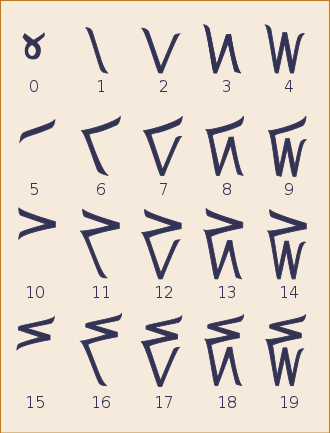
I'm fascinated by Eskimo-Aleut languages in Alaska, Canada and Greenland. There are many of these languages; they ring much of the Arctic Ocean. I just learned that they use a base 20 system for numbers, with a 'sub-base' of 5. That is, quantities are counted in 'scores' (twenties) with intermediate numerals for 5, 10, and 15. This makes a lot of sense if you look at your fingers and toes.

But the Inuit didn't have a written form of their number system until the early 1990s, when nine high school students in a small northern Alaskan school invented one!

They used 5 principles:

• Visual simplicity: The symbols should be easy to remember.
• Iconicity: There should be a clear relationship between the symbols and their meanings.
• Efficiency: It should be easy to write the symbols without lifting the pencil from the paper.
• Distinctiveness: There should be no confusion between this system and Arabic numerals.
• Aesthetics: They should be pleasing to look at.

They decided that the Kaktovik digit 0 should look like crossed arms, meaning that nothing was being counted.

This was the start of quite a tale!

(1/n)

Follow

@johncarlosbaez As mentioned above, the Mayan number system is base-20. They also invented the concept of zero, apparently before anyone else on Earth did, in order to have a positional number system. Also the first of its kind.

A positional number system makes it possible to write very large numbers (billions, trillions) which they did, and to do arithmetic with such large numbers. (Try doing arithmetic with Roman numerals and you see the problem right away.)

This enabled the Mayans to take nightly measurements of the positions of stars and planets using Stone Age instruments (no telescopes) yet end up with extremely accurate results. They did this by averaging thousands of measurements to eliminate the noise from the data. (A technique re-invented by and credited to Gauss). By this method, they computed the orbital behavior of Venus to an astounding degree of accuracy only exceeded in the second half of the 20th century.

I wonder if base-20 number systems, especially with a sub-base of five, show up in other parts of the Americas, too.

Sign in to participate in the conversation
CleverLibre Social

CleverLibre Social is an inclusive social instance for open discussion, learning, and community.
All cultures welcome.
Hate speech and harassment strictly forbidden.