
Follow

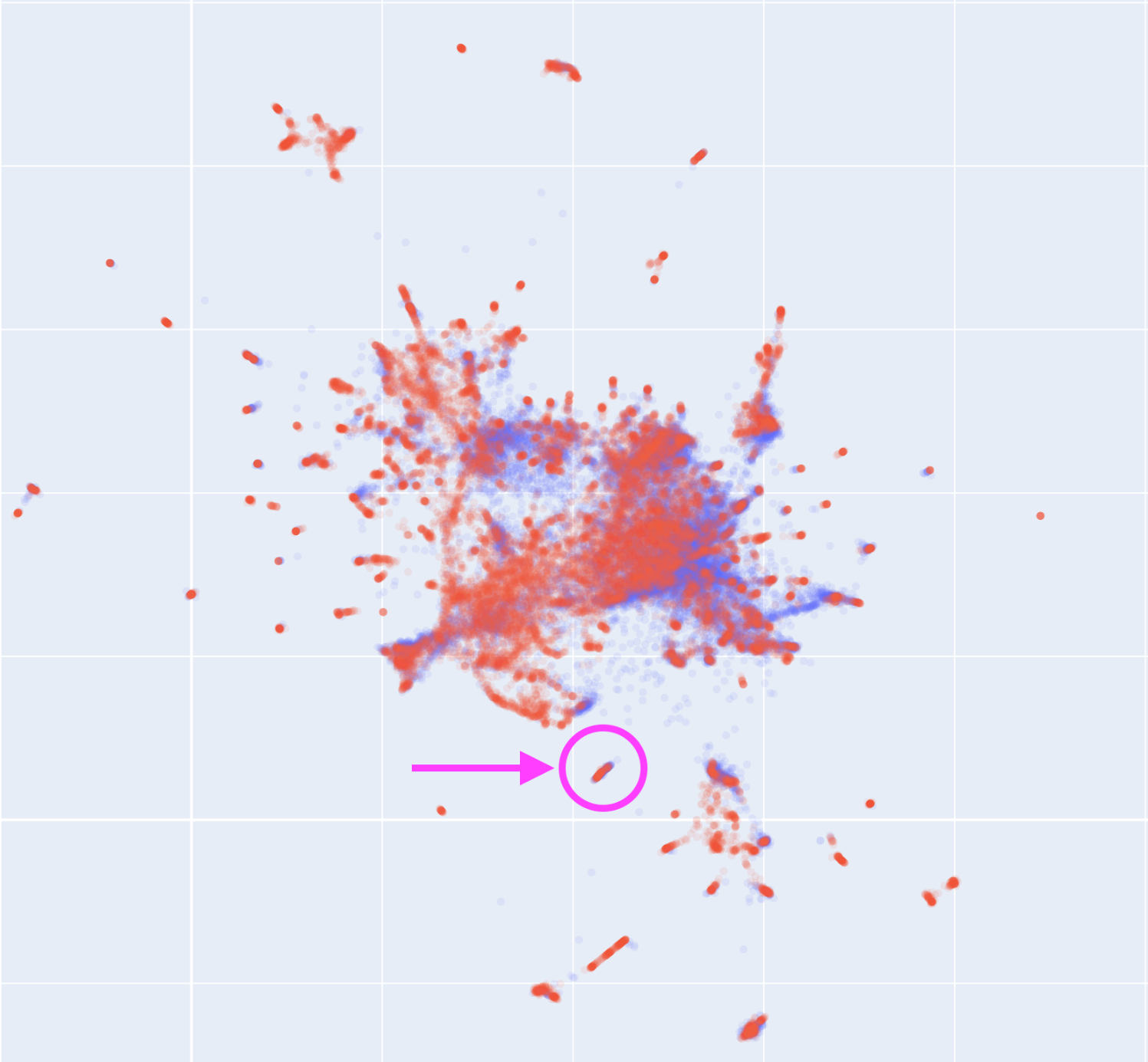
@pmcarlton what’s UMAP? I’m not sure I understood the X,Y axes nor the implication of two proteins being at the same coordinates 😅😅
@pmcarlton got it ! Where do you generate these maps?
@Chl0e_Girard
I just wrote a little walkthrough here: https://github.com/pmcarlton/umap-sequence-plotting
tldr: download data files from uniprot, install some python modules, run a small script, open the interactive plot in your browser.
@pmcarlton you are very generous!!!
@Chl0e_Girard
So far it's more a toy for exploration than anything else but I hope to develop it into something useful. I need to find a student to help with it

@Chl0e_Girard That's because I gave a crap explanation! =) Each protein is represented by a vector of 1024 numbers derived from a language model (the part I do not understand yet), and UMAP is a method to project each vector into a 2-dimensional space (so X and Y axes are just arbitrary "positions") while trying to preserve the original spatial relationships. All the proteins that "look" similar in the vector representation should cluster nearby. Sadly I could not find a worm Iho1 this way!