
Do you ever think about how many American cities have banned plastic bags and require charges for paper bags to protect the environment, but still allow free car parking?

@GordonOfSeattle and saw the article yesterday that the main source of microplastics in the environment is -- car tires...

@darwinwoodka @GordonOfSeattle Wait, what? How do rubber tires turn into microplastics?
@darwinwoodka @GordonOfSeattle Well, that's just insanity. The report specifically says that the particles are likely synthetic or natural rubber (which are biodegradable!), but that they decided to pretend they were plastic anyway 🤦♂️


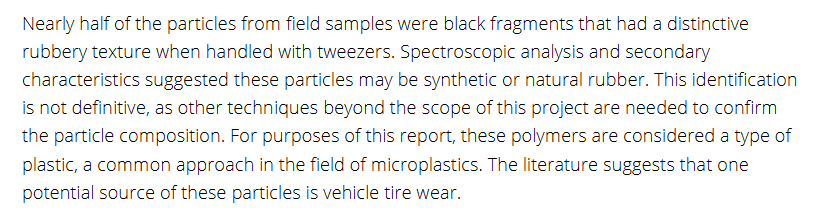
@LouisIngenthron @darwinwoodka @GordonOfSeattle
Well, looking at the age of my car tyres, I think I can definitely say they were not made to biodegrade in a manner of a few months.
@danimrich @darwinwoodka @GordonOfSeattle Well, yeah, if they did, we wouldn't call them tires; we'd call them "compost". Just because they don't biodegrade immediately doesn't mean they don't biodegrade. There are many types of naturally-occurring microscopic life that are happy to eat polymerized rubber.
@LouisIngenthron @darwinwoodka @GordonOfSeattle
How long will it take for a car tyre to be biodegraded in that way?
@danimrich @darwinwoodka @GordonOfSeattle For example, this study put rubber bands in a river. In less than a year, they all decomposed enough to break.
@danimrich @darwinwoodka @GordonOfSeattle The OP was about pieces of tire less than 5mm ending up in waterways. That sounds pretty darn comparable to me.

@LouisIngenthron @darwinwoodka @GordonOfSeattle
Yeah, but there's like 160 years of technical development between a rubber band and a car tyre. And whatever rubs off of a car tyre doesn't usually end up in a bioreactor. :)