
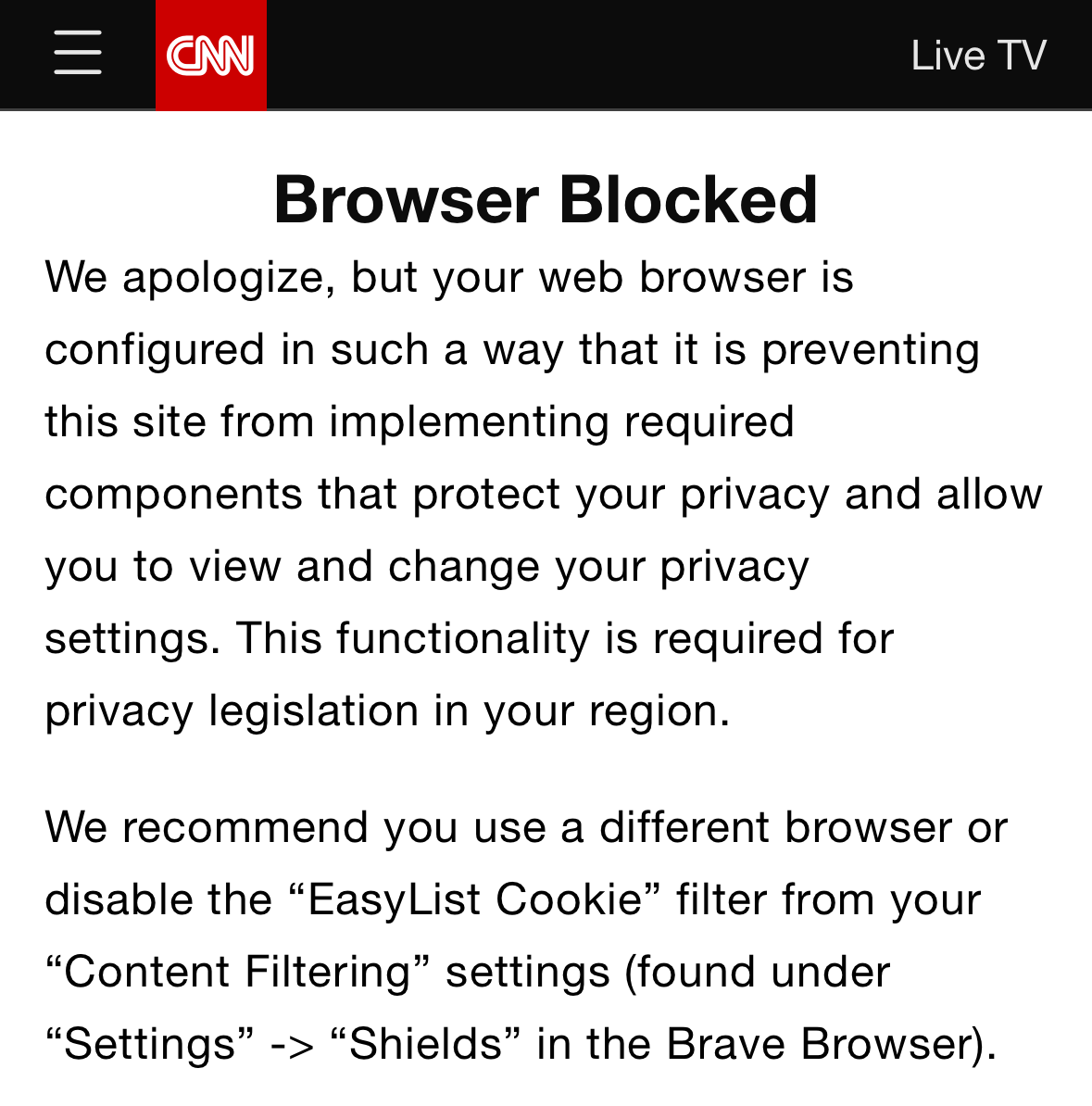
CNN blocking the default configuration of Safari is a bold move.


@oligneisti @waldoj FWIW, CNN is in the right here. Apple is forcing everyone to use their browser back-end and then not keeping feature parity with the rest of the web. It's a huge problem, and it's nice to see a company with some clout push back.
@LouisIngenthron @oligneisti No, they’re lying or their code is busted. There is no “privacy legislation” here that requires that I use something other than Safari. They’re not, like, arguing against a browser-engine hegemony—they just want to show me ads.
@waldoj Ah, right, my bad. This is because you blocked their cookie popup from showing up, and that would be illegal under GDPR, but they must not be locking the message regionally.

@LouisIngenthron GDPR does not require cookie popups (and blocking them is not illegal).
@barubary It's technically the EPD, but most people seem to treat that as part of GDPR.
And, no, it's not illegal to block them, but it is theoretically illegal to deliver content to someone who has blocked them (and therefore not given explicit consent).

@LouisIngenthron @barubary no. It is illegal to use information gathered from people that has not given consent. However, it is completely legal to deliver content. It is probably illegal to require consent as consent should be given freely...
@gazorg
You sure about that? I don't think they're allowed to, for example, deliver cookies without having gotten consent to use cookies.
Also, requiring consent as a condition of entry in no way contradicts the freedom for people to give consent freely.

@LouisIngenthron @gazorg So simply don’t send cookies until you’ve gotten consent.
@ahltorp Yes, exactly. And if cookies are necessary to the function of the website, then you end up with messages like the OP posted.
@LouisIngenthron Cookies are not necessary for the function of a public news website when you are not logged in.
@ahltorp That's only true if by "function" you mean "allow the theft of content".
No for-profit company offers content for free. If you're paying for it with cash, then you're logged in and you need cookies. If you're not paying cash, then you have to pay for it another way, even if that's just by allowing your browser to display ads, which, also, often require cookies.
@LouisIngenthron You’re confusing theft of content and theft of personal data. Cookies are never necessary to display ads, they are used for tracking. Tracking and ads are two totally different things.
You have purposefully avoided the central issue here: the selling of personal data that don’t belong to you.
@ahltorp Every effective ad system uses personalized recommendations, which require some kind of persistence, like cookies.
Also, that personal data does belong to them. The user gave it to them in lieu of payment for their content.
(FWIW, I use script- and ad-blockers myself, but I also just make it a point not to patronize sites that have predatory or invasive monetization)
@LouisIngenthron @ahltorp I can somewhat agree that the cookie law can seem a bit silly. However, GDPR and the DSA isn't and the cookie law helps.
IANAL, but it is probable that e.g.
Facebook's solution where they require a high monetary price for no tracking will fail in court. Google has a setting where they just do not personalise the ads (as much) . I think that is more in line with what the EU intended with the regulation.
@LouisIngenthron No such law exists.

@LouisIngenthron They are not informing the user. And you are still incorrect that it is necessary. They want it, and that’s not the same thing.