TheOldGuy @TheOldGuy@social.cleverlibre.org
I am a Democrat who supports Ukraine in their battle against The Russian fascist invaders.
I am a 71 year old Covid hermit who
lives on 10 acres in a sparsely populated area of the Ozarks. I heat with wood that is leftover by the lumber industry. When cutting oak for lumber only the trunk is used.
The largest town is population 2992. The county is 13k people scattered over 713 square miles.
Joined Dec 2022
If they use the missiles to attack Ukrainian command and control and their airbases - that’s another thing altogether and militarily makes lots of sense. The trouble is by now Ukraine has almost certainly prepped secondary and tertiary C3 structures, but coupled to a military offensive it would still be deeply detrimental.
Personally I think the Russians are pigs and hurting women and children is perfectly okay to them. They destroyed hospitals in Syria on purpose to ensure the population had nowhere to go. They bombed the streets to destroy the water supply and break the sewer system. Why would they be anything less than what they are when it comes to Ukraine?
Russians are basically ignorant but they’re not stupid. Whatever happens next you can be sure once started, they’ll carry on doing it. If it looks good on TV and sounds good, that’ll do nicely.
It seems some Ukrainian girls were serving food and vodka to the Orcs. Too bad it was laced with strychnine and arsenic.
https://t.me/WarriorsUkrainian/15752
From "The Analyst":
MISSILES STRIKES: WHAT IS RUSSIA WAITING FOR?
Sometime tonight I may be proven completely wrong. If not tonight some time in the next few days or weeks you might have wasted your time reading this as much as I will have writing it.
So the question is, having stashed away getting on for 850-900 cruise and other strike missiles, what is Russia waiting for?
First of all we know the maritime arm of Russian launch systems has been compromised quite severely in the last year - around half of its launchers have been immobilised or even destroyed. Ships representing easily one third of the strike force - especially the submarine and frigates have been redacted from service due to ‘leaks’ caused by Ukrainian actions.
The strategic bomber force has lost some of its Backfires, and its only fully reliable platforms are the antique Tu-95 Bear’s. Still operational after 60+ years. They feel like old sparing partners. Several times I’ve had the honour of being in a back seat during a routine interception. I didn’t think in 1986 they’d still be going strong now. The Tornado we intercepted them in has long gone.
The problem for the Tu-95’s is that they have limited capabilities when it comes to carrying these large cruise missiles. They can’t carry them internally, so four each is as much as they can manage, two under each wing. The current estimate is that a full strike of all available launchers would manage around 80 missiles.
So the question is where are they? What are they waiting for?
I’m going to tell you know how in my old job I’d have done this.
Forget the ships at this stage. Too obvious a giveaway. Frankly too predictable in their flight path and too easy to monitor as they cross Ukraine - remember everyone has that phone app and that photo tracks and instantly reports locations which rapidly cross verify with other reports and radar tracks. It’s proven remarkably useful.
The air attacks can be routed deep into Russia and planned in such a way that they could for example, come over the shortest routes from the north in Ukraine to reach Kyiv.
You have to target the whole lot in a narrow focus path to reduce the interception footprint. Waves of drones launched well in advance can entertain the local defences as distraction. What you need is to keep the long range Patriots at the nearest of the defence lines out of the battle. They won’t fire into Russian territory because they’re terrified of a missile being recovered, and their ability reduces sharply to the point of useless at low altitudes and close ranges. The furthest Patriots will also struggle with very low altitudes.
The less time the interceptors have the better, they’ll get a few missiles off but they’re never going to be able to have enough to take them all down with little notice.
The problems arise if the missiles have to get deep into Ukraine. The further they go the less chance they have - and that’s where the long range and route planning plays to their strengths. Again, if you’re planning on such a strike every last missile you can fire has to be airborne and arriving at one target simultaneously. It’s the only way to avoid interceptions. They just can’t reload fast enough to get at a mass attack.
However this is where the ROI factor should come in. What are you getting for your return on your very heavy missiles expenses investment?
If you know for sure what you’re targeting and why - like an F-16 airbase, it’s worth it. Fire 80 get 15-20 to the target and then do it again and maybe again to be sure, in rapid succession.
If you’re doing this to knock out power grids and junction transformers you’re wasting your time and effort. It’s stupid and wasteful and just militarily pointless. And it works in Ukrainian favour publicity wise. Attacking civilians and hurting women and children relentlessly and callously gets western attention.
My biggest fear is that someone up top has realised the power grid and water supply attacks are never going to change anything. CONTINUES…
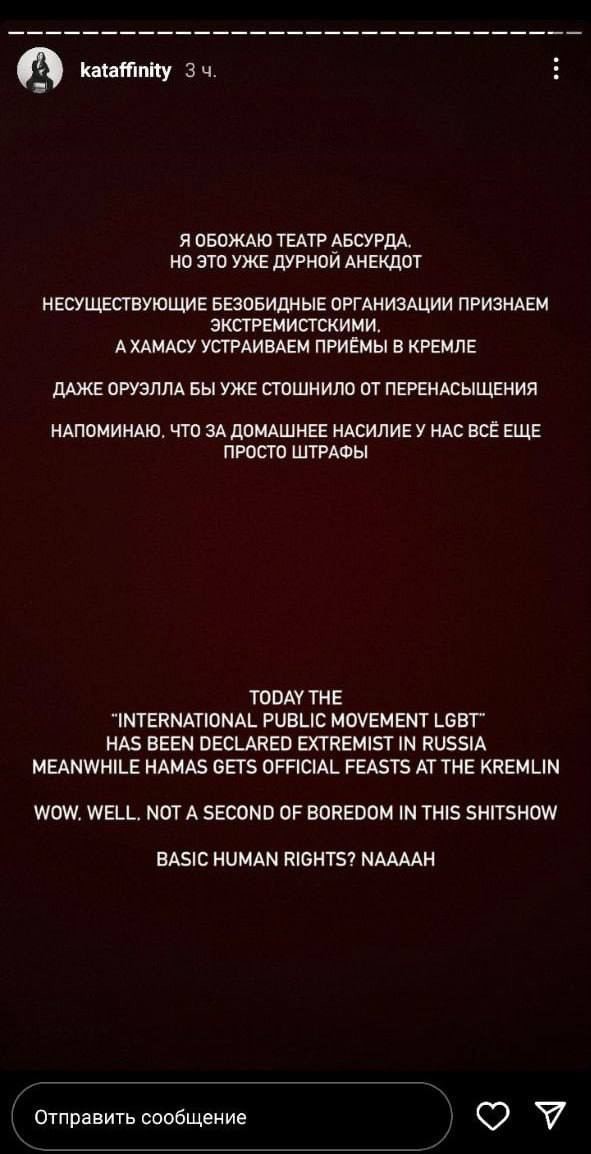
The daughter of Russian propagandist Vladimir Solovyov criticized the Russian Supreme Court's decision to recognize LGBT people as extremists
@liveukraine_media
Ukraine says it blew up railway in eastern Russia
By Jessica Parker in Kyiv
BBC News
Ukraine's security service has blown up a rail connection deep inside Russia, a senior official has told the BBC.
Successive explosions are said to have happened on trains running first through a tunnel and then on a bridge in Russia's far east.
Russia has reportedly begun an inquiry into a "criminal case of terrorism" after the attacks on the Baikal Amur line running to the border with China.
The extent of the damage has not been verified by the BBC.
Ukrainian sources said that the intention was to "disable" an important piece of infrastructure that the Russians sometimes use for military purposes.
After the first incident in the Severomuysky tunnel, on Wednesday evening, Russian railway officials said that crew had noticed smoke in a fuel tank and the train was stopped.
At 15km, Severnomuysky is the longest railway tunnel in Russia and lies in the region of Buryatia, north of Mongolia.
A senior Ukrainian official told the BBC that the freight train had in fact exploded in the tunnel.
The Russians then fell into the "trap" - claimed the official - of using an alternative bridge route.
"This is exactly what the SBU (Security Service of Ukraine) was counting on," said the official.
"During the passage of the train on this 35m-high bridge, explosive devices planted in it went off."
The second explosion has not been corroborated elsewhere although Russian telegram channel Baza has reported that another train was later blown up in the same area.
The incidents appear to have happened on Wednesday and Thursday, with no known casualties.
According to reports, the explosions have caused damage to fuel tanks and rail lines.
There's been no official or public comment from the Russian government.
⚡️The White House named three key directions for supporting Ukraine in the winter.
These include strengthening Ukraine's air defense, ensuring critical infrastructure protection, and enhancing the resilience of Ukraine's energy grid.
https://t.me/WarriorsUkrainian/15715
I love the rolling pin
From "The Analyst":
FRONTLINE UPDATE - BATTLE IN KHERSON SET TO EXPAND
NORTH
Russia claims Ukraine counter attacked in the Lyman-Pershy area of the front but there’s been no apparent movement in the lines of control.
The northern front has had fire exchanges but little else.
BAKHMUT
Russia appears to have made more gains by the Berkhivka reservoir. North of Bakhmut Russia has made some gains but there’s a great deal of confusion over who took what. The Russians claim to control more than others think they do.
What the Russians seem to be after are the ridge that overlooks Kremove looking into Bakhmut. Would be very unhelpful for Ukraine to loose it because then the Russians would have oversight westward into lower Ukrainian territory. Russia claims to have captured Kremove but that’s contested.
Klieshievka to Andrivka is under a great deal of pressure and the Russians remain persistent.
AVDIVKA
Heavy combat near the water treatment plant. Ukraine seems to have pushed the Russians back here - the Russians admit it.
The rest of the frontline remains stable.
The northern element of the pincer has allegedly been more active but there’s no confirmation.
The battles around the coking plant are repetitive, Russians use 20-30 soldiers with and without vehicles in support, persistently pushing and attriting the defenders. However the Russian losses are high.
SOUTH
Russians have made small gains along small areas of the front. Russians are making a lot of claims around Robotyne but there’s little to confirm what’s happening.
KHERSON
Russia pounds the Krynky positions with aerial bombs, but Russians don’t make any efforts to storm it because they can’t.
Russian soldiers are not happy about their situation here. Their morale is very low, they’re terrified of being captured as they think Ukraine will dismember them while they’re alive. They get fed such lies constantly. They also complain that the bombing raids are largely ineffective because nobody takes any notice of what the ground forces tell them to target, with inter-unit and inter-service communications and liaison being nonexistent.
Ukraine on the other hand launched a major HIMARS strike on command posts, air defence and artillery positions and advanced further into the forest south Krynky. Such attacks are usually the precursor to some kind of frontline attack- it looks like the Ukrainians may be on the move.
The bad weather has allowed the Ukrainians to get their rotations and reinforcements done without too much interference if any.
The Ukrainians appear ready to attack and expand the front - bright sunny weather has returned although it is very cold.
Partisans also provided the target for an important meeting of local police and military leaders which resulted in multiple deaths and injuries from a HIMARS missile.
There seems no doubt that the Ukrainians are up to something big. The question is are the Russians able to do anything about it?
I suspect the Ukrainians will try to dramatically expand their bridgehead but only as far as they’re able to defend with ease. They won’t just give the Russians any advantage and besides they probably don’t have the manpower over the river yet to break out in a major way. I think eventually that will happen, but it’s a game of take and consolidate - without rattling Russian commanders so much up the chain they turn their full focus here.
Overall, it’s relatively stable, but still very challenging. I’m getting very concerned at the ammo situation. Ukraine is clearly restraining use and aid seems ever further away. Europe isn’t doing enough no matter what it tries to pretend.
SLAVA UKRAINI 🇺🇦!
Good morning Resisters. Overcast and cold here. Even Sammie the Longhair cat is inside.
Appeals Court ruled thera is no such thing as Presidential Immunity. Stick the fork in. He is completely cooked
His "defense" has just been jerked out from under him.
https://www.palmerreport.com/analysis/the-trump-pinata-is-about-to-burst/53408/
Hacked TVs. Zelenskyy says hello to Crimea on a huge TV.
https://t.me/liveukraine_media/15886
Liora Argamani, who is battling brain cancer pleads for the release of her daughter
https://t.me/NewsWorld_23/2599
“Ukraine occupies such a key place in world history that it can be difficult to realize and admit” - Snyder, Plokhy, Gritsak and Pinchuk launched a new project to debunk Russian lies
90 historians, including Timothy Snyder, Sergei Plokhy and Yaroslav Gritsak, join forces to explore the deep history of Ukrainian lands and the peoples who inhabited them.
The project “Ukrainian History: a Global Initiative,” initiated by Victor Pinchuk, is designed for 3 years and dozens of independent interdisciplinary studies. 50 Ukrainian and 40 international scientists will develop about 70 topics, studying their interdependence.
“Ukraine is a territory where our standard understanding of history can be revised and enriched,” said Timothy Snyder at the presentation of the project at the British Museum.
Ukrainian History: A Global Initiative is a charity regulated by the Charity Commission of England and Wales.
The project will be led by an independent Board of Directors, which includes historian and Pulitzer Prize winner Anne Applebaum, Metropolitan Boris Gudzyak, poet Sergei Zhadan, and editor-in-chief of ZN. UA Yulia Mostovaya, businessman Victor Pinchuk.
The Chairman of the Board of Directors is politician and diplomat Carl Bild.
The international academic advisory board of the initiative included Sergei Plokhy, Yaroslav Gritsak, Yuval Noah Harari, Rory Finnin and others. It is headed by Timothy Snyder.
I am a Democrat who supports Ukraine in their battle against The Russian fascist invaders.
I am a 71 year old Covid hermit who
lives on 10 acres in a sparsely populated area of the Ozarks. I heat with wood that is leftover by the lumber industry. When cutting oak for lumber only the trunk is used.
The largest town is population 2992. The county is 13k people scattered over 713 square miles.
Joined Dec 2022
TheOldGuy's choices: