

Ben Taylor @VoxDei@social.cleverlibre.org
Software Engineer, Trade Unionist, Gamer, Geek, Dad. Lives in Devon
Joined Nov 2022
Ben Taylor
boosted

If you live in the UK, maybe take a few minutes to read this? It explains succinctly why none of our politicians are actually promising the things that most of us really want to happen.
Ben Taylor
boosted

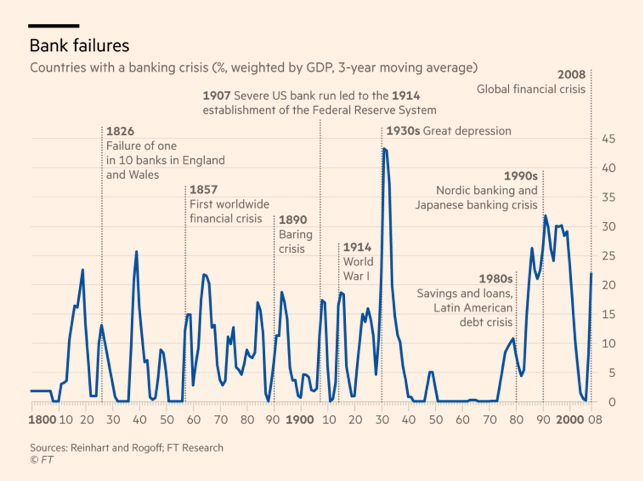
Two centuries of #bankfailures in a single chart... and the extraordinary period of stability between 1950 & 1970.
Whatever #bankers may claim about the 'problem' of regulation & the hand of the state, as @RichardJMurphy pointed out this morning - this is the period where Kenynsianism shaped public policy & delivered financial stability...
If you wanted an illustration of why #capitalism works best when it is regulated carefully, this would be it.
Ben Taylor
boosted

RT @RobDotHutton
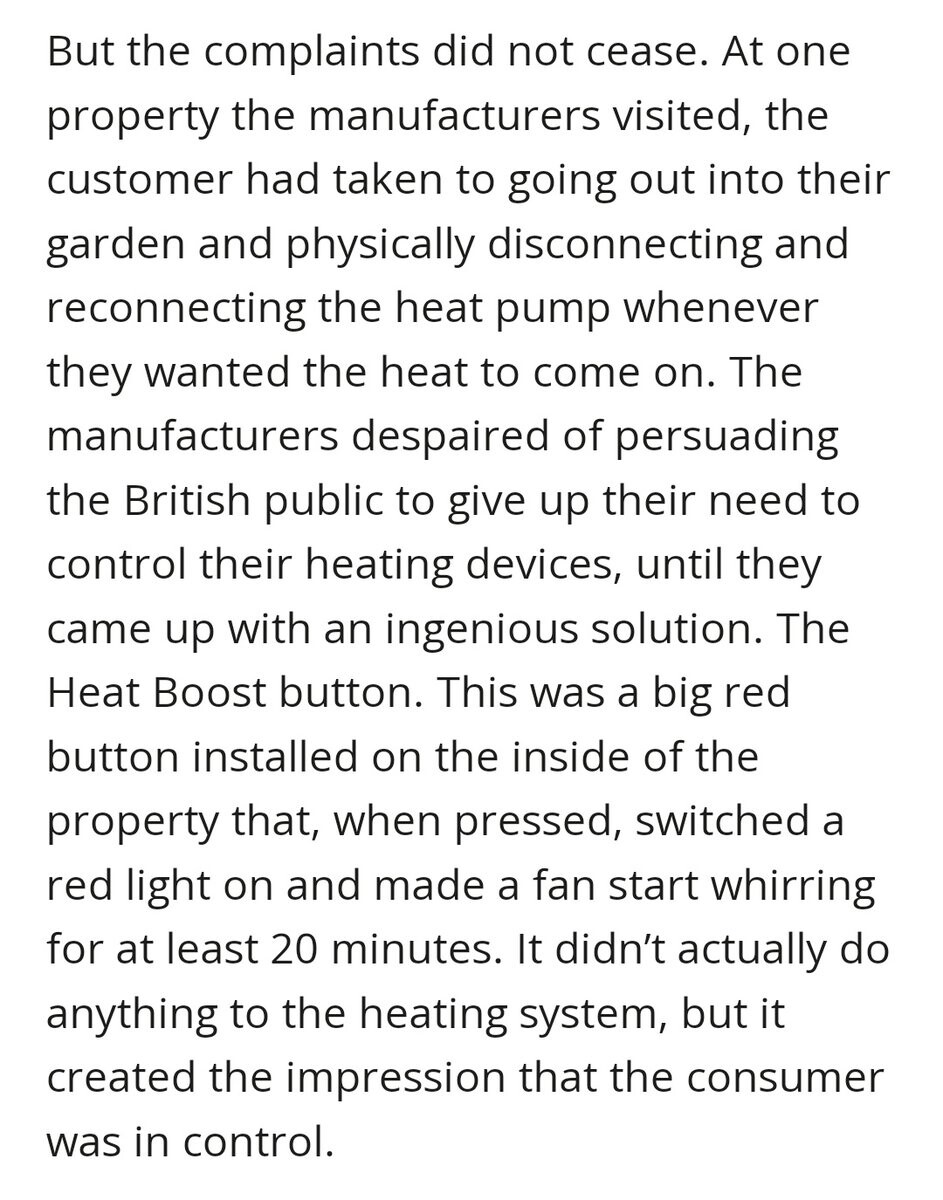
Amazing story from @politicshome about the difficulties getting people to adjust to heat pumps, which are designed to run continuously, unlike boilers.
https://www.politicshome.com/thehouse/article/hot-mess-difficulties-decarbonising-home-heating
Ben Taylor
boosted

USS William D Porter - enlivened a trip with Roosevelt by accidentally dropping a depth charge, triggering everybody's torpedo drill, then refuted accusations of being the American Kamchatka by following it up with a live torpedo fired at USS Iowa. They did indeed see torpedo boats, the only problem being it was them.
Later sunk in a slightly bizarre kamikaze attack - the plane was shot down but then the wreckage exploded underneath its keel.
Nice paint job though.
Ben Taylor
boosted

Oops! 😅 Github accidentally committed their on SSH private key to a public github repo. They rightly have changed the keys, so you'll get bit scary “WARNING: REMOTE HOST IDENTIFICATION HAS CHANGED!” messages.
https://github.blog/2023-03-23-we-updated-our-rsa-ssh-host-key/
#ssh #github #devoops
Ben Taylor
boosted

Women own only 30% of electric cars. One reason is safety. Unlike gas stations, charging stations do not have employees on site and are more out of the way. It takes 5 min to fill up a car with gas, but 30 minutes to recharge an electric car. https://19thnews.org/2023/03/electric-vehicles-gender-gap/
Deleted my Lastpass account. Feel slightly weird, was my first password manager and I was actually fairly happy with the product. Hope I'm not going to regret losing that database! But considering security is their business, it appears not to be up to scratch.
Tried Bitwarden but wasn't for me. Too many clicks, couldn't get fingerprint login to work, 2FA wasn't prompting when I wanted it to, didn't store password history and I nearly lost my AWS password on a password change (recovered only by getting my old one out of Lastpass, ironically). Have moved to Keeper now and that seems much slicker, even if I've got to pay for it. I don't mind paying a bit for a product this important that I use multiple times a day.
Now I guess I get to change all my passwords. Again.
Ben Taylor
boosted

A nice golden start to the day here in Glastonbury today.
#glastonbury #glastonburytor #somerset #sunrise #sunrisephotography #goldenhour #goldenhourphotography
Ben Taylor
boosted
If we're ever going to start the long road back for Britain, we need root and branch work on politics, the media,
We need truth and then hopefully reconciliation, a restatement of values and to walk the walk.
https://www.gov.uk/government/publications/the-7-principles-of-public-life
Ben Taylor
boosted

The thing about engaging in the delicious pilpul of the intelligence conundrum -- oh I feel it, I feel it, I'm an AI dork from way back -- is that it is an excellent distraction from seeing the extractive capitalism that has made and continues to make our lives -- our *privileged* lives -- bereft of meaning.
Oh, oh, let's debate Turing & Searle & Hofstadter & Minsky! Let's be angry, let's be slow, let's be open, let's be, let's be, let's be . . .
let's be not seeing the forest for the trees.
Ben Taylor
boosted

Ben Taylor
boosted

Metformin is the only drug that has been shown to reduce the risk of developing long Covid (which people estimate to be somewhere around 5-10%, currently).
“Until now the only way we knew that Long Covid could be prevented was to not get Covid. That’s still the case. But a new randomized, placebo-controlled trial of metformin has yielded exciting results—the first drug to be shown to help prevent Long Covid…There was a 42% reduction 1/2
Ben Taylor
boosted
It started off blanket grey here in Glastonbury. The cloud soon began to clear and the sun came out.
#glastonbury #glastonburytor #somerset #sunrise #sunrisephotography #landscapephotography #cloud
Ben Taylor
boosted

Microsoft released copilot in Excel, and it is officially caught up with Google on the AI race.
Fantastic to watch.
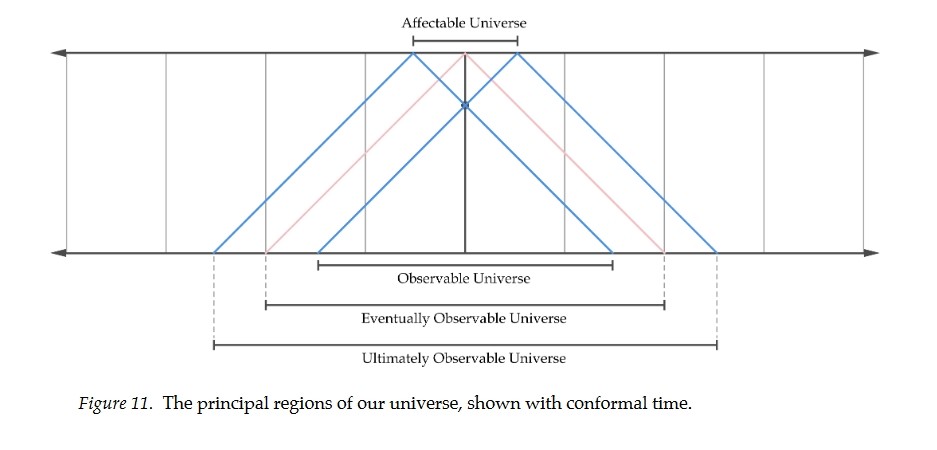
This is kind of a mind blow, for me at least. Intuitively you would assume that portion of the universe you could theoretically affect would get bigger over time as technology improves.
However, actually it gets *smaller* over time, as that portion of the universe you could reach by travelling at the speed of light shrinks as the remaining time to the end of the universe shrinks
(Obviously some practical issues with actually doing that. Implementation details, that's all.)
Ben Taylor
boosted

Toby Ord's chart shows 4 things:
• Everything we can observe now is the "observable universe".
• Everything we can ever observe if we stay here is the "eventually observable universe".
• Everything we can ever observe if we send spacecraft out in every direction at all speeds less than light is the "ultimately observable universe".
• Everything those spacecraft can ever affect is the "affectable universe".
His chart is drawn in funny coordinates where a galaxy at rest moves straight up the page and light moves at 45° angles. The Big Bang is the horizontal line at the bottom, and the infinite future is the horizontal line at top. The expansion of the universe is hidden in these coordinates!
How big are these 4 things?
• When we observe distant galaxies we see what they were like long ago, when they were closer. Those galaxies *now* form a ball of radius 46 billion light years in diameter. So people say the radius of the observable universe is 46 billion light years. But beware: we can't see what the galaxies in the observable universe look like *now*.
• The galaxies in the eventually observable universe *now* form a ball of radius 63 billion light years.
• The galaxies in the ultimately observable universe *now* form a ball of radius 80 billion light years.
• The galaxies in the affectable universe *now* form a ball of radius 16 billion light years.
These figures change with time. For example, shortly after the Big Bang the radius of the affectable universe was 63 billion light years. It has now shrunk to 16 billion light years. 90% of the galaxies we could in theory once reach - if we could have started right away - are lost to us now!
Ben Taylor
boosted

On 16th March, 1968 Warrant Officer Hugh Thompson Jnr was flying helicopter reconnaissance for an attack on an alleged North Vietnamese-controlled village at My Lai.
As the ground attack developed below, Thompson realised he was in fact witnessing something something else:
A massacre.
He decided to act. /1 🧵 #history #histodons
"“However, the right to protest must be balanced with preserving the ability of the law-abiding majority to go about their daily business. We must ensure there is a proper balance between the rights of individuals, our vital national security, essential services and effective government.”
They know we're used to interpreting politician-speak, right? Does anyone not read "Thing A that you are asking about must be 'balanced' with things X, Y and Z" as "We don't give a shit about thing A, go away and stop asking, prole"? They might as well have just said "The so-called 'rights' of the little people are unimportant" and had done.
Ben Taylor
boosted

You can complain that #vim is hard to quit, or you can accept your reality. You’ve opened vim. You’re in vim now. The only way forward is to learn it and use it.
Ben Taylor
boosted







For once, an #AI issue where I *can* speak with a certain amount of authority.
I've been hearing "expert systems outperform human #diagnostics, so pretty soon human #physicians will be obsolete" for a few years now. It's closely akin to "#airliners fly themselves these days, so what do we need #pilots for?" In both cases, people are paying attention to the best-case scenario with no understanding of the *enormous* number of how many and various the worse cases really are.
This is complicated by the fact that in most of #medicine (although not necessarily #emergency medicine, the author's specialty) and in nearly all of air travel, the best case is also the normal case. Most of the time, whatever is wrong with you can be diagnosed and treated. Almost all the time, when you get on a plane, you'll walk off at the other end of the trip as healthy as when you boarded. It's reasonable to expect those outcomes.
Not-best and not-normal cases add up really fast.
Without any false modesty whatsoever: as a #medic, I learned a truly impressive degree of clinical judgement. From the first moment I saw a patient, I had a pretty good idea of #diagnosis, #treatment, and #prognosis. (Sadly, if my initial call was "this one's not going to make it," I was almost always right. The exceptions kept me going.) I learned from the best—one of my mentors had learned *his* trade in rural Guatemala, where resources were terribly sparse and human judgement was the only line between life and death. He held back death for decades, and it came for him far too early. Gene Gibbs, RIP.
I can't code that. Neither can anyone else, and if they tell you they can, they're lying.
As a #researcher, I've done a fair amount of work in #clinical #decision #support (#CDS). The idea is simple, and valid: no human, or team of humans, can remember everything they need to know. There's simply too much knowledge for the brain to hold and recall on demand. Subtle relationships exist between disparate types of data that *nobody* knows, until we tease out the numbers. We're doing this, right now. It is saving lives and relieving suffering, right now.
The key word there is "support." Humans still absolutely, positively, 100% need to be in the loop.
Maybe that will change, someday. I'm not saying it's impossible, for two reasons. First, any time anyone says "computers will never be able to ___" they're usually proven wrong. Second, I don't want to limit my and my colleagues' imaginations. We need to stay focused, but it is a *good thing* for our reach to slightly exceed our grasp. That's how #science happens!
Just not this day, and not for many days to come. Right now, we need to keep muddling along. There's not much more human than that.
https://www.fastcompany.com/90863983/chatgpt-medical-diagnosis-emergency-room
Software Engineer, Trade Unionist, Gamer, Geek, Dad. Lives in Devon
Joined Nov 2022
