

ZingerLearns @ZingerLearns@social.cleverlibre.org
- Location
- Southern California, USA
- Interests
- STEM teacher preparation, anti-racist teaching, environmental justice teaching, humanizing pedagogy
STEM teacher educator. Humanizing teaching and learning. Believer of student brilliance. Luddite. Disbeliever of silver bullets. Nobody is coming to save us. #Edutoot #Ungrading #STEMed
@ungrading @STEMed
Joined Nov 2022
ZingerLearns
boosted

As an educator who loves to teach but hates to grade, I'm curious to hear others' experiences with #ungrading.
ZingerLearns
boosted

@cadida @TheConversationUS I prefer feedback to grading. Feedback to me consists of choosing something that moves the students’ development in each assignment. Of course as a literacy specialist I work with students in small groups, which makes this kind of instruction easier. #ungrading
ZingerLearns
boosted

Equally empowering and disastrous is how I see it after three years (500 students, 60 semesters worth of total course load) of ungrading. I am going to modify the ungrading or flipped grading with a more flexible system. For many students and fellow educators, ungrading is unnatural, confusing and even bad practice that challenges institutional norms. Many students complain that they have now to do more work, ie, reading the lecturer’s response and then think for themselves, where they could ‘just’ get a grade and ‘done with’. It’s a risky practice with students with inflated ego and who think university is same as high school. Works well with motivated, good students (who are A students anyway) and mature students.
On the plus side, it’s an emancipation and perhaps the most robust system one can think of. Teaching is enjoyable and students, when they realise that the grading is flexible and negotiated between the teacher and then, focus on the learning aspect. Most students tend to be harsh on themselves, so teaching them to assess themselves is a plus.
In summary, I will make some compromises. Make the grading system a whole lot flexible, and instead of entirely ditching rubrics (as Stommel et.al. suggests), introduce a mastery rubric. I think there are merits of old grading system that can be combined with ungrading practices. I am still figuring out that compromise.
There you go. What is your experience?
@drbixby
@ungrading
#ungrading
When considering individual student grades, I use a contract grading system where students identify course and individual goals. At the end they justify their grades. I look at their meeting our learning goals and growth. I see each student as an individual on a growth trajectory. One of the ways that helps avoid comparisons is to consider this, as well as the varying levels of privilege and challenges individual students face.
ZingerLearns
boosted

Hey #ungrading folk, every semester doing this is a bit different. Last semester at the end I had a really hard time with comparing students. Like, thinking to myself “you don’t deserve that grade, especially if x said they deserve a lower grade.” In the end I deferred to the student.
How do you help students develop the metacognition necessary to grade themselves?
ZingerLearns
boosted

@drbixby I remind myself that I’m not supposed to rank and sort them; I remind myself that learning looks different to everyone. It sounds like you want their assessment of themselves to match your assessment of them, and it probably won’t. I’ve had to remind myself of this, too. #ungrading
ZingerLearns
boosted

1. The Bills' Damar Hamlin is reportedly showing "signs of improvement" after collapsing on the field Monday night.
Hopefully, he makes a full recovery.
And no, the NFL will never be safe.
But hopefully, the NFL takes this opportunity to make it safer.
🧵
@peterdrake
We use a system of X/0/1 for the purpose of the gradebook, but use comments for additional detail, we do try to avoid points for the reason you mention.
X-not in/late, student did not provide notice or ask for extension/tell us when to expect it (works as a trigger similar to yours to check in on student)
0-incomple or did not meet required/critical criteria, invited to address missingness or issues to complete.
1-complete, meets criteria, comments reflect areas of strength and opportunity
Students are expected to complete all tasks, as tasks are connected to our learning goals and are essential for students' outcomes
ZingerLearns
boosted

I'm doing #ungrading again.
Because I can't realistically keep a sense of the progress of each of 50+ students in my head, I give a number for each assignment:
0: Turned in nothing or a blank document.
1: Significantly incomplete.
2: Basically complete. For programming assignments, passes all unit tests.
3: Above and beyond -- perhaps tackled an optional challenge problem.
Several 0s and 1s indicate a problem to be addressed. 2 is by far the most common result. If a student wants to argue for an A, they should have a few 3s.
**The question: should I show these numbers to the students?**
Pro: It give them a sense of how they're doing, and therefore how much energy they need to allocate to this class.
Con: They will look at the number, think of it as a "grade", and pay no attention to written feedback.
Thoughts?
ZingerLearns
boosted

If you use or have @ApplePodcasts and want to help out Human Restoration Project, rating & reviewing our podcast there will help connect us to more listeners!
ZingerLearns
boosted

Wear a mask to protect yourself from the flu.
Wear a mask to guard against acute or chronic #COVID19 illness.
Wear a mask because healthcare workers & hospitals are struggling.
Wear a mask because high COVID transmission levels are accelerating the virus's mutation.
Wear a mask because you might be infectious with a mild or asymptomatic case, and you want to avoid spreading infections to others.
Wear a mask because you know you should.
Wear a mask to encourage others to do so.
Just #WearAMask!
ZingerLearns
boosted

Professors tend to have been high-performing students or loved learning or both. They self-select into the pool, even as others select them for PhD slots or jobs.
The students who interact the most with profs are also self-selected, or other-selected (e.g., as in competitive RA-ships), to be good students or to love learning or both.
These selection and self-selection processes mean that professors are likely to be pretty terrible judges of what motivates most of our students.
Just saying.
@actualham thanks for sharing. CCs seem to have been hit harder by student and staff attrition, disproportionately harming historically marginalized students.
I think what is not touched on enough is the wage issue, and especially on the student services side the need for staff to be in-person. Whereas for IT remote may be more conducive, for counseling and other student services in-person, humanizing experiences are more important. My IHE, though not a CC has had significant turnover issues with staffing, and I think central to that are the comparatively low wages (nice retirement bennies are great, but they don't pay the rent or gas today) and slow adjustment to that by IHEs. When fast food joints pay more than you do for admin positions, it's not a labor shortage issue, it's a non-competitive wage issue.
ZingerLearns
boosted

Good: accomplishing with clean electricity what we used to do with fossil fuels
Even better: reimagining how we live together so that the most well being is created by the least amount of (clean, obviously) energy
Eg: you can swap an EV for a gasoline vehicle on congested roads without reimagining transportation and housing. Or you can have just the right amount of EVs for a walkable, bikable dense, multi-use, public transit rich community
ZingerLearns
boosted

Community colleges suffer from employee shortages
https://www.insidehighered.com/news/2023/01/04/community-colleges-suffer-employee-shortages
ZingerLearns
boosted
NEW: Sunil Singh writes about how mastery education is not compatible with the current time-gated, test-based structure of school. #restorehumanity #edchat #tg2chat @Mathgarden
https://www.humanrestorationproject.org/writing/the-myth-of-mastery-learning-in-education
ZingerLearns
boosted

California police more than twice as likely to use force against Black people
https://www.theguardian.com/us-news/2023/jan/03/california-police-force-against-black-people-report
ZingerLearns
boosted

FROM noozhawk.com - NWS Issues Flood Watch for Santa Barbara County Ahead of Rainstorm
Montecito Fire Protection District urges residents to monitor the weather, check storm impact map for potential debris flow risk, and have an evacuation plan by Giana Magnoli, Noozhawk Managing Editor
January 3, 2023 | 1:03 pm
https://www.noozhawk.com/
#SBA #SantaBarbara #CAwx
ZingerLearns
boosted

California caregivers are worried about the safety and academic success of their children as public health orders are rolled back and students return to schools, according to survey findings released by PRB’s KidsData program.
https://www.kidsdata.org/blog/?p=10522
#California #Education #COVID19 #CSHCN #CYSHCN #Data #Survey @edutooters @publichealth
ZingerLearns
boosted



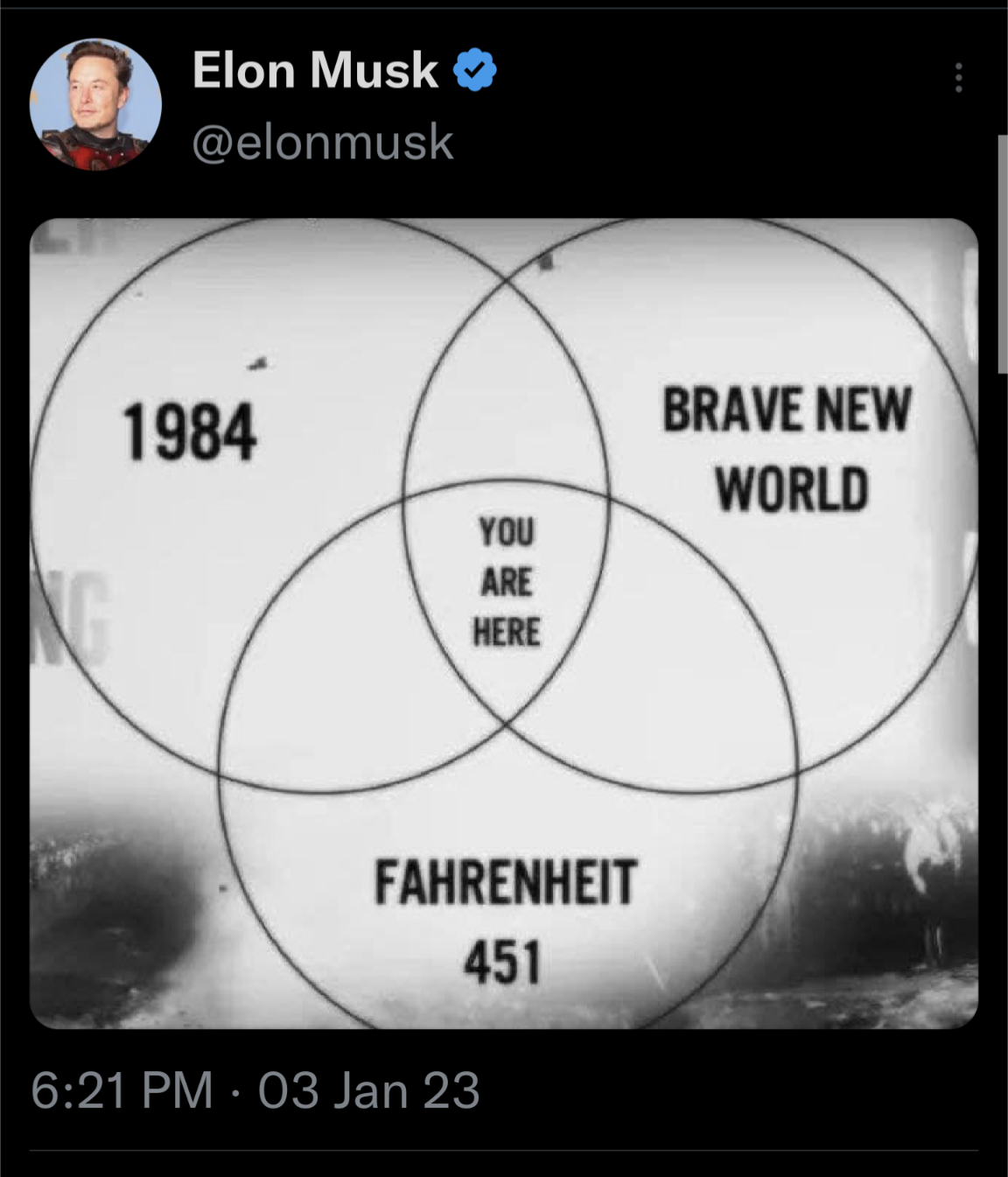
As a scholar of dystopia, allow me to say this makes no sense at all.
- Location
- Southern California, USA
- Interests
- STEM teacher preparation, anti-racist teaching, environmental justice teaching, humanizing pedagogy
STEM teacher educator. Humanizing teaching and learning. Believer of student brilliance. Luddite. Disbeliever of silver bullets. Nobody is coming to save us. #Edutoot #Ungrading #STEMed
@ungrading @STEMed
Joined Nov 2022
